

Buffalo’s New Data Buoy Tracks Lake Erie’s Extreme Weather
Buffalo, New York, perches on the eastern shore of Lake Erie–the shallowest and smallest of the five Great Lakes by volume–and sports an enviable waterfront vista. There will soon be a new, semi-permanent observer to the lights of the Buffalo skyline.
For over a decade, the Great Lakes Center at Buffalo State University has operated a data buoy in Lake Erie’s eastern basin. Its data, which is publicly available via the Seagull Network, is popular with anglers and boaters in Western New York.
In Spring 2026, it will be joined by a sibling–another buoy deployed near the city of Buffalo–with the aim of filling data gaps and providing a valuable public resource.
Brian Haas, Field Station Manager and Ben Szczygiel, Aquatic Research Specialist, at the Great Lakes Center, oversee all buoy operations and are preparing for the deployment of both the new and existing buoys once ice retreats from Lake Erie.
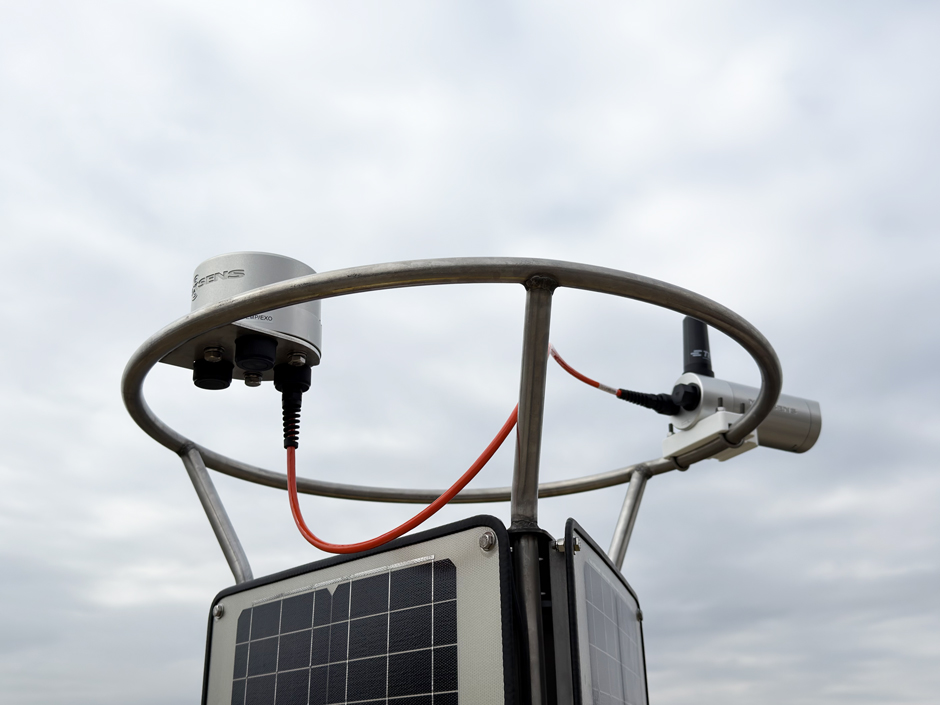
X3 data logger and EWC. (Credit: Emma McCroskey / Fondriest Environmental)
Dunkirk Buoy
The existing data buoy has been deployed seasonally since 2011, six nautical miles from Dunkirk, off Erie’s southern shore.
Until now, it has been one of the only real-time monitoring systems of this scale in the eastern basin, making its data on water quality, weather, and wave characteristics particularly valuable for informing residents and regulatory groups of conditions.
Lake Erie covers nearly 10,000 square miles and is a complex and dynamic system. It is known for seiches–large standing waves that form when storms move over the lake, raising the water level in their direction of travel.
When winds and pressure from the storm are released, the water sloshes from one side of the lake to the other in a large standing wave as it returns to its equilibrium level.
Erie’s west-to-east orientation mirrors the predominant direction taken by storms, so it is particularly at risk of seiches–in 2008, 12-16 foot waves led to flooding near Buffalo.
Alongside this, the headwaters of the Niagara River converge at Buffalo, forming Lake Erie’s main drain. The Niagara River flows along the USA-Canada border, cascades down its namesake, Niagara Falls, and on into Lake Ontario.
Haas explains, “This geographic stretch is referred to as the Niagara River Corridor and is a globally recognized site due to its ecological significance and importance to biodiversity.”
Consequently, the Niagara River Greenway Commission is funding the Great Lakes Center’s initiative to deploy and operate a new data buoy outside of Buffalo.
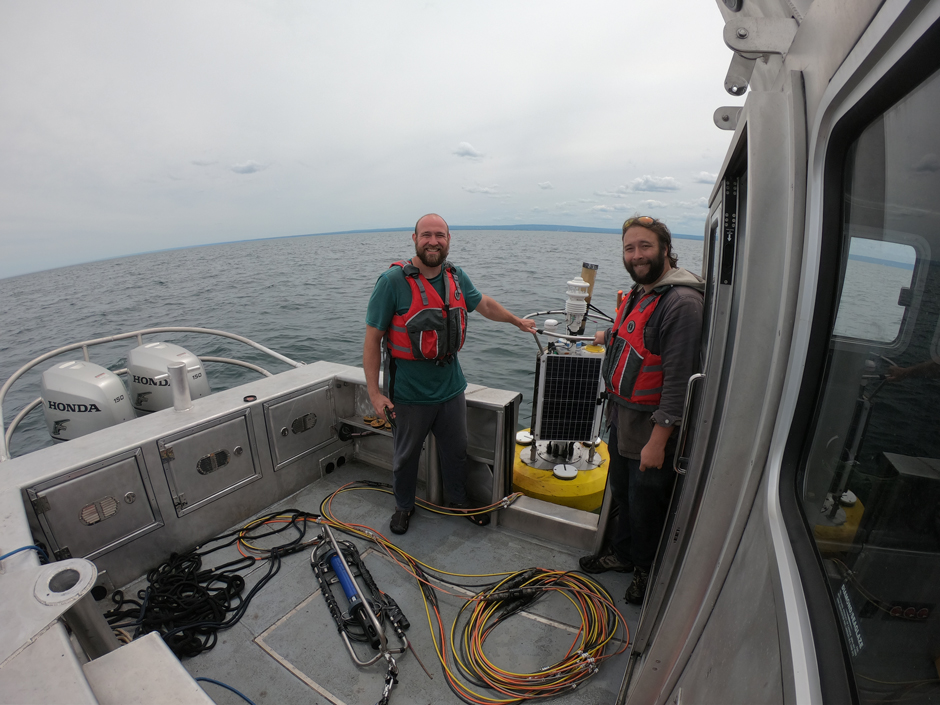
Brian Haas and Ben Szczygiel deploying the Dunkirk Buoy in Spring 2025. (Credit: Brian Haas)
Buffalo Buoy
“We identified Buffalo, New York as a prime location for a new observing system,” Haas says. “Buffalo is a large port city that has a long maritime history and is undergoing a major waterfront revitalization. Lake Erie provides many economic drivers, recreational opportunities, and is the source of drinking water for the city.”
The new buoy will be deployed for the first time in the Spring of 2026, approximately two nautical miles south-southwest of the city of Buffalo in approximately 40 ft of water–too shallow to be summer stratified.
“The Buffalo buoy provides real time wave and weather conditions, as well as water quality–dissolved oxygen, turbidity, chlorophyll–and temperature profiles. It is also equipped with a webcam that can give views of the lake and cityscape,” Haas reveals.
The buoy is a NexSens CB-650, equipped with a NexSens X3 data logger, NexSens EWC, SeaView SVS-603HR wave sensor, Gill MaxiMet GMX501 Compact Weather Station, and NexSens T-Node FR Temperature String.
It also carries a YSI EXO3 sonde equipped to measure temperature, conductivity, turbidity, optical dissolved oxygen, and total algae via chlorophyll and phycocyanin.
Collected data is transmitted from the X3 data logger using 4G cell. “The real-time data is accessible to the general public through our longtime partner, the Great Lakes Observing System,” Haas elucidates.
He adds, “They host a web platform named Seagull that aggregates and displays data from across the Great Lakes.”
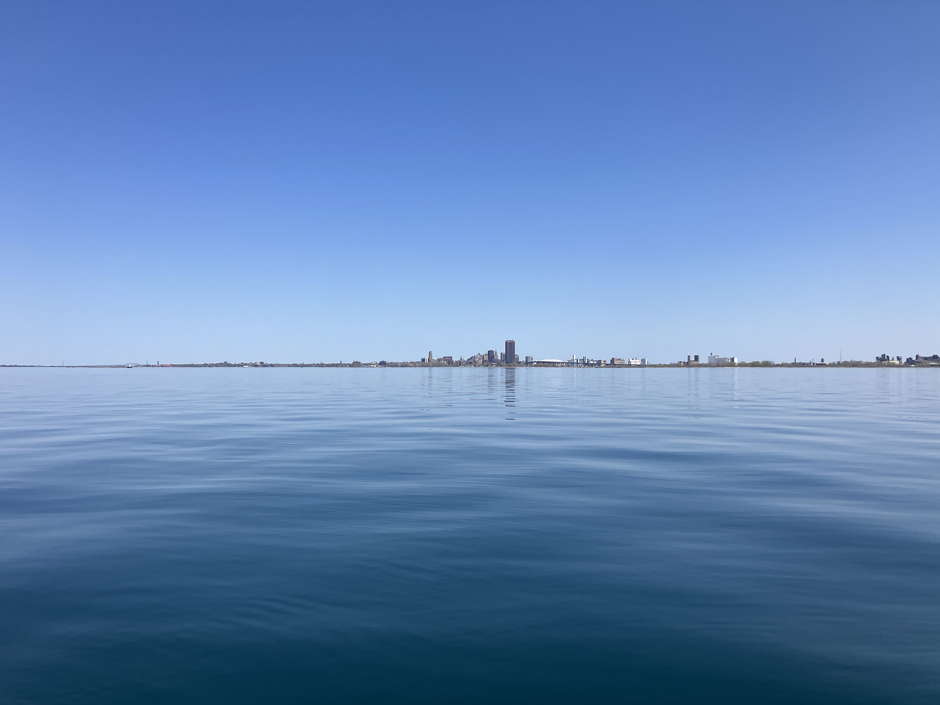
View of the Buffalo skyline from where the new Buffalo buoy will be deployed in Spring 2026. (Credit: Brian Haas)
Insights from a Growing System
The existing Dunkirk buoy has already been of huge value to the local community.
Haas cites regular use of the existing data by researchers, charter captains, anglers, recreational boaters, commercial vessels and more, and is confident the new data from the Buffalo buoy–located within just a few miles of the breakwaters at Buffalo–will “improve their experience and help them make safe decisions.”
Despite only being deployed during the ice-free season, the buoy will face harsh conditions.
“This will be the most eastern buoy on Lake Erie and will experience some of the most extreme weather events that the Lake can generate,” Haas observes–but leaving the technology deployed during these events will produce valuable data.
“For instance, seiches can cause massive waves, damaging storm surges, and extreme water level fluctuations. This new buoy in conjunction with the existing Dunkirk Buoy will help gain further insight into these events,” he continues.
Like many environments, scientists anticipate that Lake Erie’s systems and patterns will change over time.
Haas notes, “In addition to shedding light into lake dynamics, the environmental data collected can be incorporated into current and future species-specific management and research. The combination of fully accessible real-time and archived data creates a valuable tool for examining a variety of ecological and meteorological topics in this region.”
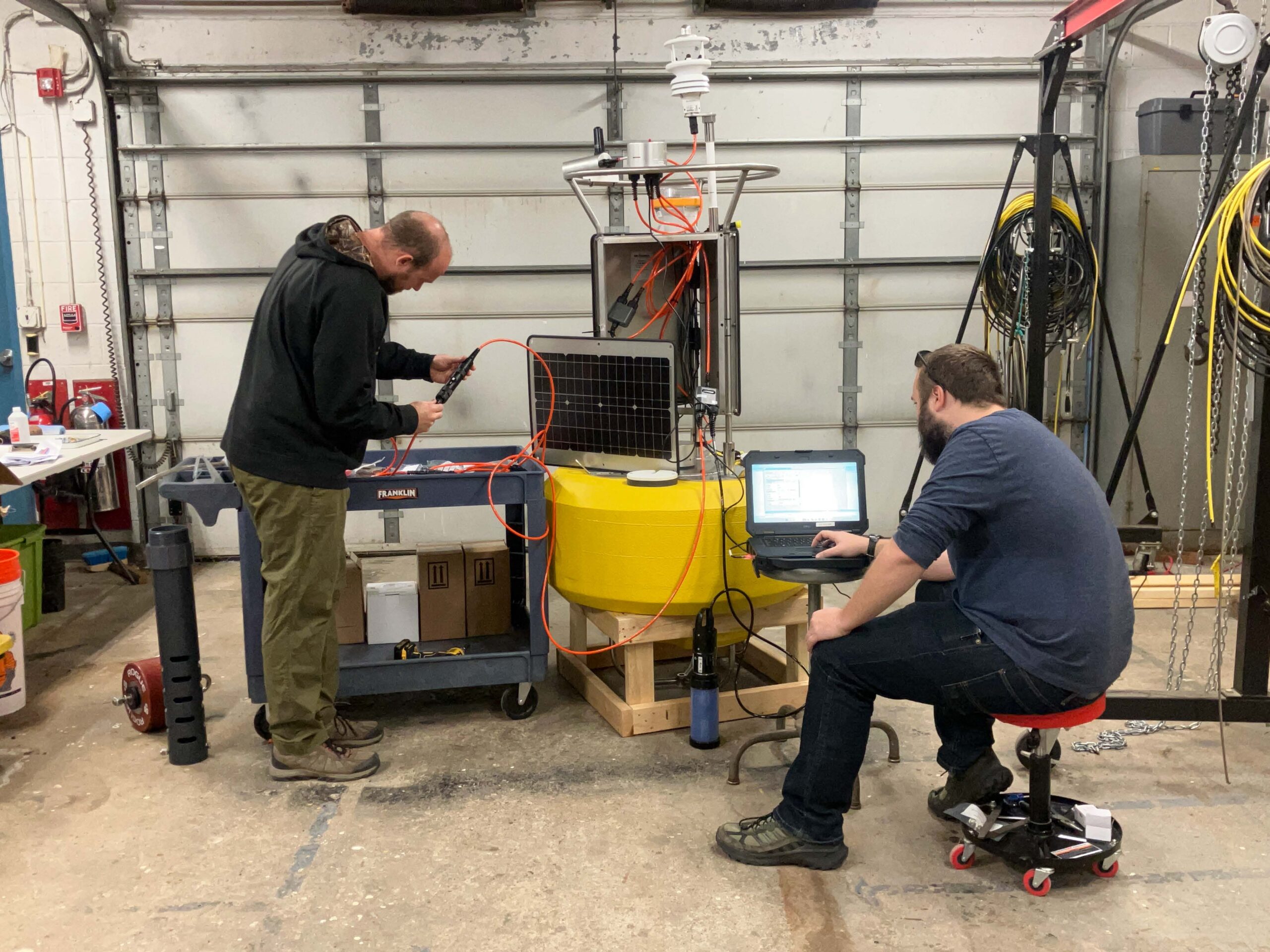
Brian (left) and Ben (right), configuring sensors on the new buoy. (Credit: Brian Haas)






0 comments