

Smart Buoys Advance Climate Monitoring in Swiss Lakes
Lakes are sentinels of climate change. Globally, they are warming at an unprecedented but uneven rate, and in many places they also face direct human pressure, including from agriculture and recreation.
In the Alps, scientists generally agree that climate change is of particular threat to remote lakes, where more pronounced warming threatens fragile ecosystems.

The Ticino region in southern Switzerland is home to dramatic subalpine landscapes, but is changing quickly as a result of climate change. (Credit: OASI)
Alpine Lakes in a Changing Climate
Matteo Tonellotto is part of the team at the Environmental Observatory of the Italian-speaking region of Switzerland (OASI)–a multidisciplinary team of scientists, IT specialists, and chemical laboratory technicians committed to collecting, managing, and integrating high-quality environmental data.
OASI is based in the picturesque subalpine Canton of Ticino in southern Switzerland, an area peppered with lakes, including the famed Lakes Lugano and Maggiore. Not only a significant part of the territory, they are critical to biodiversity, the economy, and society–not least through the provision of drinking water.
Tonellotto explains, “Climate change has led to significant temperature increases in many Swiss lakes over the past decades, and we expect this trend to continue. The warming of lake waters affects mixing dynamics, which in turn affects the oxygen content in deeper layers and can trigger the development of potentially harmful algal blooms.”
“Our goal is therefore to better understand these lake ecosystems, particularly in light of increasing climatic variability and anthropogenic pressure, and to be able to provide accurate and reliable data facilitating decision-making processes as much as possible.”
The OASI team is inspired by the role it can play in supporting an “effective and efficient response to climate change.” Their research to discern local environmental change relies on the availability of reliable, real-time data.
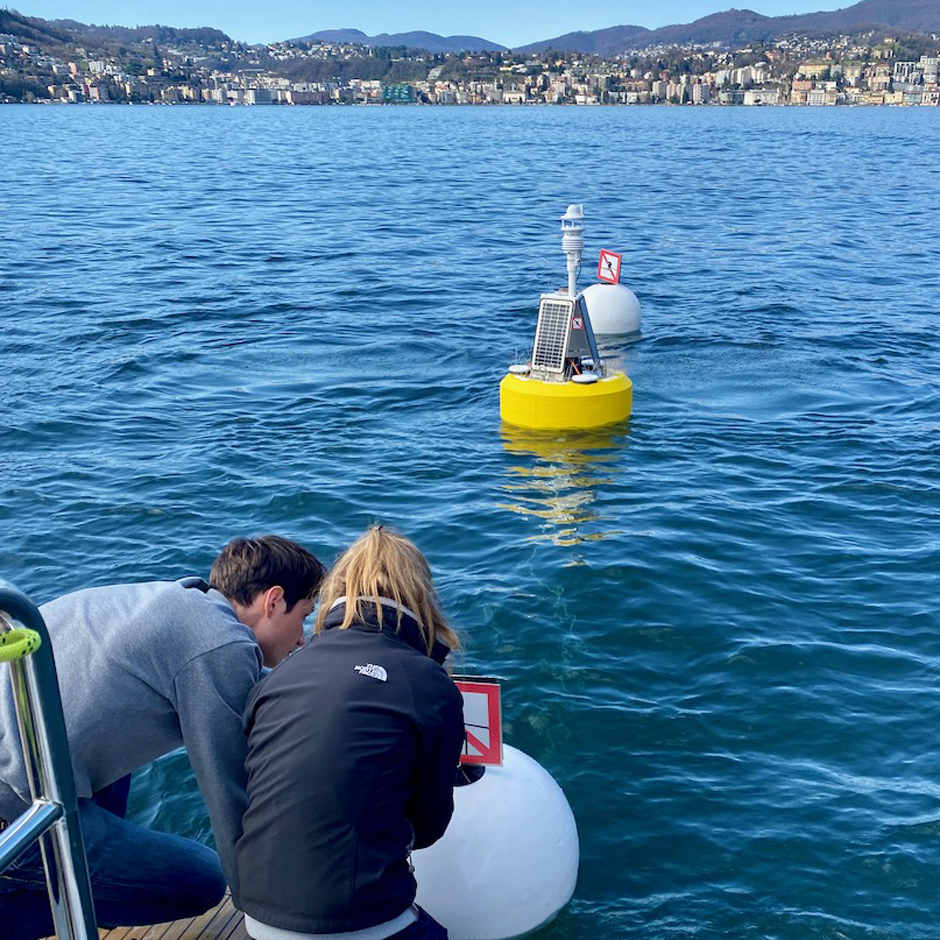
The OASI team at one of their NexSens buoys. They were first deployed in March 2024. (Credit: OASI)
Expanding Lake Monitoring with Real-Time Data
In March 2024, two NexSens CB-450 buoys were deployed on Lakes Lugano and Maggiore, positioned approximately 50 meters off the shoreline of Castagnola and Porto Ronco, respectively.
“To meet our needs, we required a well-conceived, ready-to-use, versatile and reliable system that would integrate different types of sensors into a single, autonomous, and durable installation,” Tonellotto states.
He is confident that the NexSens buoys are the right solution–“Solar panels and batteries that guarantee autonomy throughout the year are certainly a big plus for this system. In addition, the system is practical and fairly simple to use and maintain.”
The buoys are equipped with the NexSens T-Node FR Thermistor String up to 40 meters deep, the Lufft WS-Series Smart Weather Sensors, and YSI EXO3s Multi-Parameter Water Quality Sondes measure key limnological parameters like temperature, dissolved oxygen, pH, conductivity, chlorophyll, and phycocyanin.
Data are collected every 10 minutes and transmitted by the NexSens X-series data logger to the OASI server hourly, enabling near real-time lake monitoring.
Data undergo several quality control checks before being made freely available. “They are also shared with various stakeholders, including government agencies, research institutions, and local communities, to support informed decision-making and foster collaboration in environmental monitoring and management,” Tonellotto continues.
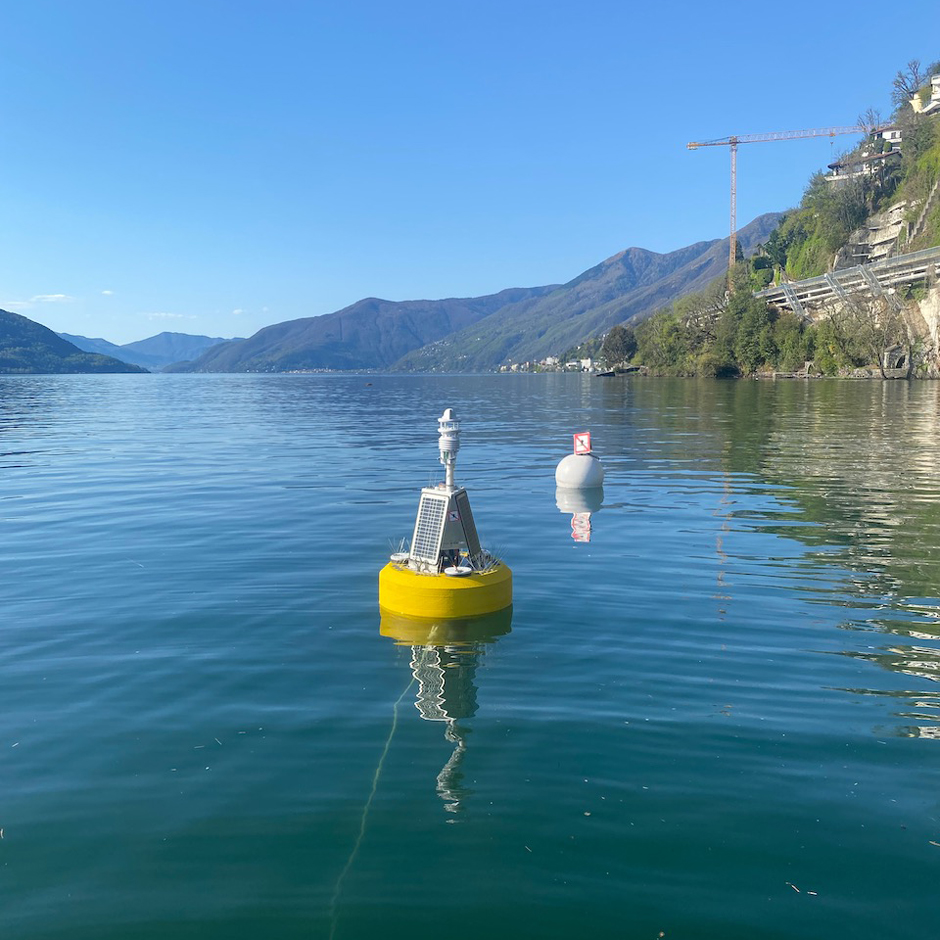
“We found in NexSens, and its employees, the tools and support necessary to quickly implement and maintain this [buoy] system,” Tonellotto says. (Credit: OASI)
An Insight Into Ticino’s Lakes
The high-frequency data collected by the buoys help fill critical gaps in regional water monitoring.
In the short term, they support the management of drinking water reservoirs and ensure the safety of bathing areas, while in the long term, they contribute to the development of predictive models and early warning systems.
“We are now able to provide environmental data from our glaciers, through rivers and aquifers, to lakes. This allows us to track the entire water cycle at the regional level,” Tonellotto explains.
Although the buoy is the first of its kind in Ticino and is still in its relative infancy, OASI scientists have already observed some interesting dynamics in the collected data.
“A notable example was recorded on Lake Maggiore in September 2024,” says Tonellotto. “Following a very hot and dry summer season, an important mixing down to our deepest measurement point occurred due to strong North wind gusts. After that, the usual winter mixing equalized the temperature of the entire measured water column.”
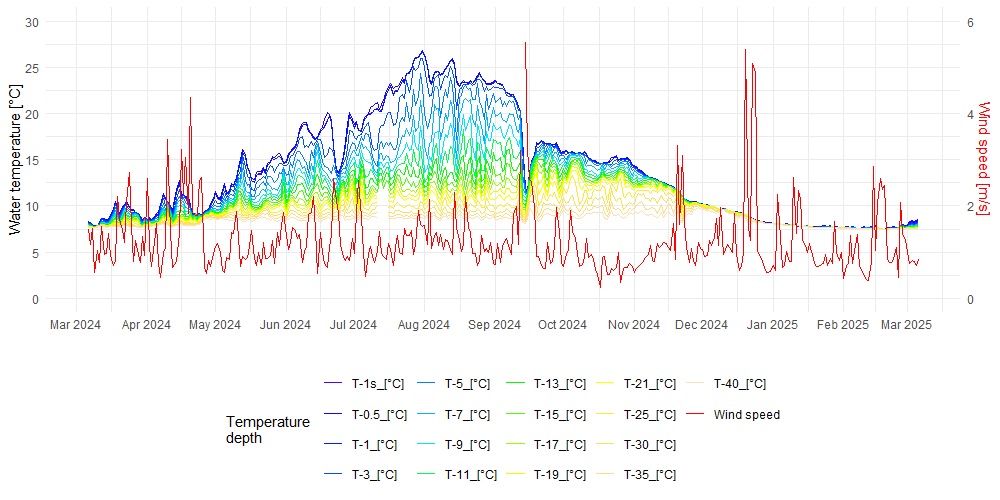
Tonellotto and the OASI team hope that in the future, the data will go even further. “We definitely need to collect some more data in order to gain a better understanding of the lakes. At a later stage, we aim to create a model that will enable us to effectively predict the days when algal blooms will occur.”
Modern Environmental Observation
“The primary objective of OASI is to optimize the environmental monitoring process by strengthening both the quantity and quality of observations, and by increasing the availability, update frequency, and reliability of data,” Tonellotto says.
Through improved data availability and granularity, data from the buoys is supporting this objective and improving understanding of how these two major lakes and the region’s water cycle are impacted by climate change.
“By promoting permanent, modern, and flexible environmental observation, OASI improves the region’s ability to respond to and effectively mitigate environmental problems,” Tonellotto concludes.
Ultimately, OASI’s efforts collect data and connect people with it. By linking scientists, local communities, and decision-makers, OASI empowers informed action and a deeper understanding of our changing environment.
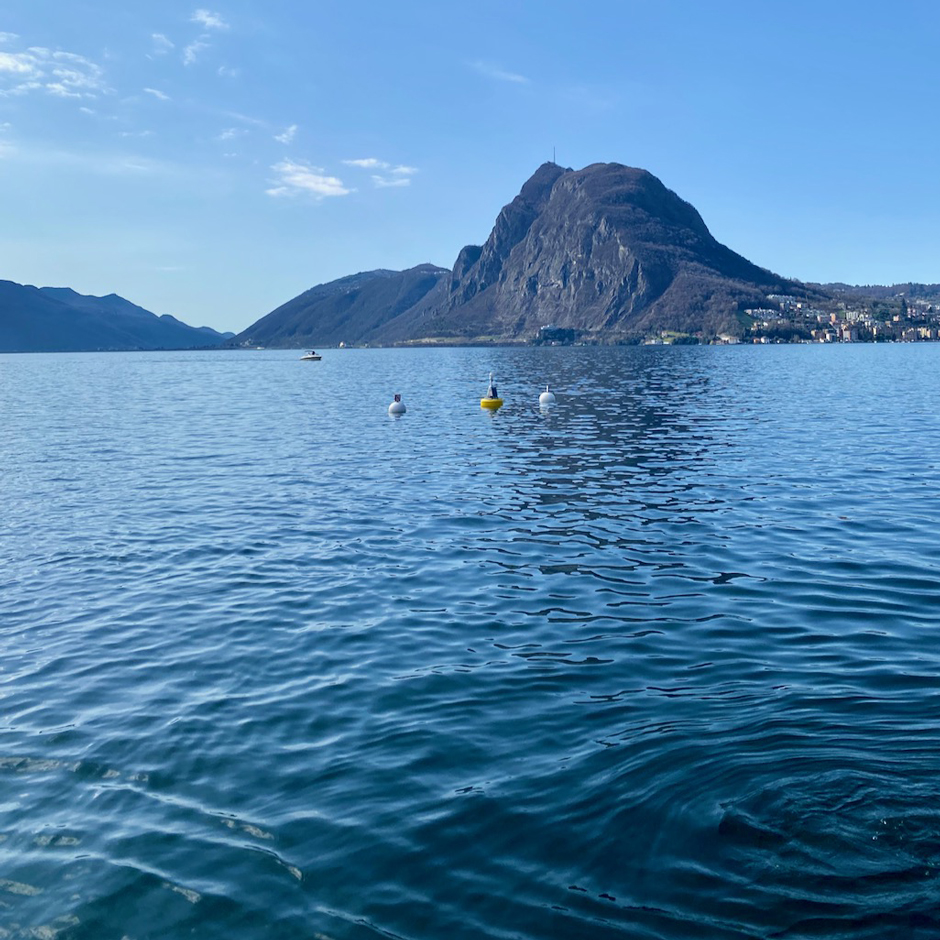
Deployed 50m offshore, the NexSens buoys provide data that is freely accessible to the public, decision-makers, and scientists. (Credit: OASI)






0 comments