

Catching Waves: Comparing Buoys to Deliver Trusted Ocean Data at PacWave
The ocean could power the future. The Inter-Governmental Panel on Climate Change (IPCC) states that the potential for ocean energy easily exceeds present human energy requirements–but technology to harness it is still in its nascent phase.
Growing power demands are forcing rapid innovation across many sectors, including diversifying energy to come from increasingly renewable sources.
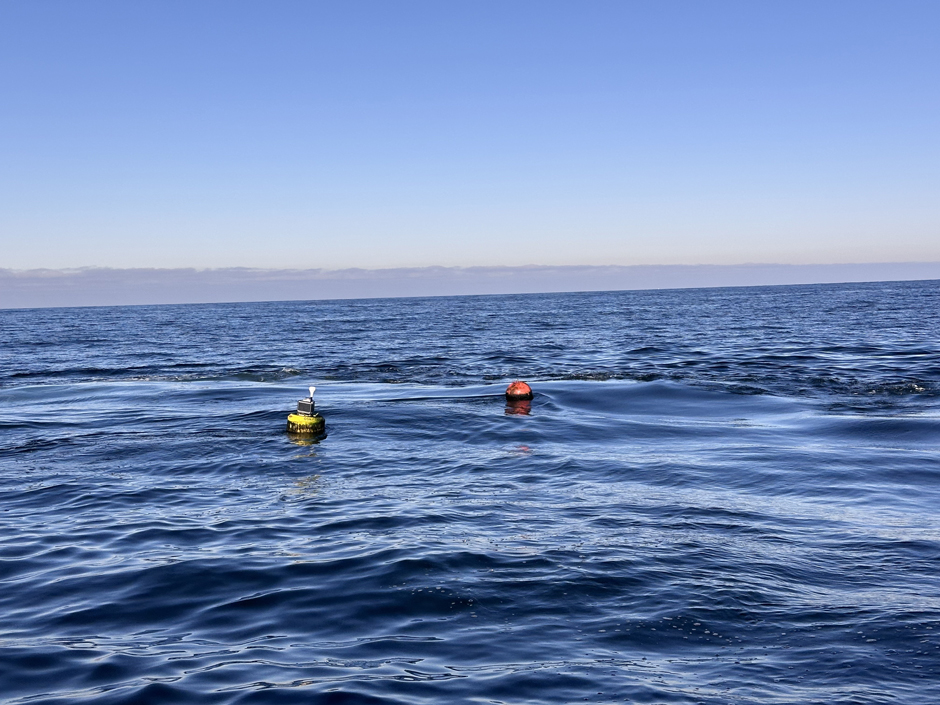
The small size of the NexSens CB-75-SVS means it can be deployed from a small vessel, but is still visible to maritime traffic. (Credit: Brett Hembrough)
Wave Energy Testing at PacWave
PacWave is the world’s biggest wave energy testing facility. Located seven miles off Oregon’s coast in the swells of the Pacific, it’s the perfect location to put new wave energy converters (WECs) through their paces.
The PacWave sites comprise a pre-permitted, recently constructed south site that connects to the terrestrial power grid via four undersea cables, and a north site–a patch of ocean designated for testing wave energy converters and supporting technologies.
Brett Hembrough is the Marine Operations Manager for PacWave. In this phase of the project, with construction complete and operations just beginning, his role includes keeping at-sea assets operational to ensure consistent and persistent measurements.
Hembrough explains that the PacWave team’s primary objective is to support and facilitate client testing of WEC technology–“We’re there to get steel in the water for wave energy and measure how that goes,” he states.
Within this, the team currently has two objectives: firstly, site characterization, and secondly, inter-comparison of wave buoys.
Site Characterization
Alongside the general testing and evaluation of WECs, PacWave will also offer accredited device testing in conjunction with the National Renewable Energy Laboratory and Pacific Northwest National Laboratory. The accreditation will provide independent verification that WEC devices perform as marketed.
“That’s where high-quality met-ocean and wave measurements come into place,” Hembrough explains. “We need those in order to perform a truly accredited test for these developers.”
The accreditations require reliable data on environmental conditions at each berth. By quantifying and controlling for any differences between them, developers can be confident that conditions are the same at all locations–or adjust for them in post-processing if they’re not.
As well as enabling the accreditation, this offers peace of mind to developers, “so that they don’t have to worry that the slot available to install their device in is any different than adjacent sites,” Hembrough adds.
Device Comparison
It’s not just WECs being tested at PacWave, but wave buoys, too.
Challenging the conventional “gold standard” wave buoys, Hembrough and the team are leaving no stone unturned, pitting buoys from four different manufacturers against each other to see how they compare.
“We want to understand if there are nuances or differences, then weigh the pros and cons,” Hembrough says.
The team considers the “support cost for larger systems versus smaller systems, convenience of vessel operations, weather, wind, [and] sea conditions that they perform better or worse in.”
In summer 2024, Hembrough and his team deployed a number of surface wave measurement buoys at PacWave’s south site, ranging from seafloor-mounted platforms to commercially available wave buoys–including a NexSens CB-75-SVS buoy that comes ready to deploy straight out of the box.
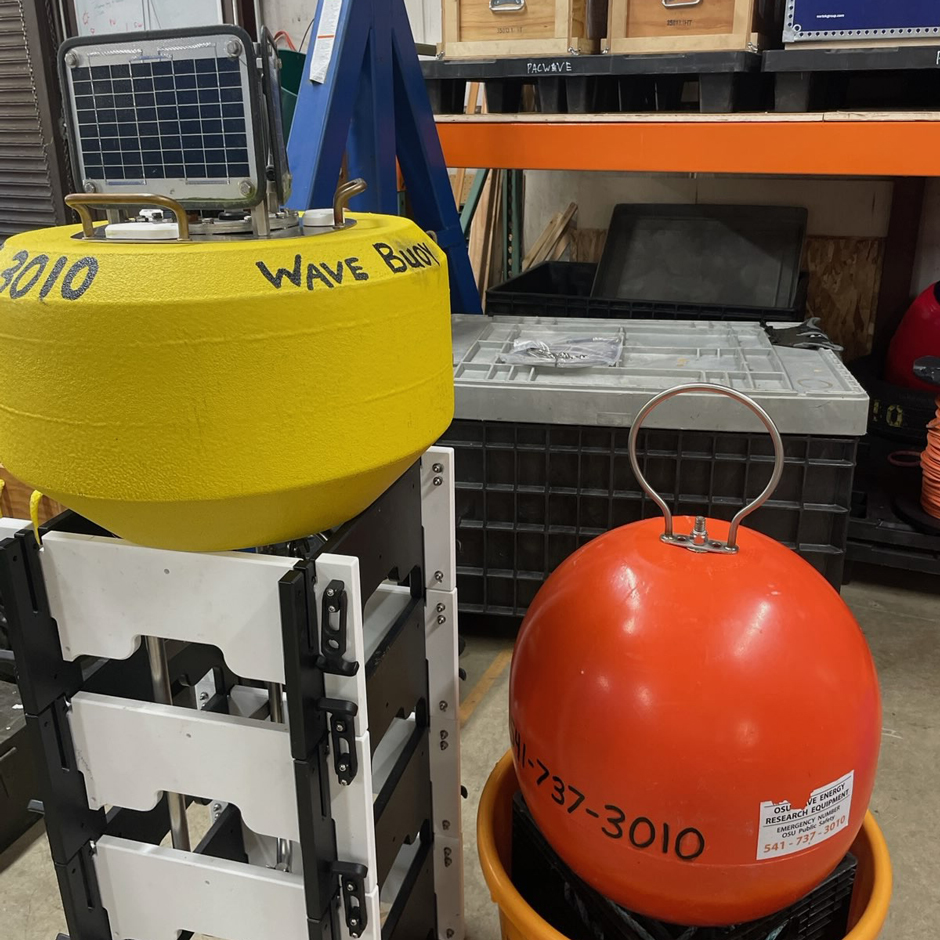
The buoy prepped for deployment in the workshop. (Credit: Brett Hembrough)
NexSens CB-75-SVS
“There is something nice to say about having a [buoy] pre-packaged, ready to go with the dashboard, firmware, and software […] versus a more bespoke DIY type of wave measurement,” Hembrough notes.
With a hull diameter of 21 inches, the NexSens CB-75-SVS comes pre-installed with the SeaView Systems SVS-603HR Wave Sensor.
So far, the CB-75-SVS has been a “happy middle ground”, where it is “still small and able to be deployed off of smaller vessels” but sits tall enough in the water to be more visible to traffic.
Furthermore, the integrated SeaView Systems wave sensor provides inertial wave measurements–generally more trusted than GPS, as it makes direct measurements, rather than deriving values. This is an advantage as data will be relied upon for the accreditation tests.
Refining Buoy Systems
Hembrough is realistic about the challenges of deploying new systems and the refinement required–“any new device is going to have some iterations on it,” he highlights.
Where adjustments have been needed to the CB-75-SVS, the NexSens team has been “responsive and supportive in a timely manner” and “responsive to feedback.” Working together, they’ve made adjustments to the system, including modifying the mounting location of the data logger antennae to improve data transmission.
They’re also assessing the small things the team can “tweak here and there to try and get the most wattage out of the buoy for the longest time.” Off Oregon’s foggy coast, this is particularly important to the system’s sustainability.
Finding the Best Wave Measurement Solution
Hembrough is clear that data, rather than market trends, is guiding the team’s decisions. Where different buoys serve different niches, multiple systems could be employed in tandem, with one system providing “backbone” data, and smaller buoys that can be deployed closer to WEC devices providing more instantaneous, location-specific measurements.
In-built system flexibility is important. “We try to take our best guess by measuring wind, current, some basic ocean chemistry and waves,” says Hembrough, “But we’re waiting to see what our clients would find useful to be measuring out there, and then we can look at avenues to either incorporate that into existing platforms or add those platforms in the future.”
This testing also extends beyond buoys to an upward-facing seafloor-mounted acoustic wave and current profilers.
“So that’s just another device comparison that we can use to see surface wave measurements versus sea floor wave measurements,” Hembrough highlights. “There’s some benefit to seafloor assets, because they don’t have the anchor and the watch circle and all the mooring riser hardware going on.”
Alongside testing by Hembrough’s team, another PacWave team is using a bigger model of NexSens buoy—the CB-1250–to measure the marine acoustic impact of WECs, highlighting the adaptability of these systems to different needs depending on requirements.
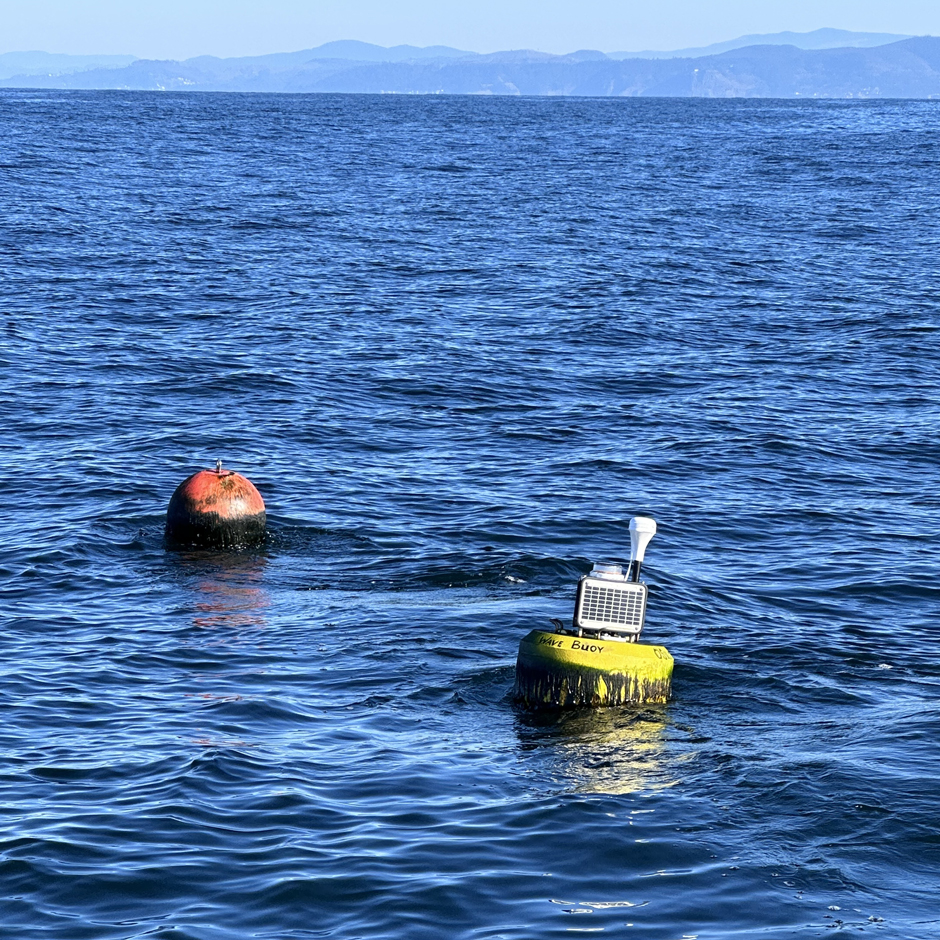
The highly productive waters off the Oregon coast lead to significant biofouling. (Credit: Brett Hembrough)
Future Possibilities of an Emerging System
The data from the NexSens buoy is automatically displayed on the internally-accessible WQData LIVE online dashboard. In the early stages of the project, when the team doesn’t have the time or resources to package and process data, this is “nice to have.”
Although not yet possible, the ultimate goal is for all of PacWave’s baseline wave data to be freely available for anyone to support scientific research and the development of WEC technology in the region, and beyond.
Better data from the buoys has additional benefits, too. Before the first PacWave data buoys were deployed, wave forecasting, analysis, and resource characterisation relied on National Oceanic and Atmospheric Organization (NOAA) buoys. However, “they’re much more distant than right there at the site, and so there’s a lot of modeling involved in that,” Hembrough notes.
Conclusion
While it’s still too soon to know the results of the PacWave team’s wave buoy comparison, the NexSens system and others are already adding value by contributing to a baseline dataset.
“Our goal here is to take known, good systems, put them in the ocean and make sure they’re functioning at their best,” Hembrough concludes. From this starting point, it’s then over to other teams to crunch the data.
With this foundation—part of a joint effort at PacWave—the team is supporting not just the next generation of WECs, but the blue economy and its related industries.






0 comments