

A Powerful Solution? Buoys Tracking the Potential of Ocean Alkalinity Enhancement
The climate is a complex network of interconnected systems.
Halting the cascading impacts of climate change is not as straightforward as cutting anthropogenic greenhouse gas emissions. Even if these emissions ceased entirely today, it would take many thousands of years for carbon dioxide (CO2) to return to pre-industrial levels.
Removal of CO2 from the atmosphere is also necessary to keep global warming within the 2°C limit stipulated in the 2015 Paris Agreement.
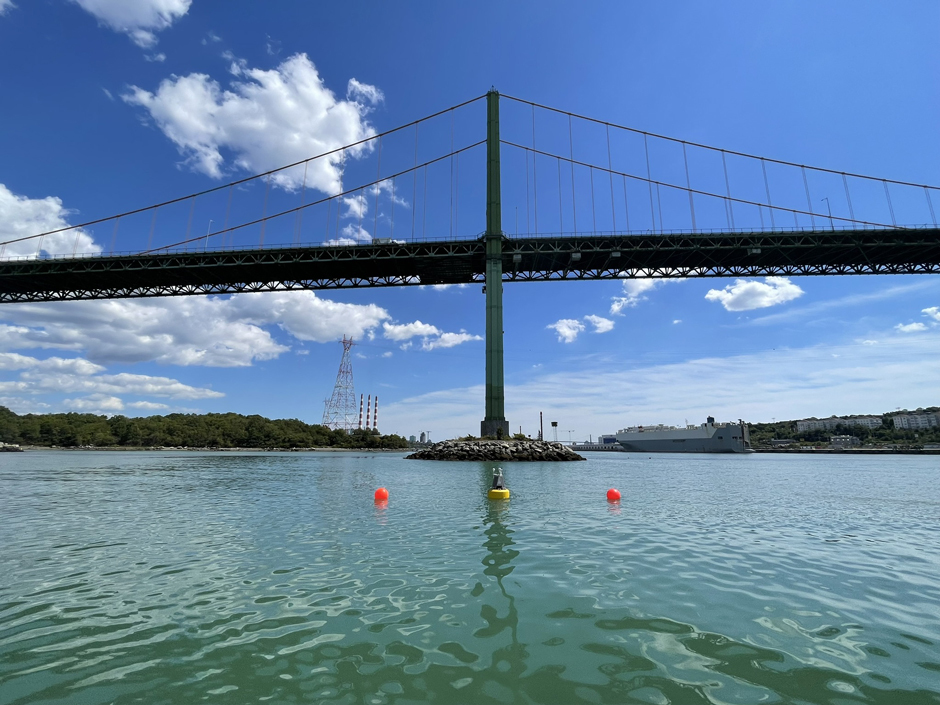
The buoy systems play an integral role in monitoring the environmental impact and efficacy of OAE efforts in Halifax Harbor. (Credit: Dariia Atamanchuk)
The Ocean as a Carbon Sink
The ocean is the world’s largest carbon sink–it absorbs 30% of all carbon dioxide emissions and captures 90% of the excess heat generated by these emissions.
“The ocean would eventually take up around 75% of CO2 from the atmosphere in the next 500 years if emissions were to cease today,” says Dariia Atamanchuk, Senior Research Associate at the Dalhousie University Department of Oceanography.
Atamanchuk is part of the research team of a pioneering ocean alkalinity enhancement (OAE) project that aims to enhance the natural processes that enable the ocean to take up carbon dioxide. It’s hoped that when used in tandem with emission reduction strategies, this double-edged sword could be part of the solution to preventing runaway climate change.
Ocean Alkalinity Enhancement
Carbon dioxide removal technologies capture and store carbon dioxide that has already been emitted into the atmosphere so that it can no longer contribute to the enhanced greenhouse effect.
Alkalinity enhancement treatments are one such technology that has the potential to mitigate climate change impacts, including rising temperatures and ocean acidification.
OAE is based on natural processes that happen “every day”–mimicking the weathering reactions of minerals that consume carbon dioxide when they dissolve, and storing it permanently in highly stable dissolved forms in the ocean. It’s estimated that natural rock weathering consumes 1.1 gigatons of CO2 a year.
“The idea is that by adding crushed alkaline minerals such as magnesium hydroxide or calcium hydroxide, we can help increase the buffering capacity of the ocean,” explains Atamanchuk.
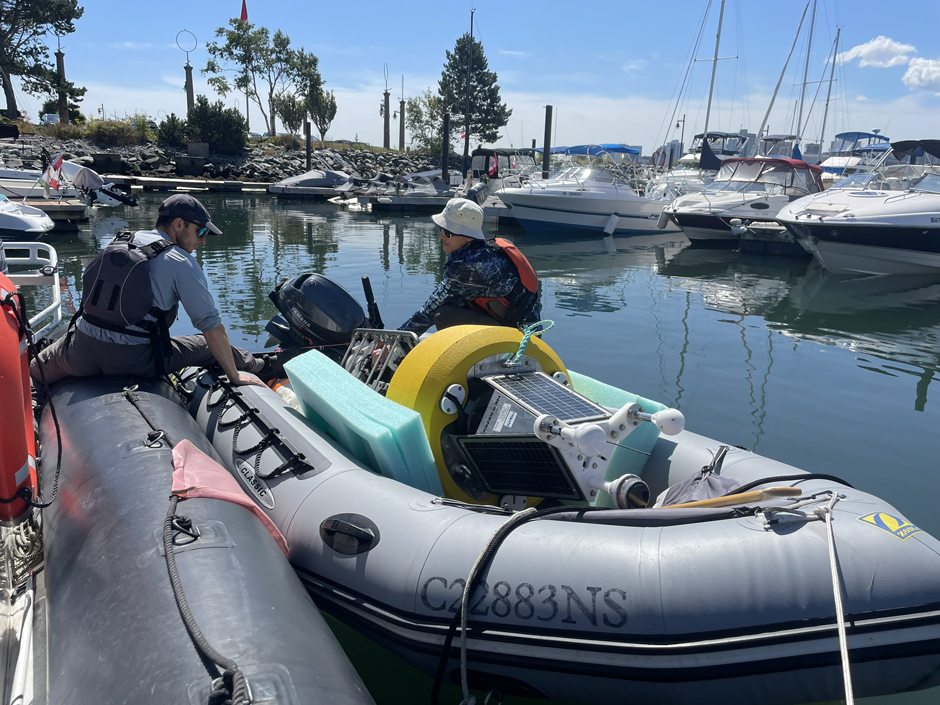
The buoy awaits deployment. One of the benefits of their compact size is that they can be easily deployed from a boat. (Credit: Dariia Atamanchuk)
Ocean Alkalinity Enhancement in Halifax Harbor
Since 2023, Halifax Harbor, Nova Scotia, Canada, has been a testbed for an OAE field trial.
Atamanchuk elaborates, “We are partnering with local climate tech company Planetary Technologies. They use the existing cooling outfall of the local power generation station to add a slurry of crushed mineral into the harbor.”
“We want to show that by adding alkaline minerals, we actually lower that partial pressure of CO2 [in the water] and create a potential for more uptake from the atmosphere,” she continues.
Although OAE is considered relatively safe, as an emerging technology, questions remain about its effect on ecosystems and–crucially–proving its efficacy.
Monitoring Ocean Alkalinity Enhancement
Atamanchuk and her team are mapping the plume of alkaline materials to understand its journey and fate after being released at the outfall. In collaboration with partners at Dalhousie, field measurements are being integrated into a biogeochemical model for Halifax Harbor.
When the project first started, Atamanchuk and her team used traditional monitoring methods. “We would jump on a boat, take water samples and try to measure characteristics such as partial pressure of CO2, pH, salinity and temperature,” she says.
This approach was not without its challenges–Halifax Harbor is one of the largest and deepest natural harbors in the world, and semidiurnal tidal flushing means conditions change quickly.
“To better understand how the alkalinity plume moves and changes in the near field, we decided to deploy the buoys, one upstream and one downstream from the outfall.”
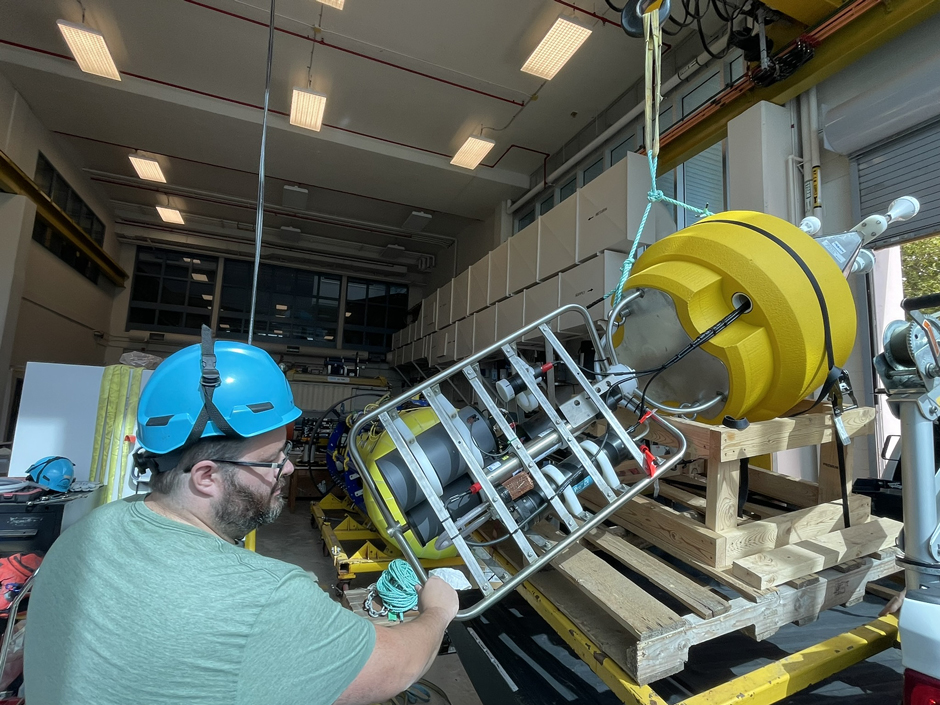
Aaron MacNeill, Electrical Engineer, built the buoy systems, which required some innovation and modification to integrate the large number of sensors. (Credit: Dariia Atamanchuk)
Upgrading to Real-Time Buoy Monitoring
In 2025, two NexSens CB-250 buoys–dubbed the C-tracker (Carbon tracker) buoys–were deployed in Halifax Harbor, 700m and 1400m away from the outfall.
Strategically located in the middle of the plume’s path upstream and downstream of the outfall, measurements give a snapshot of what happens to the mineral plume as it’s dispersed during the tidal cycle.
The buoys measure salinity, temperature, depth, oxygen, chlorophyll, backscatter, pH, total alkalinity and partial pressure of CO2. Backscatter measurements give an indication of how diluted and rich in particles the mineral plume is, and partial pressure indicates potential uptake of CO2.
Tracking carbon uptake is the ultimate goal. Total alkalinity is the key indicator–measured using sensors that are “really new, and really promising,” according to Atamanchuk.
Aaron MacNeill, Electrical Engineer, built the systems. Integrating such a large number of sensors required some innovation and modification. He explains that he integrated a custom PCB in the datawell so “four sensors are multiplexed into one data stream. The buoy receives a data string from that sensor multiplexer, and creates a single message that the X3 [data logger] can receive.”
“We have it set for hourly sampling at the moment, just because it’s sunny and summer,” MacNeill continues. “So we’re sampling every hour for 20 minutes.”
Data is transmitted from the NexSens X3 data loggers to WQ Data LIVE via 4G cellular, where it can be viewed in real-time. It is also pushed to models.
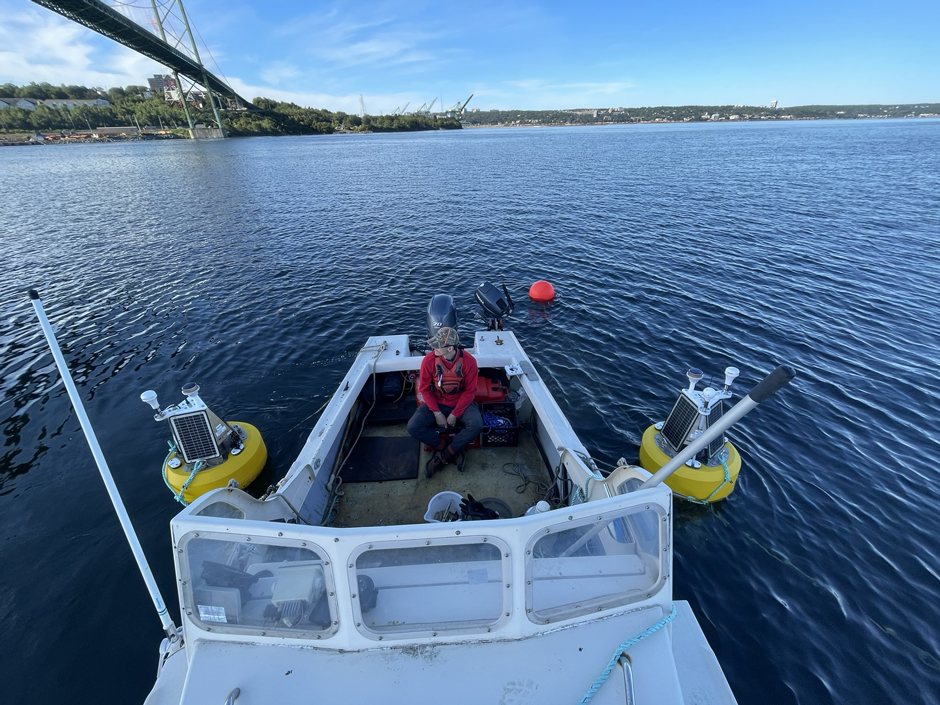
Two NexSens buoys are currently deployed on the project, alongside a host of other environmental monitoring technologies. (Credit: Dariia Atamanchuk)
Insight into Ocean Alkalinity Enhancement
The continuous, high-frequency nature of the buoy data is “super important.” With minerals now continually added to Halifax Harbor, “we expect accumulation of the signal and an increase in alkalinity above the baseline,” Atamanchuk says.
Understanding this is a key part of monitoring efforts–“The buoy data gives us the long term monitoring, but also explains the short term variability,” she adds.
So far, data has provided valuable insights. Backscatter–used as a proxy for particle concentration–has shown that the plume dissolves almost entirely between tidal cycles. Measured alkalinity rapidly decreases between sensors at the outfall and on the buoy, adding weight to the hypothesis that most dissolving happens in the very near-field and the plume is quickly diluted.
Through these findings and more, Atamanchuk and the team are helping to develop guidelines for setting up and deploying similar OAE monitoring systems, assessing their efficacy, impact, and compliance.
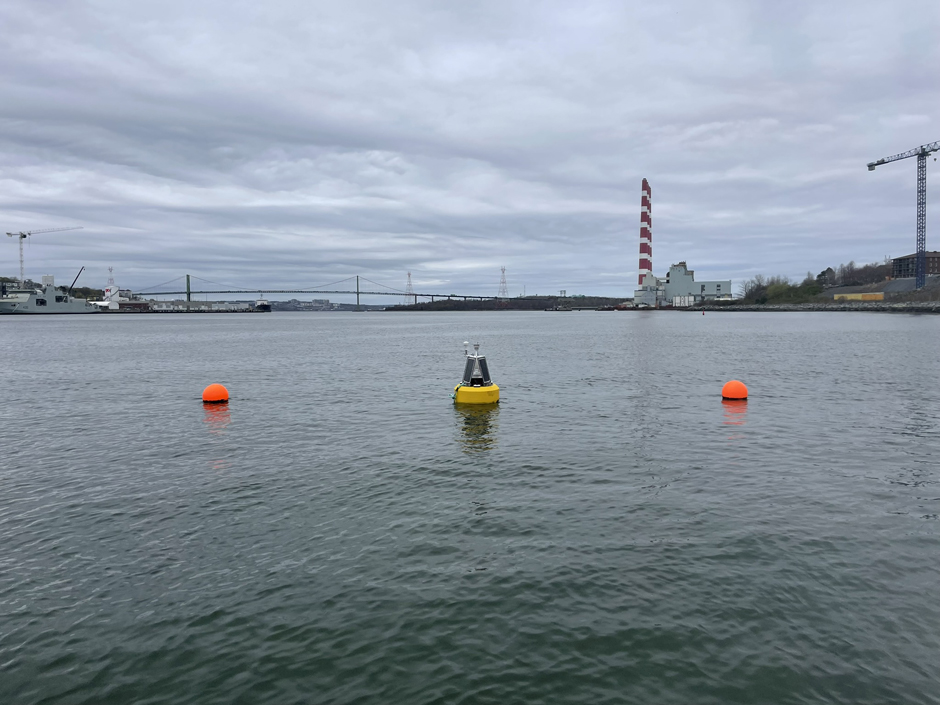
A NexSens buoy sits in Halifax Harbor, with the chimneys from the power generation station visible in the background. (Credit: Dariia Atamanchuk)
Challenges of Monitoring
Atamanchuk envisages that the buoys will remain deployed in Halifax Harbor “for a long time”, but they may be relocated to get better data on plume propagation, chemistry and, ultimately, CO2 uptake.
Regardless, limitations remain–“two points don’t really tell us anything about what’s happening basin-wide.”
While the buoys are not able to provide a complete picture, they are not the only method of environmental monitoring technology providing insight into the OAE efforts in Halifax Harbor.
For example, Sequoia Scientific, Inc. has deployed two instruments near the outfall as part of a Joint Learning Opportunity. Connected to the cloud via NexSens X3 data logger, they measure particles in the water, gathering data that contributes to research on the potential of OAE to contribute to surface supersaturation and lead to the formation of solid carbonate precipitates.
A Powerful Solution?
Alongside the urgent need to cut greenhouse gas emissions, negative emissions technologies will play a role in trying to curb warming to less than the 2°C limit, with OAE earmarked as one of the most viable approaches.
By advancing research now through trials and data collection, projects like this help lay the foundation for sustainable and impactful OAE schemes in the future.






0 comments