

Angler-Driven Citizen Science: Monitoring Black Bass Populations in Arkansas
In Arkansas, the rugged terrain of the Ozark and Ouachita Mountains dominates the north and west, eventually yielding to the vast, fertile flatlands of the Mississippi River Delta to the east. Hundreds of reservoirs and lakes punctuate the landscape, while swift streams snake through the valleys and hills, eventually giving way to the slow-moving rivers and bayous in the south.
The waterways of the state are teeming with life. Black bass dominate most of these ecosystems and have drawn anglers for centuries.
The most sought-after fish in one of the country’s most prominent fishing states, Arkansas treasures its black bass populations. The state’s native black bass populations include smallmouth bass, largemouth bass, and spotted bass, and resources are poured into protecting and improving stocks.
Population monitoring and research occur at popular water bodies where the black bass species thrive, offering bountiful recreational opportunities.
The Arkansas Game and Fish Commission’s (AGFC) Black Bass Program is dedicated solely to understanding these economically and recreationally vital species. Whether to enhance fishing tournaments or search for new, endemic species, environmental research and monitoring are at the heart of their mission.
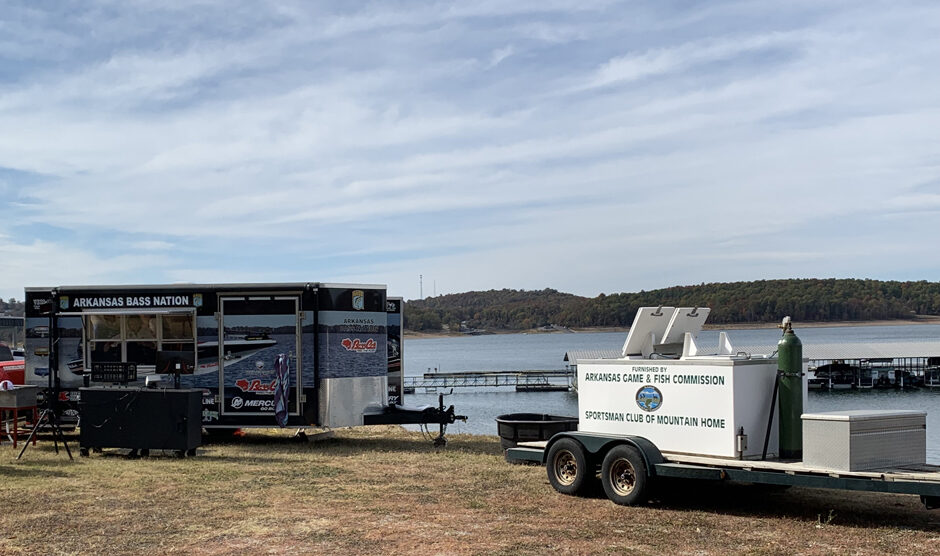
Fish care by the Arkansas Game and Fish Commission at a fishing tournament. (Credit: Jeremy Risley)
The Importance of Black Bass in Arkansas
Each year, Arkansas hosts hundreds, if not thousands, of different fishing tournaments. It’s a huge economic driver for the state, and AGFC’s Black Bass Program Coordinator, Jeremy Risley, says this was a primary reason for the program’s creation over 20 years ago.
“The majority of our anglers, they do target black bass,” Risley says. “So our agency felt like it was at that level that we needed to have dedicated staff who are only focused on black bass.”
Risley explains that Arkansas is home to hundreds of lakes, reservoirs, streams, and rivers that offer habitat for the bass. Still, with the immense popularity of fishing, populations must be managed to protect these resources and meet angler expectations.
Healthy bass populations produce more large adults, so to have trophy-worthy fish, the commission must understand bass population characteristics. The base of a healthy population is abundant habitat and forage, according to Risley. Therefore, these aspects are constantly monitored, starting with the bottom of the food chain.
Shad are a common prey for bass species, and can help predict bass populations. The AGFC uses hydroacoustics, physical sampling, and a YSI ProSolo multiprobe to understand shad population characteristics.
“We use our DO meters and other equipment to get water quality, and that’s adjacent with our hydro-acoustics sampling allows us to estimate the number and biomass of shad within our reservoirs,” Risley says. “But we primarily use water quality meters to determine the location of the thermocline. Knowing where the thermocline occurs allows us to understand better where the shad will be during our summer sampling.”
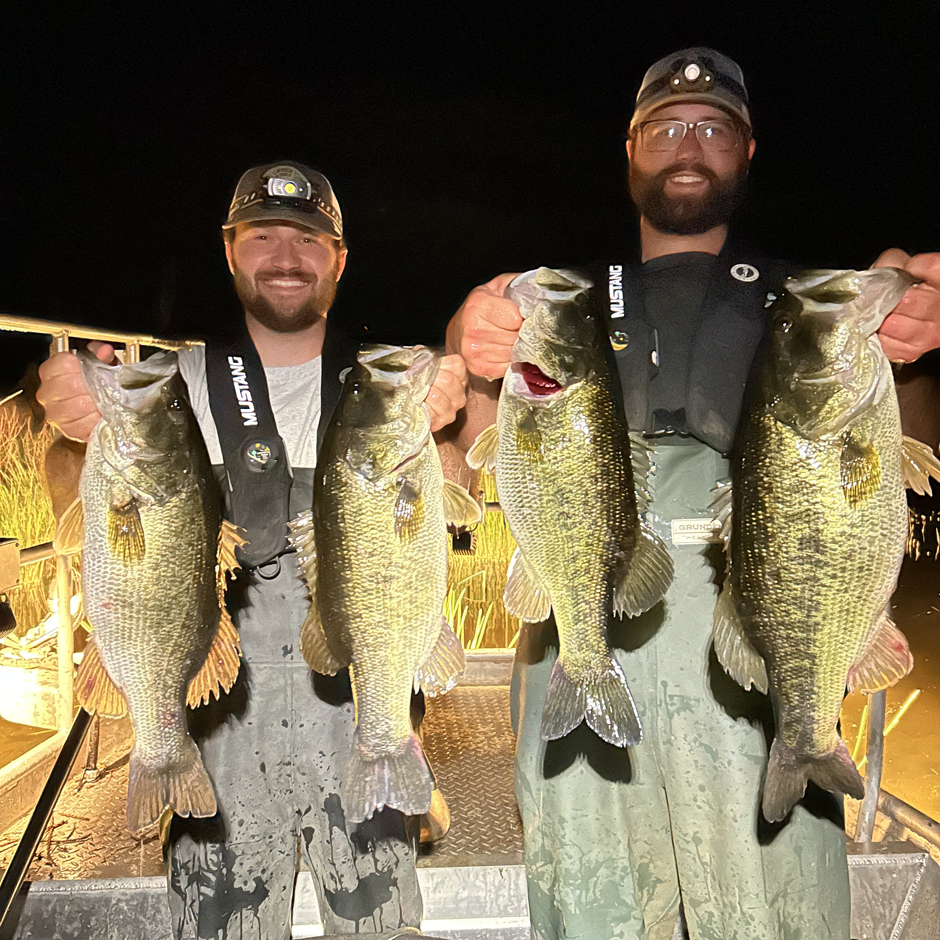
AGFC biologists display several large Florida Bass sampled by boat electrofishing. (Credits: Walter Trulock)
Understanding shad is just one part of the program’s main research, which includes monitoring bass population characteristics. The fishing regulations set by the AGFC are based on countless days and nights of sampling, monitoring, and analyzing data from Arkansas’s most prized fish species.
“A lot of these regulations are developed through population characteristics: growth, mortality, recruitment, how fast they grow, and how long are they living, and how many fish are replacing those that are dying each year,” Risley says.
Risley explains that, while fishing regulations may seem restrictive, they are designed not only to protect bass populations but also to enhance the angler’s experience.
To catch the larger fish, they must be allowed to grow and thrive. Overfishing can lead to population loss, while harvesting smaller, juvenile bass inhibits recruitment and the expansion of the species. Therefore, data-driven harvesting regulations will help anglers catch better fish, Risley says.
“Ultimately, we seek regulations that safeguard bass populations while ensuring high-quality bass fisheries for anglers,” Risley says.
The AGFC continues to monitor year after year, installing habitat, enforcing regulations, and ultimately increasing access to fishing opportunities.
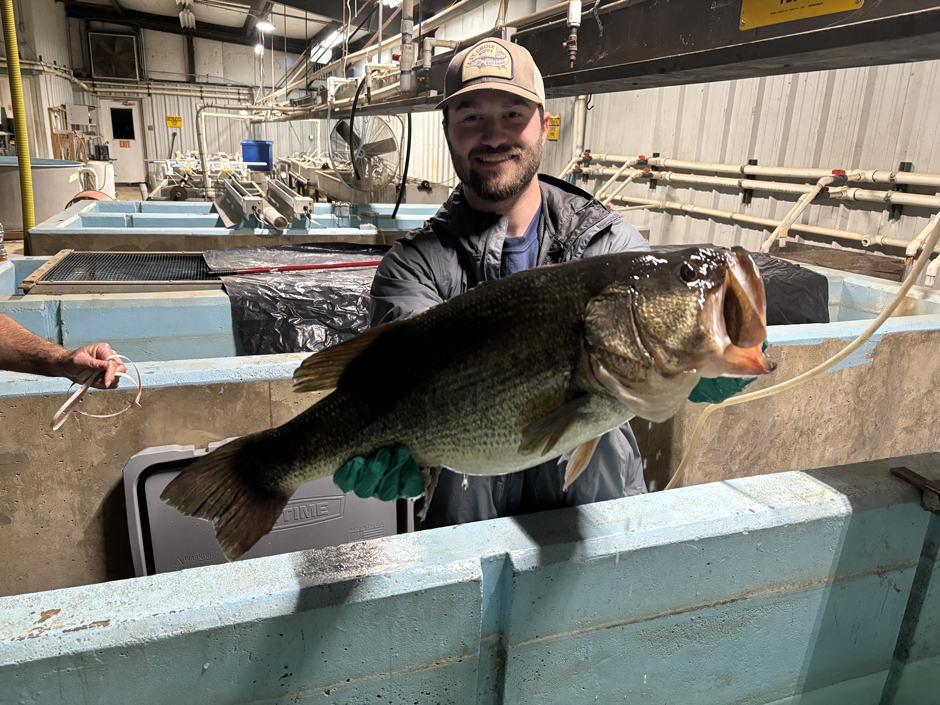
A 10.5-lb Florida Bass used for spawning at the Joe Hogan State Fish Hatchery. (Credits: Chris Baker)
Tournament Fishing and Citizen Science
While Risley and his team are often doing the hard background research to maintain bass populations, they aren’t the only ones involved. Taking advantage of the hundreds of fishing tournaments in the state each year, the AGFC launched the Arkansas Tournament Information Program (ATIP) in 1990, where tournament participants can voluntarily submit information about their catches.
Black Bass Program Biologist Eric Naas says that analyzing this data is an important part of his and Risley’s work, as this data is then used to inform future management decisions and connect with the public.
“We’ll analyze the data to see how our reservoirs are performing for anglers throughout the course of the year,” Naas says.
Since ATIP data is based on angler participation in citizen science, Risley says it increases opportunities to interact and communicate with anglers, and provides them with a chance to be part of the management efforts.
Tapping into citizen scientists has proved to be a huge help for the Black Bass Program. Typically, Risley and Naas try to avoid anglers while sampling and monitoring, often working at night to not disturb them.
However, the tournament program engages the public and helps them see the research that goes into their recreational pastime. And, with so many anglers submitting their data, Risley says it greatly benefits the commission’s understanding of the state’s bass populations.
“They’re seeing stuff that we don’t see, and then we’re seeing stuff that they don’t see,” Risley explains. “So by combining those together, we’re getting a better overall picture of our bass population, and it gives the anglers an opportunity to have buy-in or contribute to the management of the black bass in the state.”

Jeremy Risley (second from left) at a bass tournament on Norfork Lake, Arkansas. (Credit: Jeremy Risley)
Conclusion
To encourage more people to get on the water and volunteer their data, the Black Bass Program also works to improve fishing access and opportunity across the state.
“We continue to seek ways to involve anglers in the management and conservation of black bass in the state, including [new programs] aimed at producing trophy bass,” Risley says.
Whether it’s stocking fish, improving boat launch docks, hosting educational events, or setting regulations, anglers benefit from the program’s work. And in turn, through data collection and revenue, the anglers help AGFC.
“So it’s just important to consider we’re always trying to act in the best interest of both fish and anglers as we’re collecting that data,” Naas says.






0 comments