

How Ohio’s Inland Fisheries Research Unit Uses Science to Improve Fishing
Ohio is a state defined by its water bodies, with Lake Erie to the north and the Ohio River meandering along its southern and eastern border. Within these boundaries are the Buckeye State’s inland waterways, sporting over 60,000 miles of rivers and streams and 112,000 surface acres of lakes and reservoirs, according to the Ohio Division of Wildlife.
This plethora of water also offers ample opportunities for anglers to pursue the variety of sportfish that can be found in Ohio. While Lake Erie is well-known for its recreational opportunities, Ohio’s inland waterways also provide plenty of opportunities to pursue everything from bluegill to catfish.
These thousands of miles of water are monitored and researched by many agencies and organizations within the state. Leading fisheries research and management within Ohio’s borders is the Ohio Division of Wildlife’s Inland Fisheries Research Unit (IFRE), which works year-round to better understand the state’s inland sport fish populations.
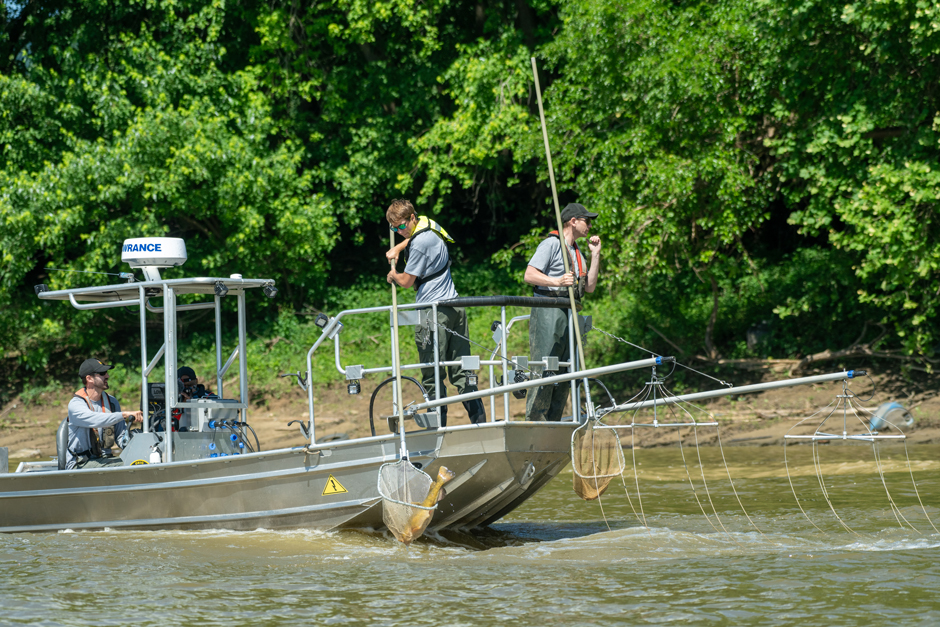
Inland Fisheries Research Unit staff sampling Blue and Flathead Catfish populations on the Ohio River using low-frequency electrofishing. (Credit: Tim Daniel)
Surveying and Improving Ohio’s Sport Fish Populations
Taylor Hunkins has worked as a Fisheries Biologist at the IFRE for the past three years. She is the unit’s leader in habitat research and surveys, which is just one of the three surveys that the unit conducts. Along with habitat surveys are sport fish population assessments and creel surveys.
Hunkins’ habitat survey is relatively new compared to the other two, but it is important to understand the habitat currently available for sportfish. She has partnered with the University of Cincinnati on developing an assessment protocol to better understand the habitat available to sport fish.
“We’ve been working […] to develop a protocol using recreational-grade side-scan sonar to quantify the amount of physical habitat and the quality of this habitat available for sport fish populations,” Hunkins explains.
Water temperature conditions are monitored annually using HOBO Pendant temperature loggers in a subset of Ohio reservoirs. The IFRE uses the loggers to gather data for research projects and better understand the thermal environment.
The other surveys that the Unit conducts are more common, although still vital. Hunkins’ colleagues talk with anglers at some of Ohio’s most popular reservoirs for the creel survey.
The population surveys are the most intensive that the unit undertakes. To tackle the entire state, the Division of Wildlife is split into five management districts. Hunkins and her colleagues work with staff from these districts year-round on standardized assessments that survey over a dozen sportfish species.
“This is a system that we’ve put together over the years with standardized methods to assess the abundance and estimate the age to determine growth of certain sport fishes,” Hunkins says.
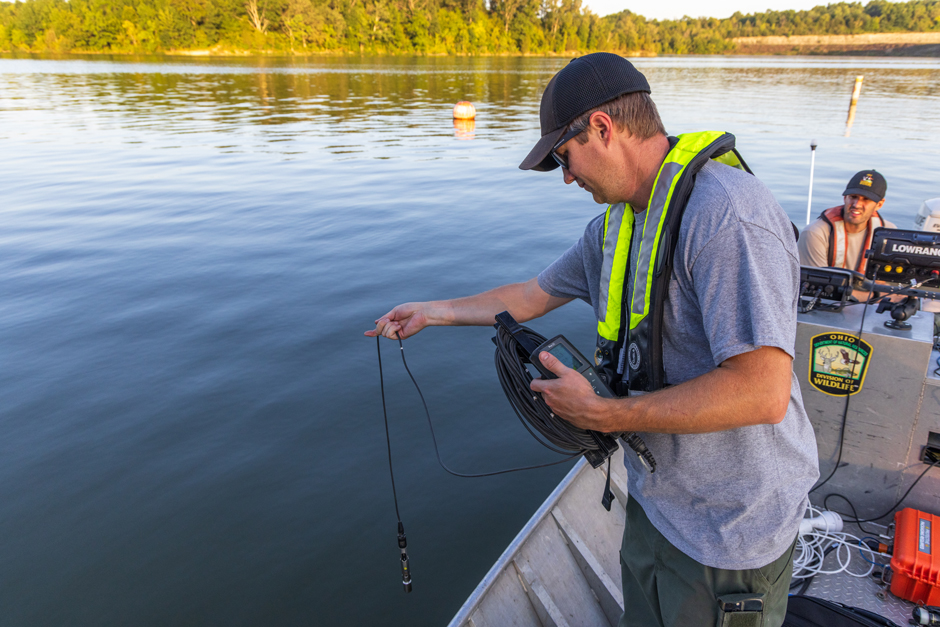
Inland Fisheries Research Unit staff taking a water profile prior to a survey. (Credit: Josh Zielinski)
In the spring, the inland fish staff begins conducting electrofishing surveys to sample for black bass populations in reservoirs. Once June rolls around, which Hunkins and her colleagues call “catfish month,” hoop nets are used to catch and survey channel catfish.
In certain reservoirs and the Ohio River, they use low-frequency electrofishing to survey blue and flathead catfish.
Toward the end of the summer, Hunkins explains that district fish staff sample black bass in Ohio’s many streams. Meanwhile, the IFRE begins its hydroacoustic surveys to assess forage fish populations, such as prey fish like gizzard shad.
In the fall, popular pan fish like crappie, bluegill, and pumpkinseed are surveyed. They also conduct electrofishing surveys on the Ohio River to assess bass and Sander species (sauger, saugeye, and walleye) populations. At the same time, in reservoirs, they sample stocked young-of-the-year sportfish.
Finally, as the year comes to a close, the IFRE deploys gill nets in reservoirs to capture and sample sought-after species like walleye, yellow perch, and saugeye.
While Hunkins says these surveys are considered routine, they’re still carefully thought-out. The Unit is also interested in understanding the environmental conditions during these surveys. Hunkins explains that before each population survey, she and her colleagues use a YSI Pro Plus to take dissolved oxygen and temperature profiles.
“That helps us determine if we can conduct the survey, and know if there’s enough oxygen within the lake at a certain time, [to determine if] we’ll actually be able to capture these species with the gear that we’re using,” Hunkins explains
Ultimately, these surveys help the IFRE understand how sportfish populations are changing. The primary mission of the unit is to manage Ohio’s fisheries for recreational use, so understanding population dynamics also enables the unit to enhance the experience for Ohio’s anglers.
“We want to manage so that in the future, others can enjoy these resources in the state of Ohio as well,” Hunkins says.
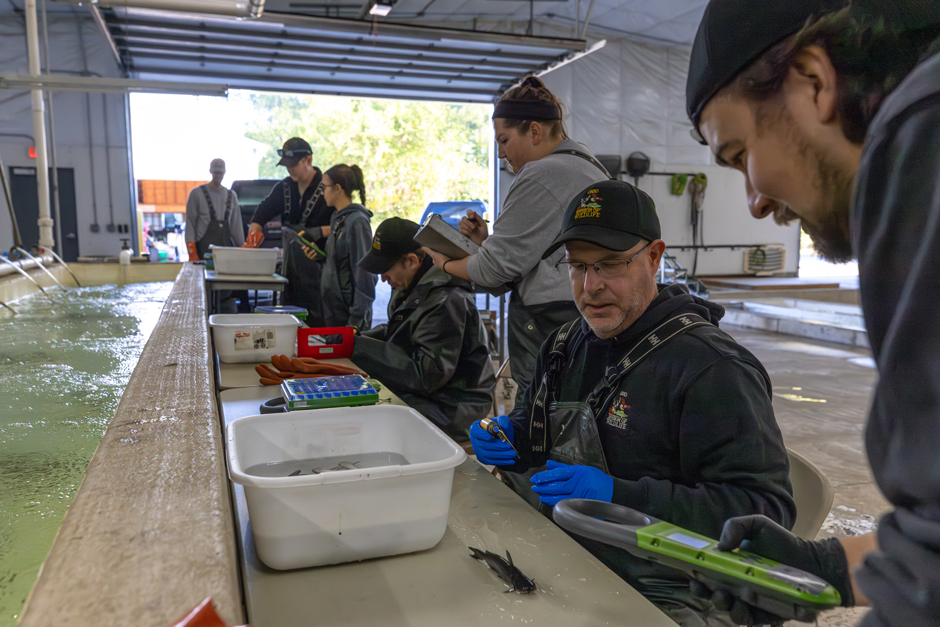
Inland Fisheries Research Unit staff marking fingerling Blue Catfish with passive integrated transponder (PIT) tags prior to stocking for a research project. (Credit: Josh Zielinski)
How Fisheries Research and Management Supports Anglers
When the IFRE conducts its surveys on Ohio’s waterways, it’s actively looking for ways to provide opportunities for anglers. Hunkins says that things like conservation naturally come into play, but their core mission remains “to conserve and improve fish and wildlife resources and their habitats for sustainable use and appreciation by all.”
This is where research comes in, as employees like Hunkins use the data from their surveys to look for ways to bolster the state’s sport fish. This is occurring now, as a blue catfish management plan is underway at a popular reservoir in central Ohio.
“Hoover Reservoir is a trophy blue catfish fishery. And recently, within our surveys, we noticed that [catfish] growth was starting to decline with age through time,” Hunkins says.
So, Hunkins says inland fish staff adjusted stocking rates and frequency and removed the protected 18–28” slot limit regulation, which restricted harvest. “We’re hoping that this will help improve [catfish] growth over time,” Hunkins explains.
Moreover, with the popularity of these fish, the Division of Wildlife has expanded to nine Blue Catfish program reservoirs.
“After about five years of stocking, we’ll add those locations to our sampling list,” Hunkins explains. “We’ll monitor these populations over the next few years and estimate if we’ll reach our goal of establishing a fishable population of [trophy-size] blue catfish.”
Ohio anglers can also use data collected by the Division of Wildlife fish management staff to find their next fishing spots. These include websites that show anglers where to fish and compilations from their sport fish population surveys.
Division of Wildlife fish management staff are continually searching for new ways to improve fish habitat, populations, and the quality of Ohio’s fisheries. This comes from the important combination of traditional surveys, water quality monitoring, and new research.
“We always want to try to improve and hopefully create new fishing opportunities for our anglers on inland waterways,” Hunkins says.
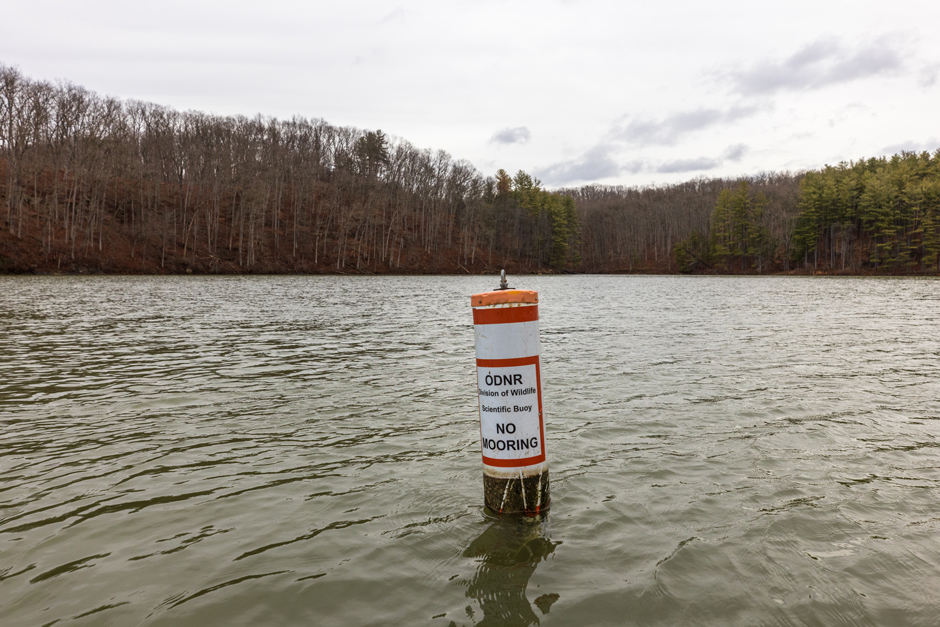
Water quality buoy used for collecting water temperature data in an Ohio reservoir. (Credit: Josh Zielinski)
Enjoying the Survey and Management Process
At the end of the day, Hunkins greatly enjoys the work she does. She enjoys collaborating with colleagues, universities, and partners to improve Ohio’s fisheries.
At its core, collaboration promotes collecting and sharing important data on the habitat and populations of some of Ohio’s most prized fish.
“Collaboration is key in our field, also sharing data […] improves all of our projects,” Hunkins explains.
With so many partners and so many water bodies to cover across Ohio, Hunkins also appreciates the opportunities to explore and learn more about her home state. From popular reservoirs near her office to the massive Ohio River, the state’s rivers and lakes offer something new for researchers and anglers alike.
“I always feel like I’m learning something new each day,” Hunkins says, “or seeing something new and different and learning more about Ohio and our resources day by day.”
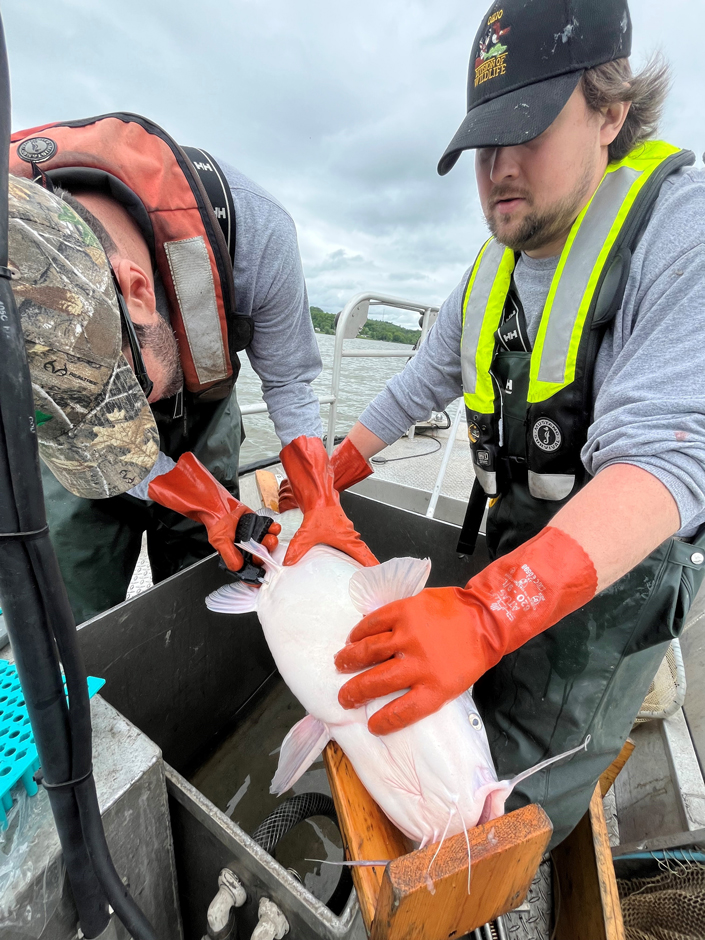
Inland Fisheries Research Unit staff marking a Blue Catfish with a passive integrated transponder (PIT) tag for a research project. (Credit: Taylor Hunkins)






0 comments