

Monitoring Water Quality and Seaweed to Protect the Nantucket Sound
Nicole Corbett has spent her life surrounded by water. From summers with her grandparents in Cape Cod to her home near the Nantucket Sound, she has always been near the ocean. Both of her parents worked in aquatic science fields, and Corbett knew her local marine environment well.
As a high schooler, she noticed changes occurring along the coastline of her hometown, Popponesset. Dense mats of unusual red seaweed began washing ashore, much more than usual, and jellyfish blooms were becoming more frequent. Around this time, studies were finding high levels of nitrogen in small, nearby bays.
“When I was in high school, I started to notice that this coastal area was really starting to change ecologically,” Corbett says.
She went off to college and earned a master’s in environmental science before returning to the coast near Popponesset to teach high school science. When she returned, she realized these problems hadn’t improved. So, to create a platform for researching these changes, Corbett founded the Popponesset Water Stewardship Alliance (PWSA).
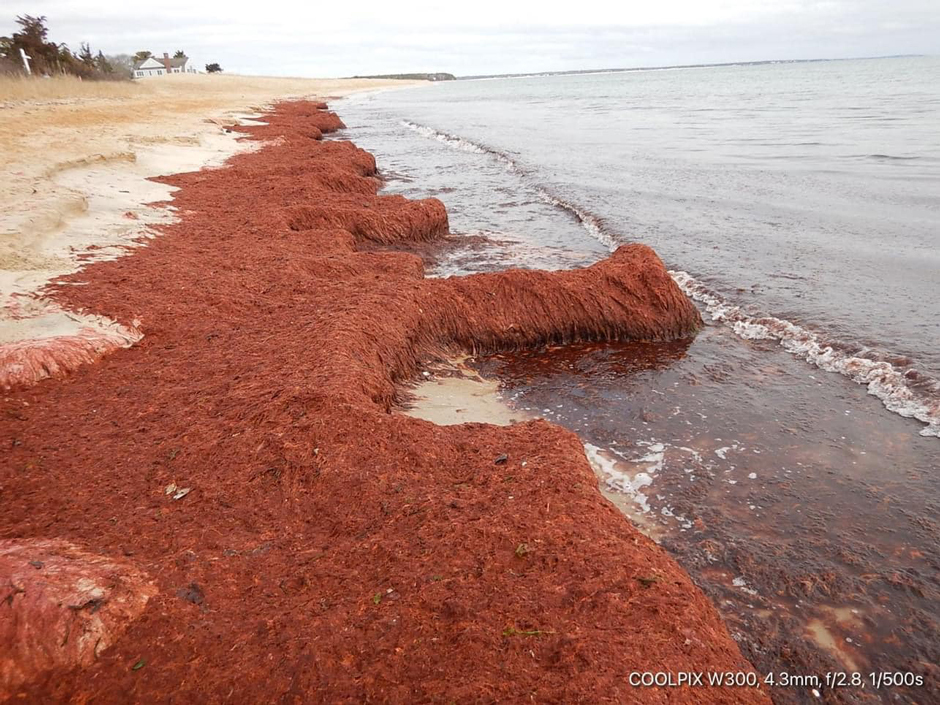
Dasysiphonia japonica inundation on Popponesset Spit in January 2021. (Credit: Popponesset Water Stewardship Alliance)
How the PWSA is Filling a Research Gap
Corbett officially incorporated the PWSA as a non-profit in 2023, though the organization had been running for a few years prior. Her first action was to reach out to local researchers to help identify the seaweed washing onto Popponesset’s shores.
She says the bright red seaweed differs from the green “Dead man’s fingers” that are commonly found around Nantucket Sound. It was forming large clumps on the beach, which would begin rotting and emitting an unpleasant smell.
Soon, she learned the red seaweed was Dasysiphonia japonica, an invasive species from East Asia. A professor from Stony Brook University had identified nitrogen loading as a key influence on Dasysiphonia japonica growth. This made sense to Corbett, who knew of high nitrogen loading in the small Nantucket Sound embayments.
“The little bays that border Nantucket Sound have been highly studied because of septic pollution,” she explains. “And there’s a lot of eutrophication in these bays that is causing well-documented ecological problems.”
However, the seaweed mats don’t form within the small bays, but out in the much larger Nantucket Sound. Corbett began searching for nutrient-loading and ecological research in the sound, but was surprised to find little information.
So, she decided that PWSA would fill this gap and investigate the “potential link between large amounts of this [seaweed] and large amounts of anthropogenic nitrogen getting into the water.”
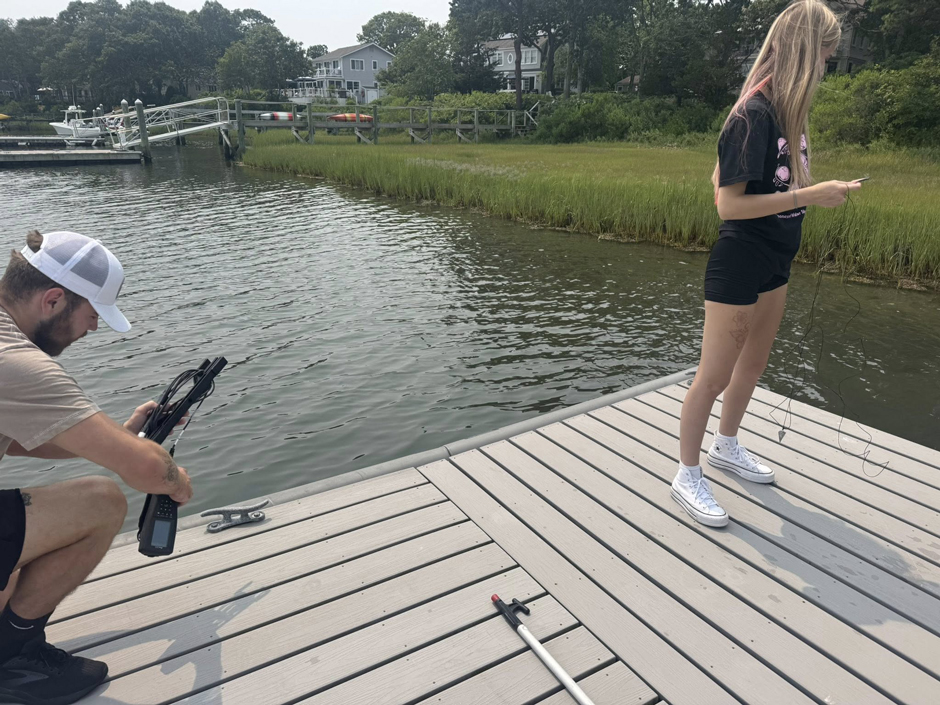
PWSA interns Olivia Posk and Robert Hokanson assembling settling plates to be suspended off a dock in Popponesset Bay. (Credit: Popponesset Water Stewardship Alliance)
Seaweed and Water Quality Monitoring Projects
Starting in the spring of 2026, Corbett says the PWSA will collect tissue samples from seaweed that washes onto the beach. These will be sent to Salem State University’s Viking Environmental Isotope Laboratory, which will identify the different nitrogen compounds and determine whether they’re from anthropogenic or natural sources.
“I think that’ll help to give us some answers about whether our septic issues that are impacting the bays may also be impacting Nantucket Sound coastal waters,” Corbett explains.
The PWSA will take it a step further and determine where these seaweed mats are most problematic. Corbett says they’ve had volunteers taking pictures of the seaweed for several years at different locations, and they recently took their visual observations to the sky.
“We have a drone that goes up and down the beach and kind of shows how much seaweed is building up, and then you can cross-compare it and see how it changes over time,” Corbett says.
Along with seaweed, the PWSA has been monitoring water quality along Popponesset’s coastline for the past several years. Corbett says they hope to learn not only what nutrients may be impacting Nantucket Sound, but also where they’re coming from, as that may establish a link between the seaweed and septic systems.
“[We want to know], how much nitrogen can go into this without tipping that scale, in terms of keeping everything ecologically balanced?” she says.
Water quality data on temperature, salinity, and nitrogen are collected with a YSI ProDSS. The PWSA also uses dissolved oxygen test kits and takes grab samples to send to their partner, the Center for Coastal Studies, who test for other nutrients such as phosphorus.
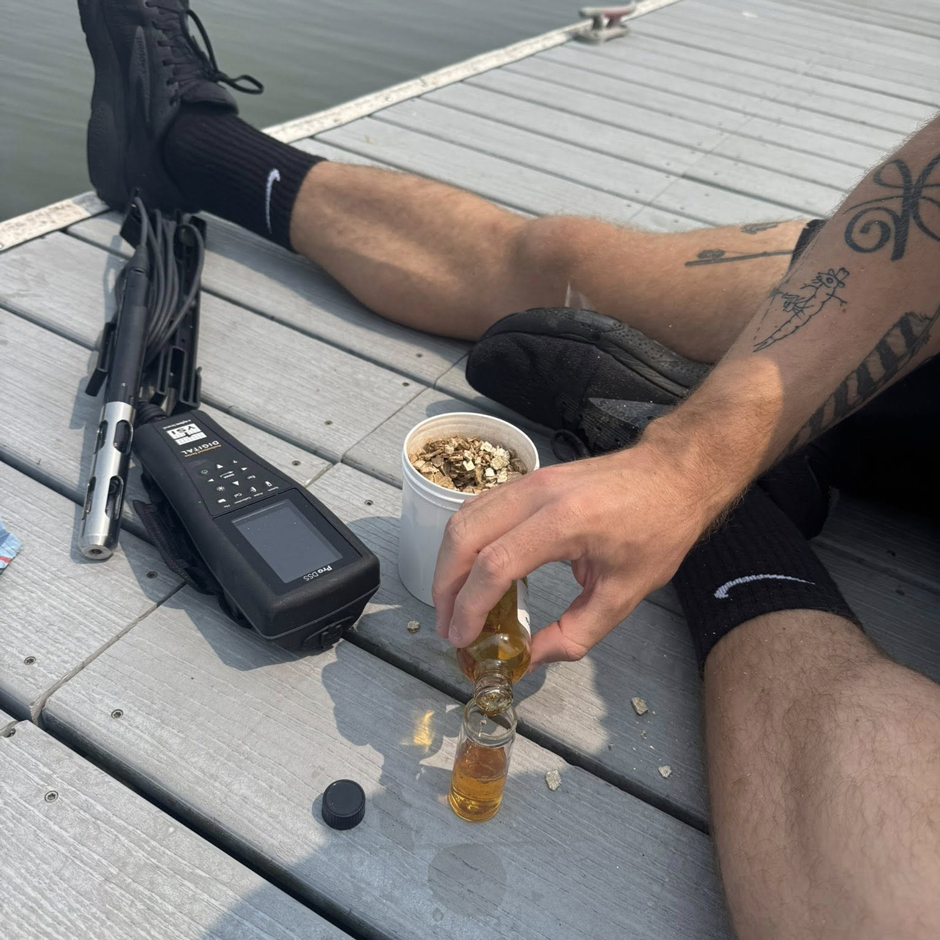
A YSI sonde and LaMotte Dissolved Oxygen test kit used to test for DO levels off a dock in Popponesset Bay while placing settling plates in August 2025. (Credit: Popponesset Water Stewardship Alliance)
Corbett, her interns, and PWSA volunteers will go out throughout the year to collect data. In the summer, they go out every two weeks, and in the winter, once a month, depending on conditions.
Currently, their data is not publicly available. However, Corbett says that a PWSA board member is coding a webpage that will display their years of water quality testing data.
The webpage will display a map that pulls weather data from NOAA’s Nantucket Sound Buoy, as well as a nearby USGS station.
“Ultimately, the goal is to incorporate information collected and stored on the YSI ProDSS onto the web-based application,” Corbett says.
She continues, “It is the hope that this numeric data with overlapping observational data may help to provide more information about cause-and-effect relationships pertaining to seaweed inundations, jellyfish blooms, water quality, and short/long-term weather conditions.”
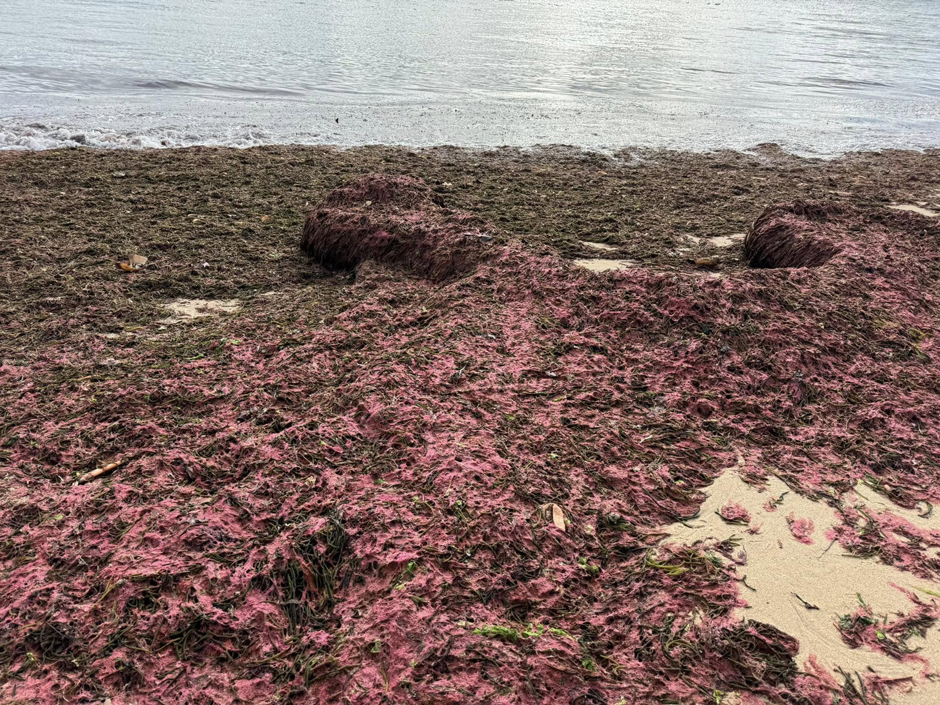
An influx of Codium fragile (Dead Man’s Fingers) and Dasysiphonia japonica at Popponesset Spit. (Credit: Popponesset Water Stewardship Alliance)
Environmental Education and Community Outreach
Much of the PWSA’s work is done with volunteers and interns, so Corbett says she also prioritizes interacting with and educating the community. She utilizes the partnerships she’s formed to help connect volunteers to legitimate, ongoing science.
“The overall mission is to try to get more people in the community involved in local environmental issues by making these citizen science projects [connect] to actual science institutions that can help guide the process along.”
Each summer, the PWSA hosts education programs to share its work. Corbett says she, board members, and interns will talk to children and community members about their jellyfish samples, water quality monitoring, and seaweed tracking.
She believes people connect best when they see how nutrient pollution is impacting their favorite beaches, and it sometimes inspires them to volunteer with PWSA.
“We get a good amount of involvement from the community,” Corbett says.
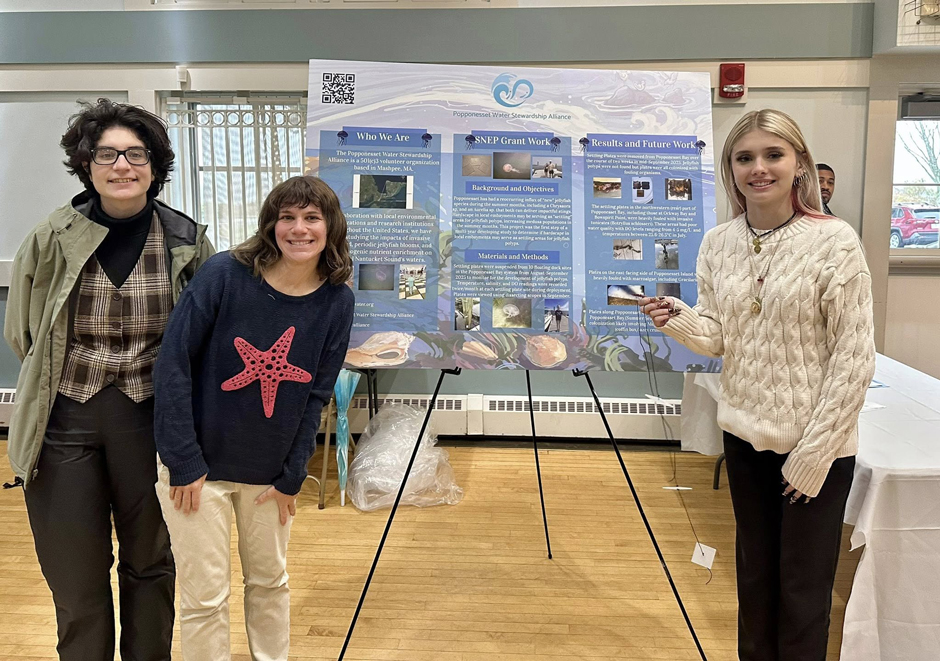
Nicole Corbett (center) with interns Lidi Vidal and Olivia Posk at the Southern New England Estuaries Project grant awards assembly presenting settling plate work in October 2025. (Credit: Popponesset Water Stewardship Alliance)
The team also volunteers with the local Town of Mashpee Department of Natural Resources to conduct water quality monitoring in the Popponesset Bay.
Corbett says this monitoring in the bay has raised awareness about the septic tank problem, prompting the town to replace septic systems with sewer treatment and look into expanding oyster aquaculture in local embayments.
Ultimately, Corbett says people living in Popponesset and the entire Cape Cod and Natucket Sound region naturally connect to the PWSA’s work.
Similar to Corbett herself, she believes the community wants to know why their ocean is changing; they just need someone to start researching.
“At the end of the day, when you’re on the Cape, the water in the coastline and the beaches are just so critical to the community,” she says. “They’re part of the lifeblood of the community. So understanding what’s going on–and if we are negatively impacting it–is really important.”
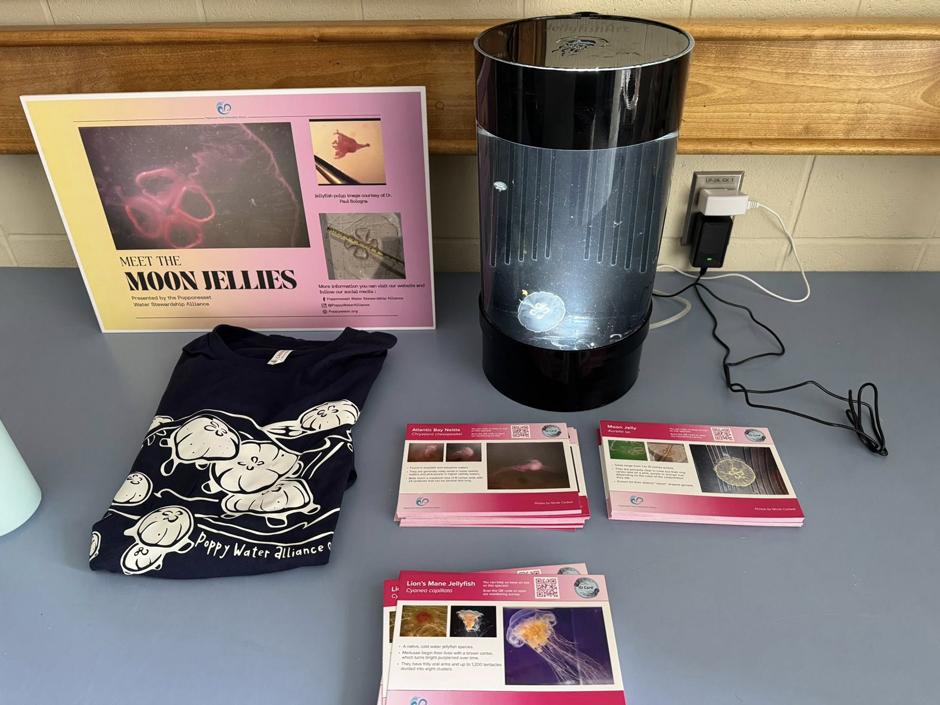
PWSA’s jellyfish exhibit at the Massachusetts Marine Educators Conference at Woods Hole in May 2025. (Credit: Popponesset Water Stewardship Alliance)






0 comments