

Reimagining Water Filtration: How Monitoring and Science Enhance FloWater Filtration Systems
Over 50% of Americans think their tap water is unsafe, according to the Environmental Working Group (EWG). Other recent surveys have found that number to be as high as 70% of persons surveyed.
Whether due to increased public awareness of water quality issues or confusion about how municipal water sources are regulated, there is a clear distrust of tap water in the United States.
According to industry expert Rich Razgaitis, CEO and co-founder of the water purification company FloWater, this issue creates a damaging cycle. Razgaitis explained that the health and environmental problems associated with contaminated water aren’t the only issues.
As people become increasingly aware that some tap water is unsafe, they resort to bottled water. Yet, not only are plastic bottles notorious environmental polluters, they also pollute the human body. Microplastics from these bottles, among other sources, enter the human body and can cause a myriad of health problems.
So, Razgaitis said that some people will push back against plastic bottles, but fail to accommodate others’ distrust of tap water. This creates a cycle where people are caught between concerns about their health and the environment. And Razgaitis says this may lead people to become chronically dehydrated, without a clear option for safe consumption.
This is where Razgaitis and FloWater have found themselves, working to fix this problematic cycle. Through a process involving the removal of contaminants, monitoring water quality, and holistically controlling the process from source to consumer, Razgaitis is trying to transform water consumption in the United States.

Technician installing the FloWater Refill Station.
FloWater Purification Systems
“The goal of our Refill Station is to […] take any tap water, anywhere in the US, and completely standardize the purity of it and the taste of it,” Razgaitis says.
FloWater achieves this through a “7x Advanced Purification” process in its Refill Stations. While Razgaitis says that some use the two terms interchangeably, filtration and purification are quite different processes.
Filtration is the physical process of removing contaminants such as sediment. However, filtration struggles to remove things such as PFAS, heavy metals, or bacteria. This is where the purification process comes in.
For FloWater, this involves using “Advanced Osmosis.” Their form of reverse osmosis moves water pure with as little as 0.0001 microns of contamination through a semipermeable membrane, leaving the more heavily contaminated water on the other side.
“What it is, effectively, it’s like having a set of kidneys operating in the Refill Station so that your body is not absorbing all of those contaminants,” Razgaitis says.
Yet, harking back to the damaging cycle associated with tap water and plastic bottles, Razgaitis acknowledges that clean water is only half the battle.
He explains that if consumers don’t enjoy the taste of their water, then the problem is not truly solved. But by adding minerals and alkalinity, he says their water from the Refill Stations achieves an enjoyable, standardized taste.
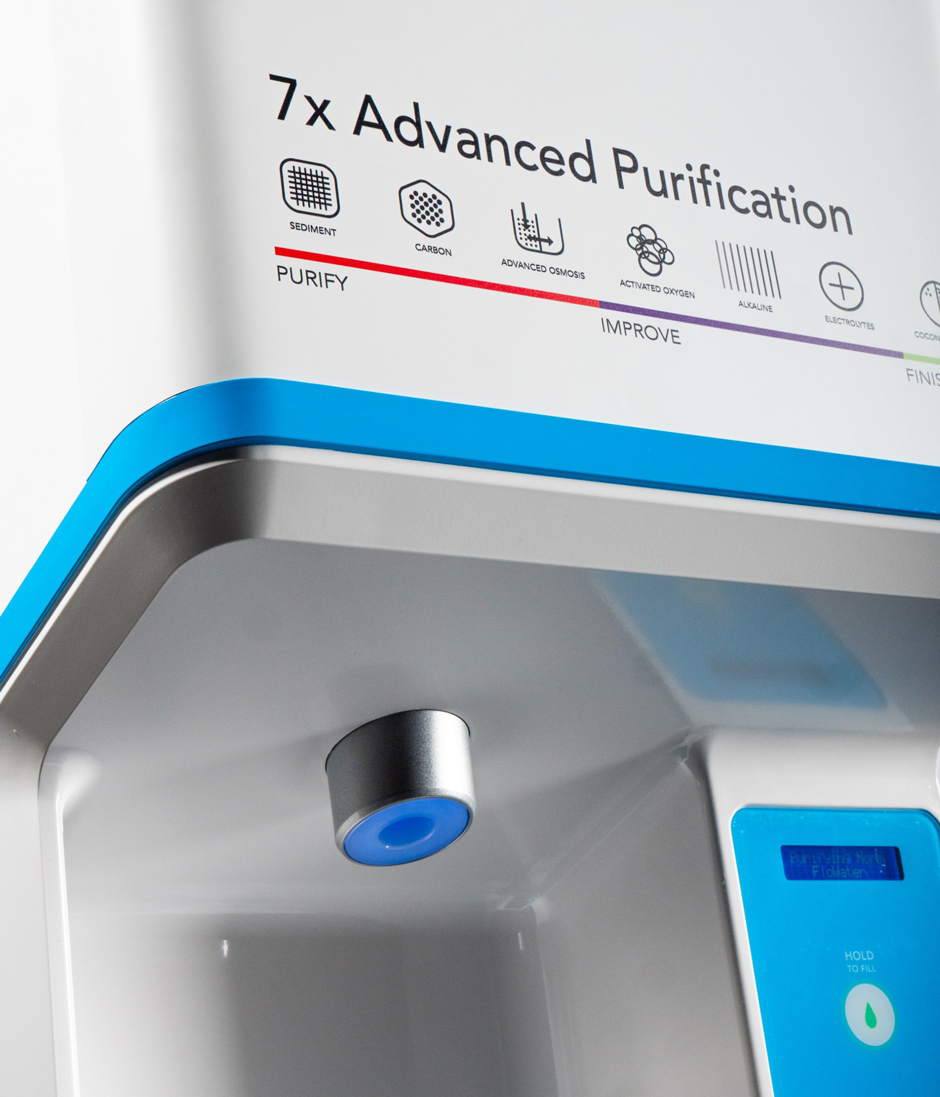
FloWater Refill Station 7x Advanced Purification.
Monitoring and Evaluating Water Quality
FloWater does not internalize its process, as it partners with outside organizations to monitor and evaluate the effectiveness of its water systems. On their website, they list common contaminants identified by EWG that are removed by their filters, including PFAS, lead, arsenic, radium, and more. They also use data from EWG to help inform visitors which contaminants are in their own tap water.
However, that data may only provide a snapshot of all chemicals in drinking water. Razgaitis says that there are over 50,000 chemicals in production in the US today across its many industries, any of which could end up in a water source. Therefore, he says it would be improbable to test if their filter removes each individual chemical.
Instead, FloWater will test the effectiveness of its Advanced Osmosis membrane as a whole by sending the filter to the National Sanitation Foundation for its NSF Certification.
“There are so many contaminants in the US that I don’t feel the need to test PFAs, glyphosate, every one of these,” Razgaitis says. “What I do feel the need to do is to test the reverse osmosis membrane purifies to 0.0001 microns. By default, you just know anything going down to 00.001, microns is getting removed.”
Similarly, Razgaitis emphasized the importance of monitoring water quality before and after it goes through their filters. Alongside an NSF certification, technicians will periodically use total dissolved solids meters to gauge the effectiveness of the Advanced Purification process.
Moreover, FloWater will send water samples to third-party labs if they are testing for specific chemicals, as was the case when they donated $60,000 worth of Refill Stations to Flint, Michigan in 2016.
The tap water from Flint had lead concentrations 43 times above the EPA allowable limit at that time. Yet, after putting that water through their FloWater filters, the lead concentration was undetectable, according to Razgaitis. The results from before and after were given by the same third-party lab at the Colorado Department of Public Health and Environment.
Razgaitis emphasizes that in certain cases, taking extra measures to monitor the water they’re using is crucial, ensuring that the confidence in FloWater’s filters is backed by science.
“It’s got to be rooted in fundamental technology that’s proven to work and be efficacious and deliver a great result,” says Razgaitis.
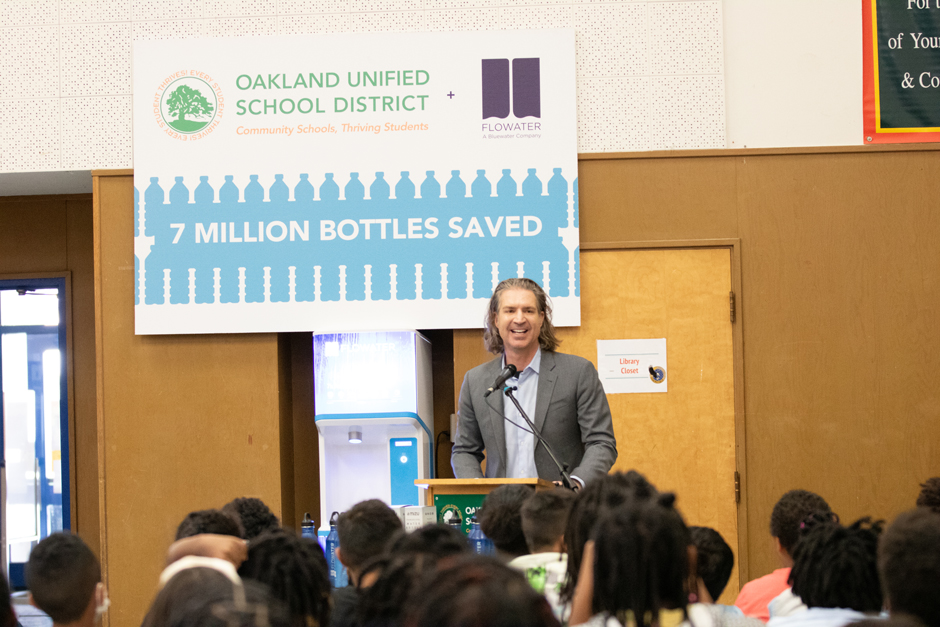
Rich “Raz” Razgaitis speaking at Oakland Unified School District.
FloWater Applications from Columbus, Ohio, to Oakland, California
Beyond Flint, Razgaitis has taken FloWater’s product and science-driven approach across the country. A native of Columbus, Ohio, FloWater recently provided hydration at the Breakaway music festival in the city, which saw tens of thousands of attendees.
Razgaitis explains that in events like Breakaway, where dehydration is common, it is imperative to provide safe drinking water. And, in line with his other goals, Refill Stations also reduce plastic waste that often litters the ground at festivals.
Meanwhile, on the other side of the country, FloWater recently installed 60 new refill stations across the Oakland, California, school district.
Their installation was funded through NBA superstar Steph Curry’s Eat.Learn.Play Foundation, along with other organizations. Razgaitis says this collaboration emphasized that the health benefits of clean, accessible drinking water are just as important as the environmental ones, especially as FloWater continues to expand into new niches.
“We’ve got almost 15,000 customers across the United States, schools, hotels, gyms, and businesses,” Razgaitis says. “Everything from the Oakland Unified School District that has hundreds and hundreds of FloWater systems throughout the schools […] to thousands of gyms where we’re brand standard.”
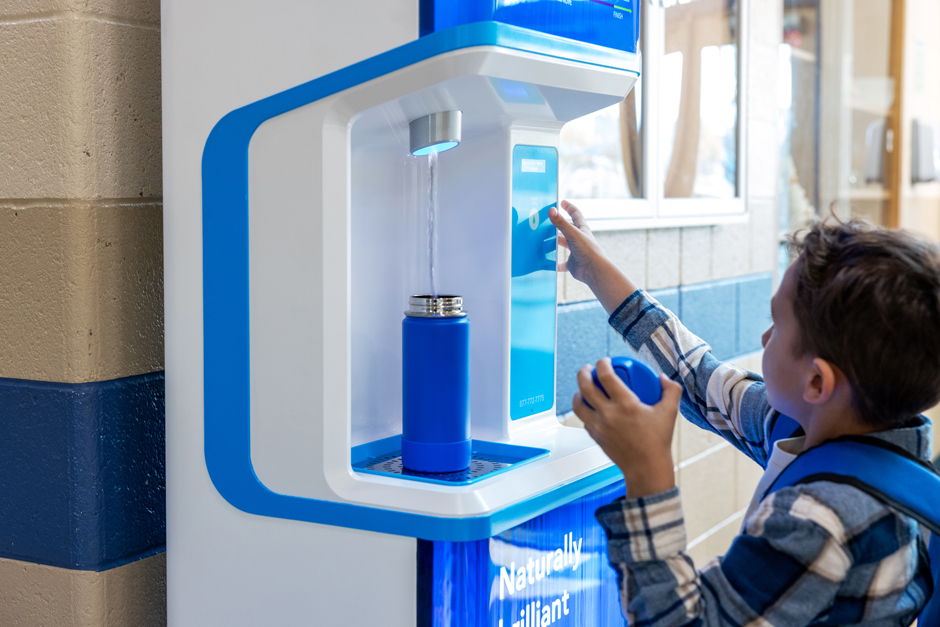
School kids using the FloWater Refill Station
Conclusion
Besides ensuring that the FloWater Refill Stations are rooted in water quality monitoring and science, sharing the story of these benefits is perhaps the most important aspect of Razgaitis’ work. Keenly aware of the societal weariness at the root of the problem he’s trying to solve, Razgaitis also believes in the importance of storytelling.
Without explaining the importance of clean, accessible, and reusable water, he says that the work going into making the filters will be lost. Therefore, using science as his base, Razgaitis continues to spread awareness of the root problems surrounding America’s drinking water.
“You can’t have the world’s best science and technology and not have it meet the market in a way that it resonates,” Razgaitis says.






0 comments