

Testing Beaver Dam Analogs in Pennsylvania
Constructed of natural materials found in the region, beaver dam analogs are a restoration strategy that are often used to improve wetland and groundwater recharge. The dams slow the flow of rivers and streams and limit the transport of sediment, allowing for the above-dam waterway to temporarily flood and redistribute sediment.
During flooded periods, riparian areas soak up excess water and store sediment, which helps restore eroded banks. This improves the resilience of stream ecosystems in response to extreme precipitation and droughts.
Though commonly deployed in controlled areas out West where there is little present-day land use, Susquehanna University (SU) is testing beaver dam analogs at their Center for Environmental Education and Research (CEER) Field Station in one of its ephemeral streams.
Some dams were built wider and lower, depending on channel morphology. (Credit: Matt Wilson, George Saradakis, and Savannah Rhoads, Marketing and Communications / Susquehanna University)
Susquehanna University’s Beaver Dam Analogs
According to Matt Wilson—Director of the Freshwater Research Institute and CEER Field Station at SU—this site was chosen due to its flashy nature. “The stream is almost 100% rainwater, so it just flows whenever there’s a storm and then the water’s gone,” he explains.
Wilson also notes the mix of historical agricultural and newer urban land use upstream that makes the system unique from traditional applications of beaver dam analogs out West.
In such a non-traditional application, Wilson has been working with Siobhan Fathel, assistant professor of earth & environmental sciences at SU, to get the beaver dam analogs installed, as well as monitor conditions in the stream.
The stream has been managed by SU since 2005, and little is known about conditions prior to the university’s acquisition. However, an old consultant report from when the university purchased the land contained photos of the stream, which appeared to flow year-round.
While it’s hard to know for sure, Wilson hypothesizes that the stream appears to be losing groundwater over time. Even in 2019, when Wilson first started working at SU, he had seen the signs of decreasing groundwater.
“There were a few trees right along the bank of the stream that I could watch the soil eroding from and the trees basically standing on their roots,” states Wilson.
He also adds that this kind of flashy stream is not expected for a young forest where the stream is located, and so the beaver dam analogs could give a much-needed boost to the groundwater and improve seasonal flows in the stream.
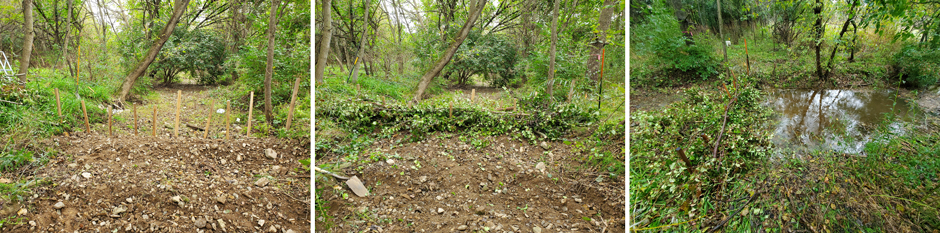
During and immediately after install. A low “ramp” of substrate at the base of the stakes is designed to prevent erosion around the base of the stakes. (Credit: Matt Wilson / Susquehanna University)
Challenges to Building Beaver Dam Analogs
Though Wilson initially pitched the idea of beaver dam analogs in the stream back in 2022, it wasn’t until the following year that they were installed. This was in large part due to permitting difficulties.
“People think of it as risky to try and build beaver dam analogs in dry streams like this because you don’t really know where the water is going to go when you put them in,” shares Wilson.
He continues, “Sure, they let water through, but the whole point is they slow it down so they’re going to push it onto the floodplain and you can model all you want, but it’s probably not going to do exactly what you expect.”
In areas where there is nearby infrastructure, the intentional flooding caused by the dams could be dangerous. At the field station, the only surrounding infrastructure is an access road on one side of the stream, so the team constructed the dams in a way that ideally prevents flooding on that side.
The dams also had to be constructed far enough away from private properties upstream in order to avoid impacting private properties and have total control over the project. In the end, the eight dams were constructed about 200 meters downstream from the private property line.
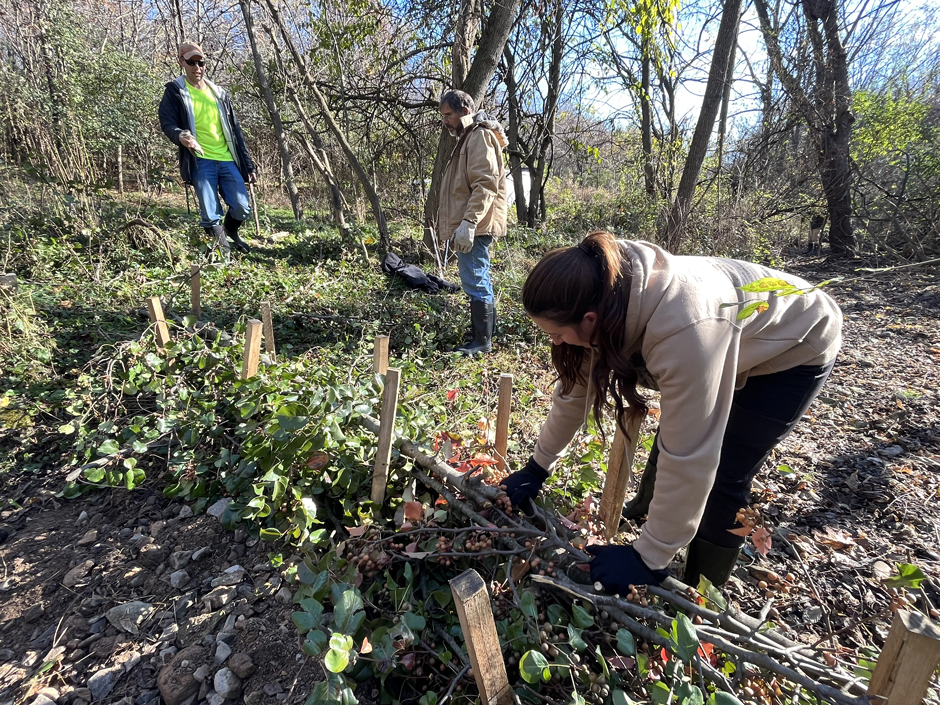
Matt Wilson and Mark Cline weaving Callery pear between stakes during install. (Credit: Marketing and Communications / Susquehanna University)
While putting the dams in a relatively remote area made permitting easier, there was the larger issue of this being the first time beaver dam analogs have been used in Pennsylvania—meaning that there was no established permitting process.
While the project is being done as a restoration initiative, beaver dam analogs are not on the approved list of strategies, which would categorize it as experimental and prolong the approval process.
Instead, Wilson worked with the Pennsylvania Department of Environmental Protection (DEP) to see what would be the best option.
“We looked at the site together and I explained all the measurements we wanted to take, why this was important, and had buy-in pretty quickly, but it was just the actual paperwork side of things,” explains Wilson.
He continues, “So we went back and forth for a while, and then finally, someone from the state actually had the realization, that we were trying too hard to permit this like a restoration project. If you take analog and beaver out of the name– we know how to permit dams.”
In addition to a more standard permitting process, the size of the stream made the process easier. Over the next few months, Wilson worked with the DEP to approve the dam locations.
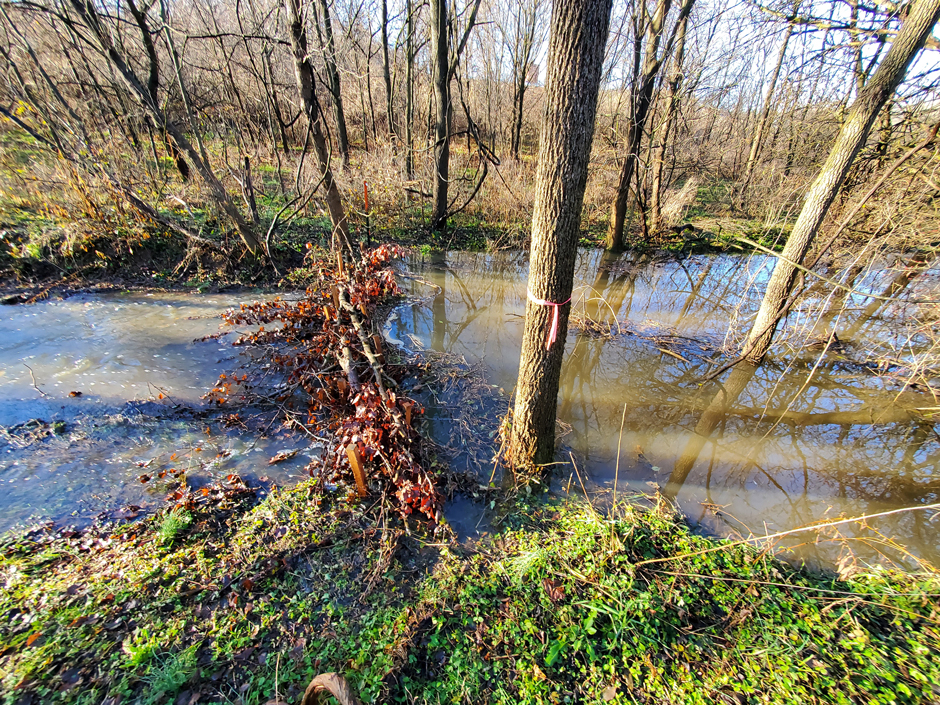
After the first storm, post-install dams were slowing the flow and trapping organic matter. (Credit: Matt Wilson / Susquehanna University)
Building the Beaver Dam Analogs
By the end of 2023, all eight dams were installed, with construction costing only around $500—much cheaper than alternative restoration efforts that aim to improve groundwater recharge and restore banks.
“When you’ve got a highly incised stream like this, you’ve got two options to reconnect it to its floodplain: You can either dig the floodplain down or you can bring the stream channel up,” explains Wilson.
Both digging the floodplain down and dumping sediment in the stream to bring up the streambed can be costly because it requires heavy machinery and replacement materials like aquatic vegetation and sediment.
In contrast, the beaver dam analogs trap sediment that is already naturally flowing through the stream, which will settle on the stream bed, bringing the channel bed back up.
“The more the channel raises, the more water goes into the floodplain during every storm, the smaller the storm it takes to re-engage the floodplain, the more sediment gets trapped, so you initiate this positive feedback loop,” states Wilson.
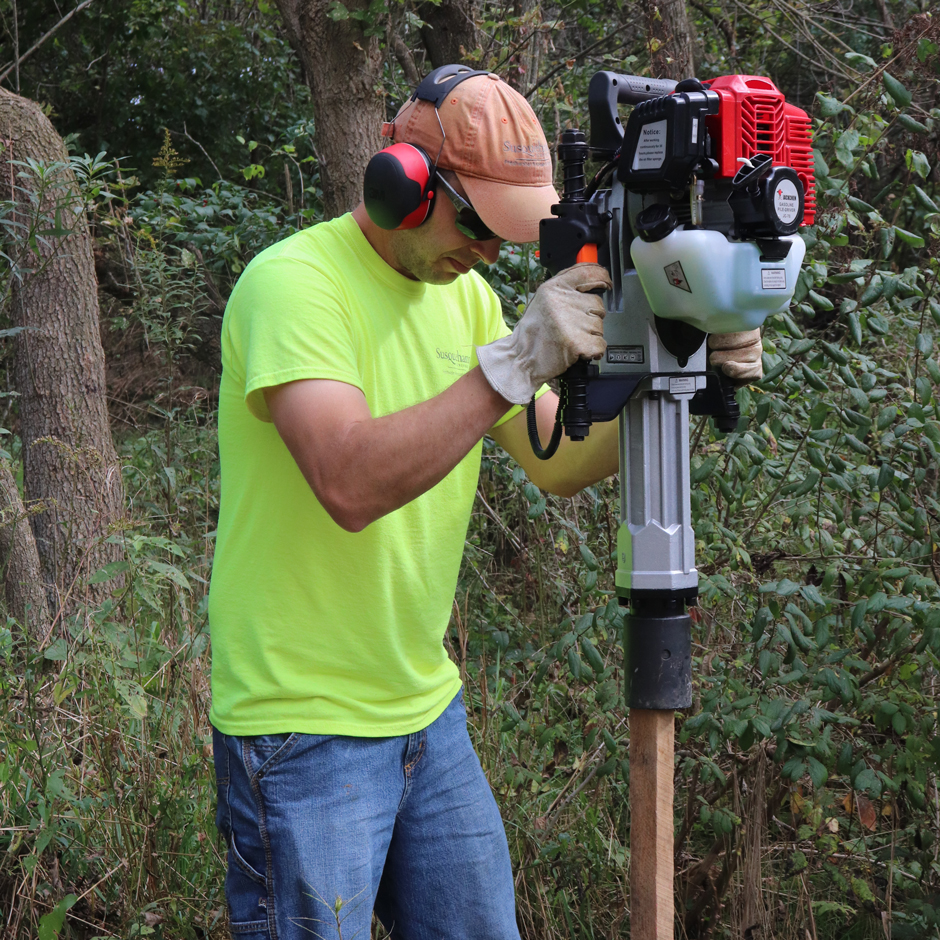
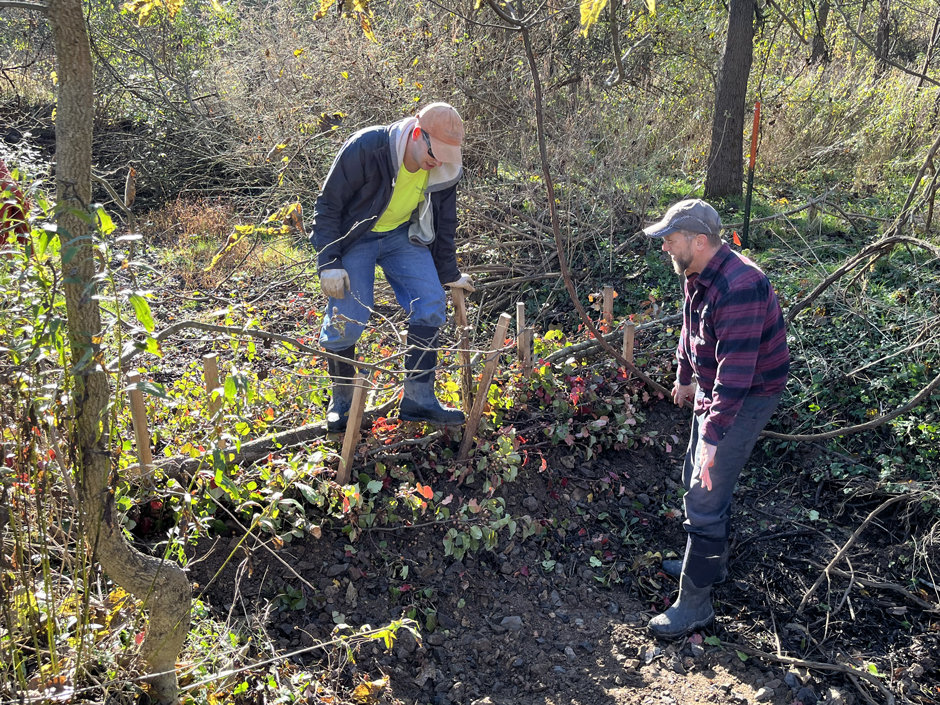
Using post-pounders in areas with larger cobble and difficult substrate for hand tools. (Credit: Dan Ressler / Susquehanna University)
Monitoring the Efficacy of Beaver Dam Analogs
Wilson is hopeful that SU’s beaver dam analogs will inspire other projects in the East if they can successfully restore the stream. The CEER team deployed a “kitchen sink” monitoring approach before the dams were installed and plans to continue to monitor in order to document the stream’s recovery.
The team took transects of the channel upstream of where each dam was installed to establish a baseline before the dams were built. After only 2 years, over 20 tons of sediment have been deposited in the stream.
They have also been using HOBO pressure transducers to create hydrographs for the dams. According to Wilson, the hydrographs have shown some interesting changes.
“It looks like a normal hydrograph where the water slowly starts to go up—like you would normally expect—until it hits the top of the dam, and then it appears to break,” explains Wilson.
He continues, “Once it goes over the top, because you’ve got a lot of water moving at once, it shoots back down the way you would expect, but then instead of a long tail like you would expect, it appears to sink right into the ground.”
Wilson believes that this is happening because the groundwater is so low that the water is being absorbed quickly, which has caused some fluctuations in the inundation period, or how long water remains in the pools above the dams after a storm.
“We’re seeing it retain water for longer over time, which is really good,” states Wilson.
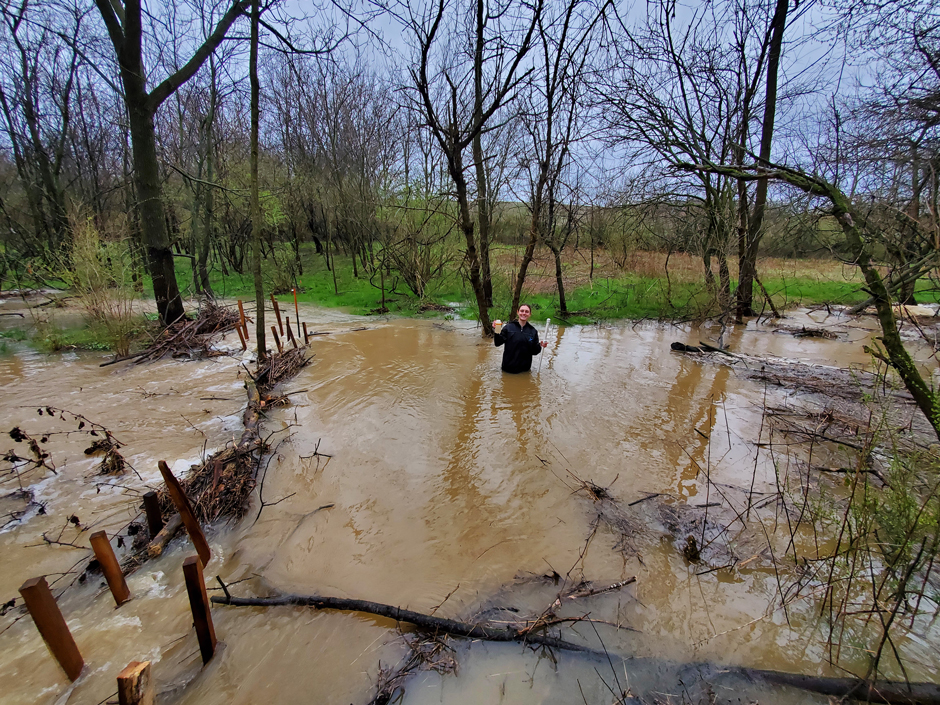
Alyana Krempa sampling water during a major storm with water flowing onto the floodplain behind her. (Credit: Matt Wilson / Susquehanna University)
The team is also using bank pins and scour chains to monitor bank and channel aggradation over time. “The problem is that we have so much sediment trapped that we can’t find any of the chains now, which is a good problem to have,” notes Wilson.
He adds that they will be going out and evaluating the bank pins soon.
As for measuring the groundwater, Fathel will be evaluating the efficacy of the beaver dam analogs by measuring soil moisture in the nearby flood plain.
“Our monitoring focuses on how water moves into and through the floodplain,” says Fathel. “If we see sustained soil moisture after storm events, it indicates the dams are slowing runoff and increasing infiltration, even if we’re not directly measuring groundwater levels.”
The team will continue to monitor the stream and dams with a new project focusing on sampling above the dam during storm events. These samples will be filtered for total suspended solids and analyzed for organic content.
Wilson shares that this project will hopefully answer two questions: How much sediment is being trapped, and is the water receding back into the stream from the flood plain higher in organic content?
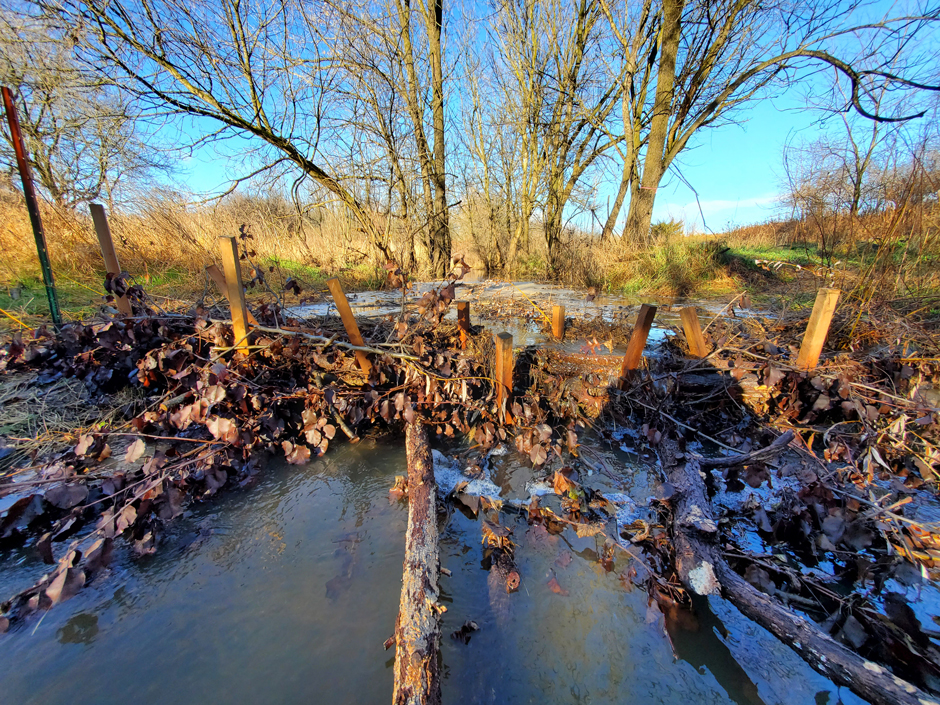
After the first storm, post-install dams were slowing the flow and trapping organic matter. (Credit: Matt Wilson / Susquehanna University)
Getting People to Care About Beavers and Streams
So far, the dams appear to be performing as hoped, and Wilson is excited to see the data. If the strategy proves effective, it could be added to the list of approved restoration strategies to be deployed elsewhere in the region.
“I’m not saying that it’s going to solve every problem everywhere, but having it as an option in the toolbox could be really useful,” he explains.
Personally, he shares that he is excited to see the stream recover and show the public that beavers and their dams serve an important ecological function.
“When you say the word ‘beaver,’ people get a bit nervous because they think that they’re going to chop down all the trees and clog culverts, but narrow and eroded channels are not pristine,” states Wilson.
He stresses that a perspective shift is essential to understanding how important and beneficial beavers are.
“Streams are messy. They want to be in a floodplain—they want to go all over the place and make little seeps and springs and bogs, and you should have these interconnected pools that slowly trickle to each other and spongy groundwater everywhere,” explains Wilson.
He recognizes that changing people’s minds can be difficult, but he is hopeful that he can use the data from the project to help change the minds of those willing to listen.






0 comments