

Tracking Stream Network Changes with Year-round Sampling in the Lamprey River Watershed
Across the United States, a collaborative project among five universities is studying the dynamics of streams as they expand and contract. This increasingly important, but historically underresearched, characteristic of stream flow is being investigated through the Department of Energy-funded QuEST (Quantifying Ecosystem exports across Space and Time) Project.
This collaborative research group originated in New Hampshire, where the coastal lowlands gradually give way to the foothills of the rugged White Mountains. Snaking between the Atlantic Ocean and the 6,000-foot peaks is the Lamprey River Watershed, where the University of New Hampshire (UNH) has set up sensor sites and grab sampling locations to study this important watershed.
Leading the New Hampshire portion of the QuEST project is Associate Professor Adam Wymore, who also serves as the Director of the UNH Water Quality Analysis Lab and the New Hampshire Water Resources Research Center.
Now, his work has led him to the forefront of an important area of stream research. Both perennial and non-perennial (also known as intermittent) streams expand and contract throughout the year, but as climate change increases temperatures and impacts weather patterns, Wymore says these flow dynamics may become more pronounced.
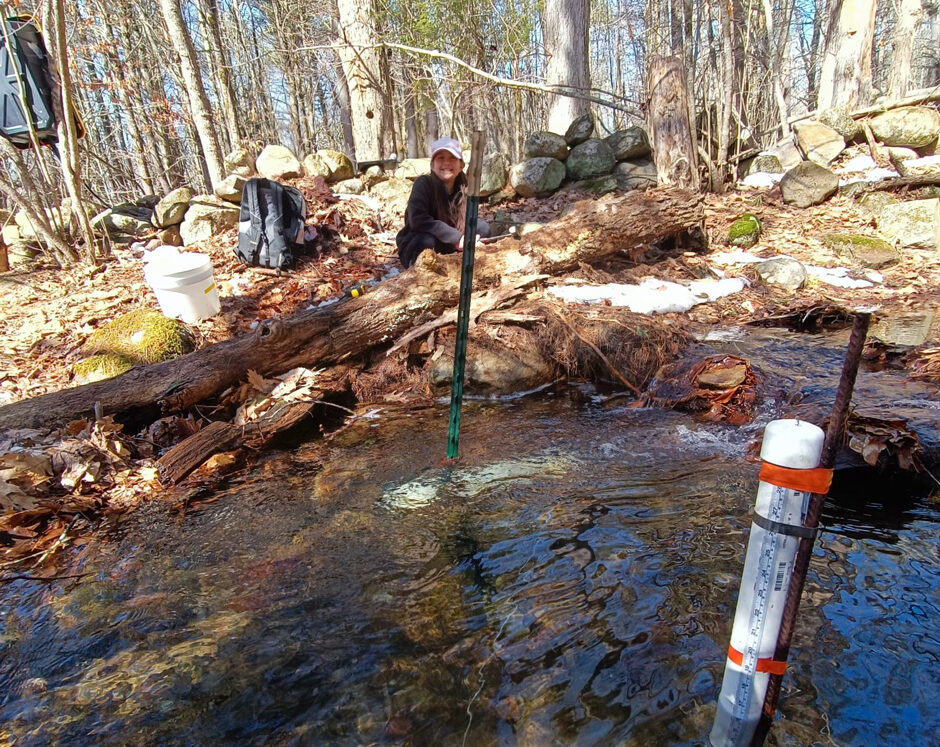
Instrumentation at one of the 1st-order tributary sites (Saddleback Mountain) within the Lamprey River watershed. On river right is a PVC pipe housing a S::CAN spectrolyser. In the foreground, a HOBO pressure transducer and staff gauge are housed in PVC. (Credit: Juan Pesantez).
Stream Network Changes in the Lamprey River Watershed: Expansion and Contraction
The goal of the QuEST project is to understand how nutrient and sediment transport change as streams expand and contract. Wymore says these changes are especially pronounced in headwater streams, the upstream portions of watersheds that dictate the flow of their main stems.
In the Lamprey River Watershed, tributary streams are changing. These once perennial streams are running dry and contracting, and the impact this will have on the rest of the watershed is still unknown.
“That’s one thing that we’re really able to uniquely explore, is a system that is shifting from once perennial to taking on more of an intermediate, intermittent status,” Wymore explains. “Tracking that change in real time is pretty cool and very interesting.”
High precipitation hit New Hampshire in the spring and summer of 2025, but for the past three months, the state has been dealing with a drought. Much of the state is in either severe or extreme drought according to the US Drought Monitor. Now, some headwaters are completely dry. So, Wymore and his students are monitoring a significant inland chunk of the Lamprey watershed to understand how these changes are impacting the entire system.
“In a place like New Hampshire, there’s really no history of this type of stream contraction; there’s no analog to a system changing from perennial to intermittent,” Wymore explains. “And the fact that we can try and capture part of that process and then understand how those dynamics influence downstream surface water chemistry or nutrient delivery to our estuaries is really important, because that is a consistent trend that we’re seeing.”
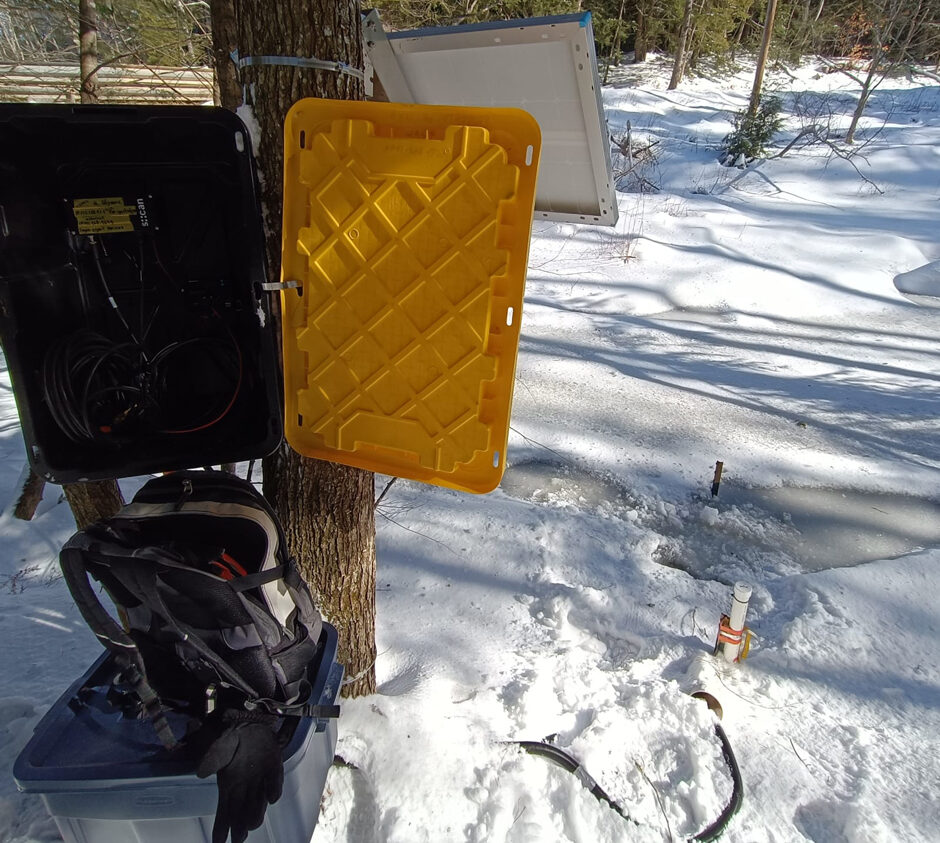
Datalogger and battery charger housed in a box mounted on a tree. Below it, a second box contains a large battery designed to support low-light conditions, such as during winter. Behind the main box, a solar panel supplies energy. Note the frozen river surface, where a PVC pipe holds a HOBO U20 sensor. (Credit: Juan Pesantez).
While these fluctuations in stream flow aren’t common in New Hampshire, they are in the other QuEST Project locations.
For example, in Arkansas, non-perennial streams are common, but haven’t been well researched. Wymore explains that it’s important to understand the difference between these two locations, as New Hampshire watersheds may react differently than places such as Arkansas, where streams experience more flow fluctuations.
New Hampshire also has four distinct seasons, which are quite different from those of the QuEST partners in New Mexico and Nevada. Out west, many streams are snowfed and have always run dry in the winter, so equipment isn’t kept at all sites year-round.
But in the Northeast, Wymore and his team keep their sensors in place all year-round, including through the extreme winter months of the northern latitudes. This not only offers more data points but also allows unique insights into how processes throughout winter impact the downstream movement of solute flow.
Monitoring winter changes is important as New Hampshire is experiencing more rain-on-snow events. The Lamprey River is also in a semi-suburbanized region, which differs from the partner watersheds.
“Are we becoming that type of system?” Wymore questions, referring to the streams his partners are studying, “Or are we off in some whole new ecological trajectory?”
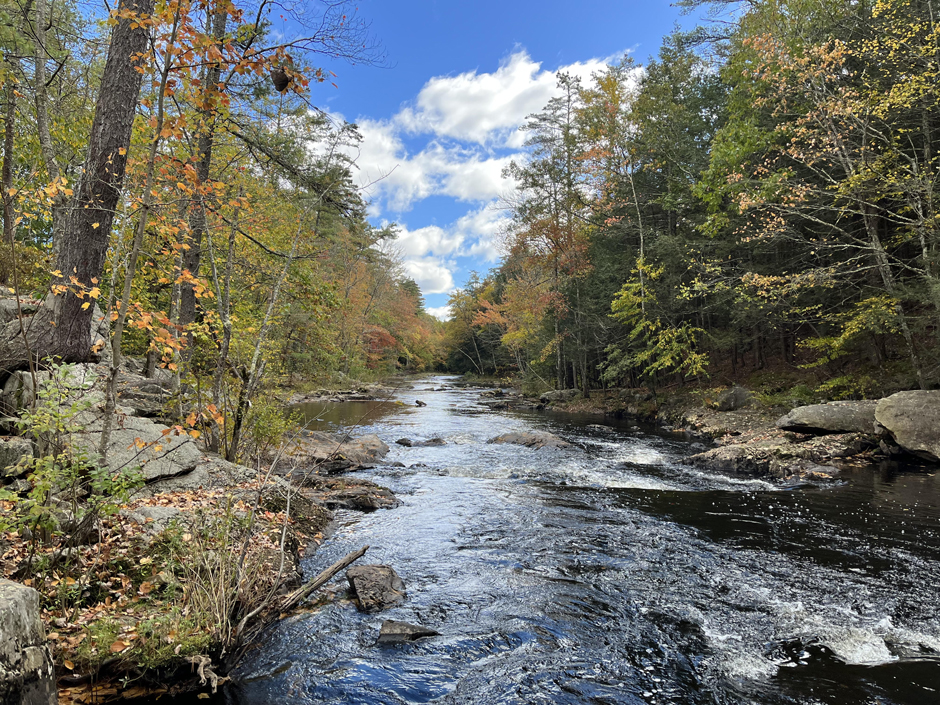
The Lamprey River at river kilometer 27, which is the most downstream site of the QuEST project. (Credit: Adam Wymore).
Monitoring Stream Flow and Water Chemistry
The QuEST Project monitors water quality conditions and stream flow to understand the changes happening in watersheds. A combination of continuous remote monitoring and monthly grab samples is used to get a full picture of watershed conditions.
In New Hampshire, Wymore has set up six remote sensor sites. Each site is equipped with a HOBO U2O water level and temperature logger, a S::CAN spectro::lyser UV-Vis sensor, and a staff gauge.
In the Lamprey River, one site is in the upstream portion, one in the main stem, and two are downstream. The downstream sensors coincide with USGS stations, which offer discharge measurements along with QuEST’s hydrological data.
Wymore explains that the sensor sites collect dissolved carbon and nitrate concentrations. The location of these sites along the Lamprey River, paired with discharge data, allows Wymore to track nutrient transportation in the watershed.
These sensors are calibrated with monthly grab samples at tributary sites within the watershed. All grab samples, from the Lamprey River and from the other universities, are sent to the UNH Water Quality Analysis Lab, where they are analyzed for various dissolved solutes, from ammonium to nitrate to chloride (among others), to understand water quality conditions holistically.
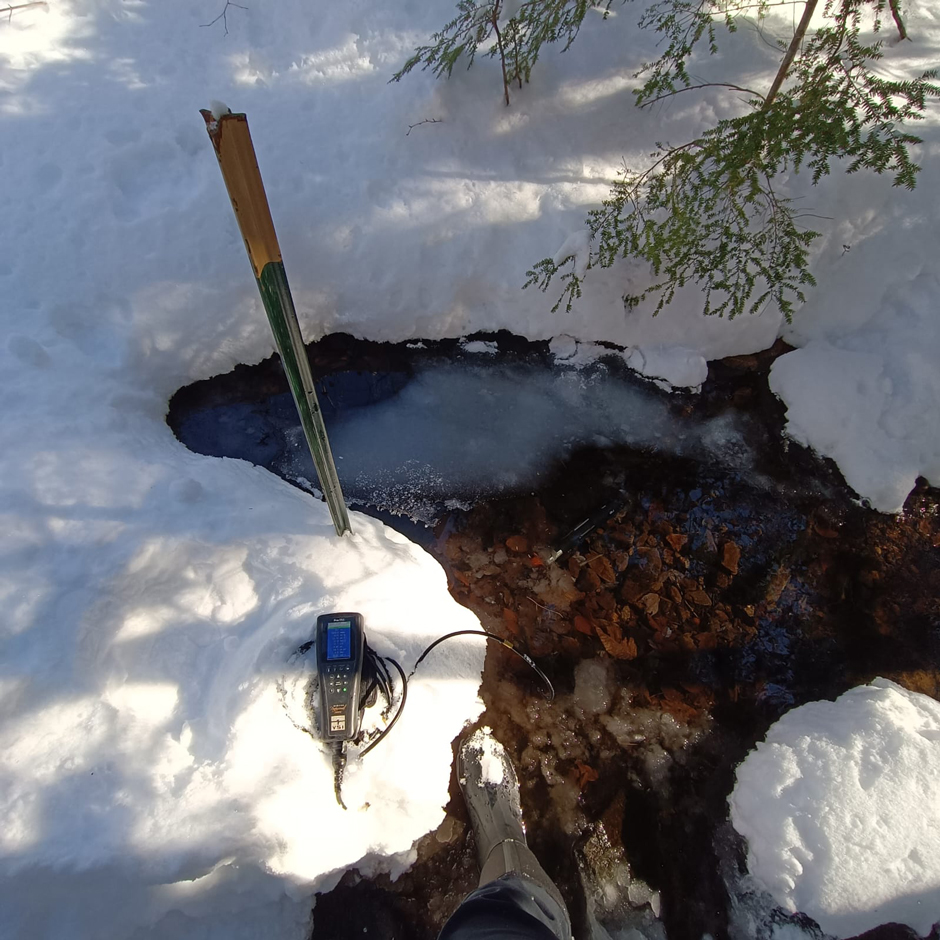
Sampling the Lamprey River during the winter months. Handheld YSI sonde in the foreground collecting physical chemical data. A fence post is used as a staff gauge to record the water level on each sampling campaign visually. (Credit: Juan Pesantez).
Post-doctoral scientist Juan Pesantez adds that, to complete their hydrological understanding of the watershed and its connection with biogeochemistry, they collect stable water isotope samples from both rainfall and streamflow, which provide insights into water age, storage volumes, and the paths water takes through the catchment.
With such a complete picture of their section of the watershed, Wymore also explains that the project can be scaled to larger areas.
“Here’s how the big watershed works and looks, and then we go into our QuEST sensors,” Wymore says. “And you know, here’s how the watershed looks at a smaller scale, look at changes in land use, land cover, watershed size, and how they influence surface water chemistry.”
Stream expansion and contraction are expected to become more pronounced around the world, and just like in New Hampshire, more are expected to dry up and become intermittent. This means that the QuEST project is positioned to collect important baseline data for a water system that will likely become more common in the future.
“You have to know what your baselines are, you have to know what is natural variance, and you need, therefore, to be able to identify when a system is moving out of that background level of variation,” Wymore explains.
Ultimately, Wymore says that the QuEST project is building a large, long-term data set about stream expansion and contraction. With projects across the country at different climate gradients, he believes the project is well-equipped to provide baseline data for stream intermittency that can be scaled around the country.
Across the different universities, sensors have been in the water for less than two years. However, Wymore says that the first round of data analyses is currently under way and with that, the data will be compiled and made publicly available, initiating the start of the long-term knowledge base.
“Long-term data sets are the only way that you can capture this kind of change,” Wymore explains. “The type of change we’re talking about is a relatively slow phenomenon. You’re not going to capture it with a year or two of study; you have to have decades worth of data.”
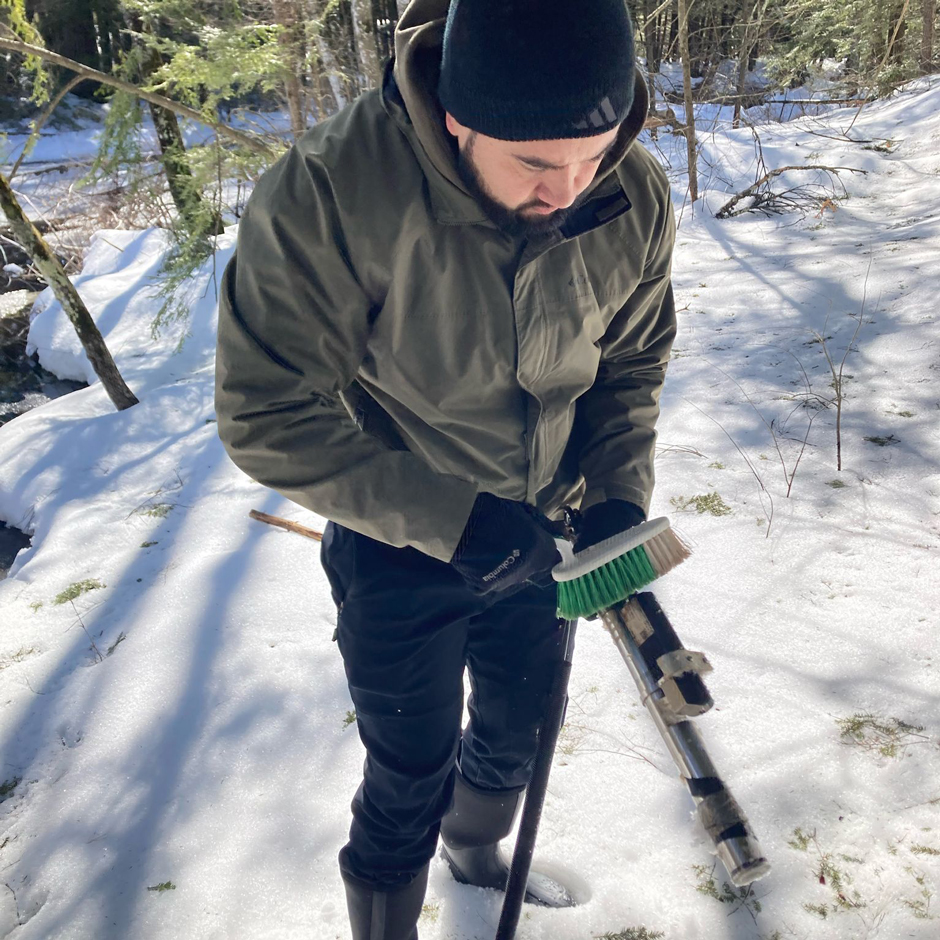
Post-doctoral researcher Dr. Juan Pesantez cleans a S:: CAN spectrolyser during the winter field season. (Credit: Adam Wymore)
Looking to the Future
Long-term datasets won’t last, however, if there aren’t new researchers to carry them into the future. For Wymore, training the next generation is an important part of the QuEST Project.
“It’s an opportunity to provide research opportunities for new graduate students and post-doctoral research, to pull in new people, new students, into our program,” Wymore explains. “So there’s sort of a multi-generational element too.”
In fact, QuEST began as a way for students and early-career researchers to share their work during the COVID-19 pandemic. Without the opportunity to travel, Wymore and dozens of other colleagues from universities around the country teamed up to host virtual conferences about new research in stream hydrology and water quality.
Even as restrictions eased and students could once again share their research in person, several colleagues stuck together. Wymore spearheaded the effort, and united by the goal of getting students involved in studying stream flow dynamics, the QuEST Project began.
“[It’s] a real fundamental part of what we do, and why we do it, is to give opportunities for students to come into our programs, to learn how to run high-end analytical instrumentation, and how to operate sensors in the field,” Wymore says.
Between grab samples, sensor measurements, and data analysis, the project offers plenty of opportunities to conduct environmental monitoring and water quality analysis. And, still under two years old, the QuEST project has only just begun to unravel how changes in stream flow and size will impact their surroundings.
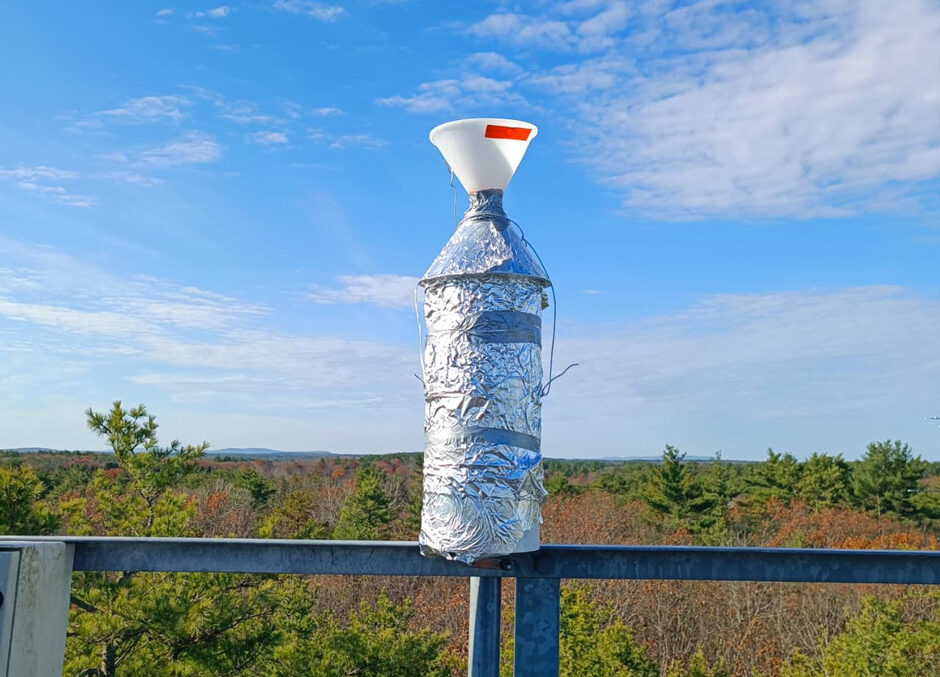
A stable water isotope collector on top of a 30-meter tower at Thompson Farm, New Hampshire. (Credit: Adam Wymore).





0 comments