

Research and Conservation: Understanding the “Outsized Influence” of Intermittent Streams
It’s a chilly winter’s day in northwest Arkansas, and several University of Arkansas students trudge to an intermittent stream frozen over with a layer of ice. They bring normal water quality sampling equipment with them, and something else: a sledgehammer to break through the ice.
The cracks ring out across the streambed, and eventually, they can access the water rushing beneath. They measure a host of parameters, from dissolved oxygen to water temperature, before packing up and heading to another site.
They have 20 sites to sample from, and one day to collect them. Hopefully, they won’t have to use the sledgehammer on all of them.
The streams they’re sampling from are unique, as only a few months ago, they were dry. The students are studying intermittent streams, those that only flow for part of the year.
During the hotter months, these intermittent streams cease flowing, leaving behind only pools of water, or sometimes nothing at all. Even in these months, students will take samples in the still pools and continue sampling throughout the year, as the ice melts and the flow increases in the spring.
Their work is led by Assistant Professor of Water Quality, Shannon Speir, and is part of a nationwide project focused on understanding these under-researched ecosystems and describing the “outsized influence” they seem to have on their downstream ecosystems.
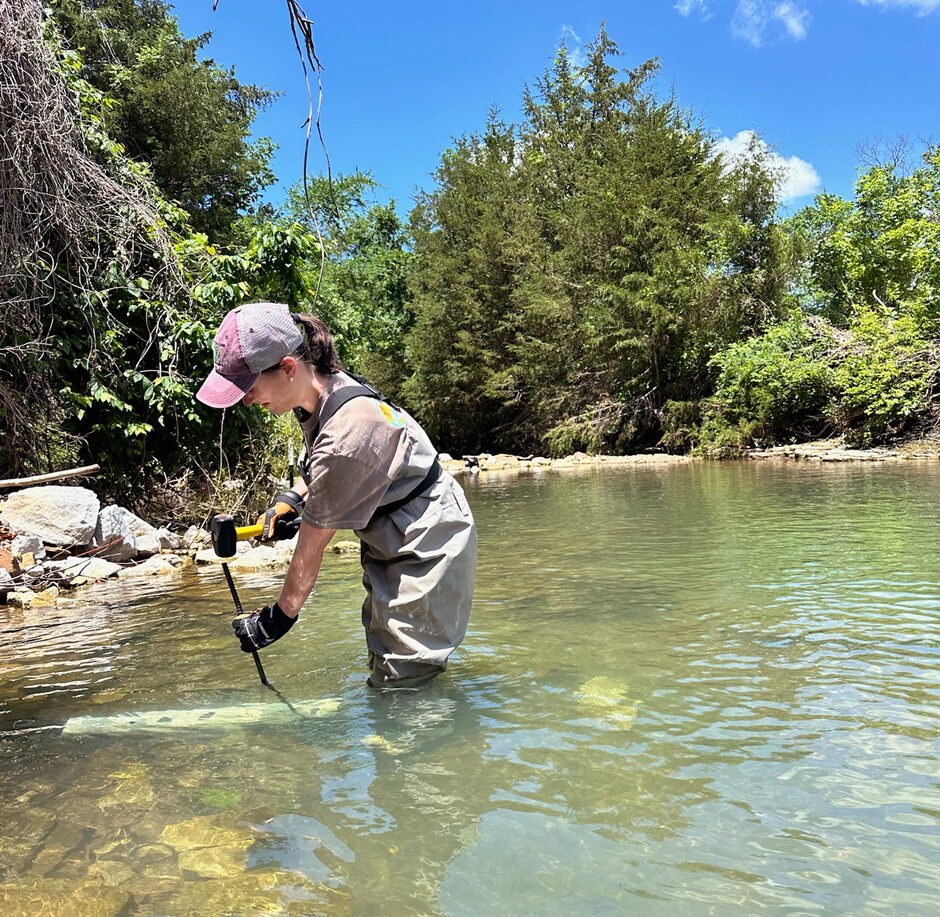
Undergraduate, Auldyn Faulk, ensures one of the Speir Lab’s s::can spectro::lysers is secure and clean during a routine maintenance visit. (Credit: Karessa De La Paz)
A Nationwide Project Studying Intermittent Streams
Intermittent streams make up over 50% of the nearly 400,000 miles of streams in the United States, according to the US Environmental Protection Agency. Yet, because of their inconsistent flow, Speir says that they’ve been historically ignored in scientific research.
“We’ve really started to recognize that these systems actually have an outsized influence, when they are flowing, on water quality downstream,” Speir says. “But there’s not really a lot of foundational work that’s been done on them to really understand, ‘How important are they?’”
That is what Speir’s lab is working to uncover, along with universities in New Hampshire, Alabama, New Mexico, and Nevada. The five labs are part of the Quantifying Ecosystem transport across Space and Time (QuEST) project, which is researching how intermittent streams shape landscapes as they expand and contract.
The project is funded through the Department of Energy’s (DOE) EPSCoR Grant, which offers funding to “accelerate research in underfunded states,” according to Speir. All five of the states involved are considered underfunded by the DOE.

Caroline Anscombe (right), Kathleen Cutting (middle), and Alana Strauss (left) sample nutrients and measure water quality parameters with a YSI ProDSS below a culvert in Brush Creek. (Credit: Shannon Speir)
In Arkansas, Speir’s project focuses on the transport of water, energy, and nutrients. Specifically, she’s interested in understanding how intermittent streams expand and contract, how they move nutrients and impact water quality within a watershed, and how they impact the surrounding ecosystem.
“For me, it’s really about extending this knowledge about when the streams turn on and turn off, and what that does to nutrients, into, ‘Can we figure out how to target specific areas for different types of conservation?’” Speir questions.
The lab’s 20 sites give her a snapshot in time of water quality parameters across the watershed. On top of this, she has three nested sensor sites on the main stem of the Bush Creek watershed, which take water quality readings at the headwaters and outlet.
The 20 watershed sites are sampled monthly with a YSI ProDSS and OTT Hydromet flow meters. Data from the longer-term sensor sites is recorded continuously, taking readings every 15 minutes, with Solinst loggers, YSI EXO2 sondes, a HOBO weather station, spectrolysers, and a NexSens X-Series datalogger.
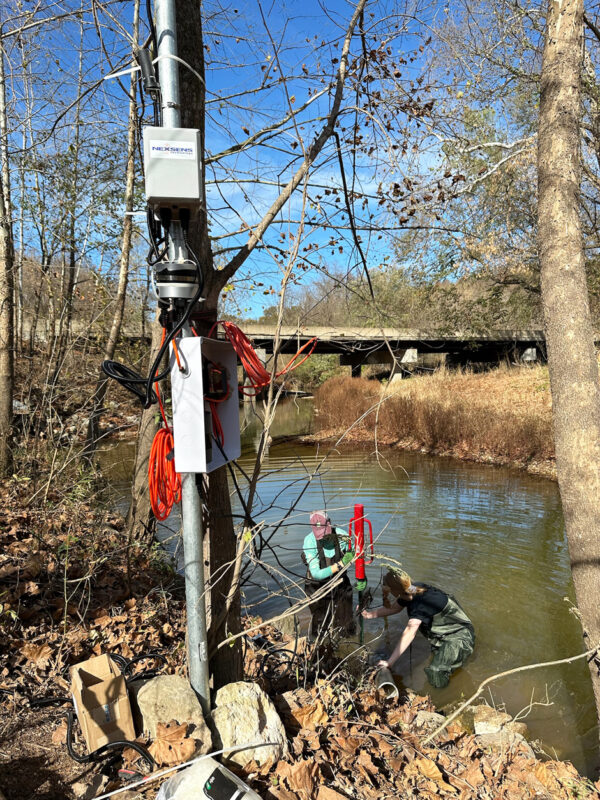
Karessa de La Paz (left) and Kathleen Cutting (right) install the Speir Lab’s telemetry setup at the Brush Creek outlet. The setup includes a Nexsens data logger, s::can spectro::lyser, a YSI EXO2 sonde, and a vented pressure transducer. The sensors measure every 15 minutes and transmit data live to WQData LIVE. (Credit: Shannon Speir)
As the intermittent streams expand and contract, becoming more and less connected, her lab is taking note of the water quality at different sites.
With nested sensors at the headwater, middle, and outlet, they can determine where water quality parameters may be changing within the watershed. This combined approach lets her understand how intermittent streams move nutrients and sediment through an ecosystem, and where that movement occurs.
“So what our project is looking at is how, as a stream network expands, […] how does that change how nutrients move downstream?” Speir explains.
The project is still new, so there aren’t many results. Yet, Speir says that preliminary findings show that when the stream network contracts, there is reduced nutrient export.
With her sensors only having been in the field for a year, and the QuEST Project itself only two years old, there is still much to learn about how these sporadically flowing streams function. Yet, Speir already knows that she’s studying a vital ecosystem component.

Alana Strauss walks along the stream, preparing to conduct a “salt slug” to measure stream discharge in Brush Creek. Solinst LTC loggers will measure stream conductivity every. (Credit: Kaitlyn Feld)
Why are Intermittent Streams Ecologically Important?
Despite comprising the majority of stream miles in the country, Speir says intermittent and non-perennial streams aren’t federally protected under the Clean Water Act. Currently, a stream must flow all year to qualify.
Nonetheless, intermittent streams still shape the landscape. While the specific details of when and where are still unknown, Speir knows that these streams carry nutrients and move energy throughout ecosystems when they are flowing.
And, even when dry, Speir says they often leave behind pools of water that can be a habitat for aquatic wildlife. In fact, the ecosystem role these streams play when dried up may be just as vital as when they’re flowing.
“They’re everywhere, and that’s also what makes them potentially super important,” Speir says. “That’s a lot of river miles to be made up of streams that don’t flow all the time.”
What’s more, Speir and other researchers believe the number of streams classified as intermittent may increase with climate change. Speir states that several global-scale research papers have predicted that stream intermittency will increase significantly as temperatures rise in the future.
“I think it’s a pretty good chance that we’re going to see a lot of places that used to flow year-round start to stop flowing at some point in the year,” Speir says.
Meaning that Speir and others in the QuEST project find themselves spearheading a field of study that will only become more important as time passes. With the number of these streams likely to increase, understanding how to protect them and the ecosystems they flow through is paramount for Speir.

Caroline Anscombe, a recently graduated master’s student in the Speir Lab, measures dissolved oxygen, conductivity, turbidity, and temperature with a YSI ProDSS below a culvert in Brush Creek. (Credit: Shannon Speir)
Conserving Intermittent Streams
Speir’s work on intermittent streams doesn’t stop at understanding their role in the ecosystem; she’s also invested in their conservation. Before they can be broadly protected, research like Speir’s must understand both the importance of these streams and what features indicate conservation is needed.
“[We’re] trying to figure out how we can identify features of the landscape, or of these intermittent systems, that are translatable to similar watersheds locally,” Speir says. “Which can then inform how we target and implement different types of conservation.”
Her lab’s work is guided by the foundations of translational ecology, which she calls the “idea of turning your research into actionable outcomes.” This double-headed approach of researching and conserving intermittent streams is the only way Speir could imagine approaching the project, as she doesn’t want her work to exist in a vacuum.
“I feel like we’re at a place, globally, where I shouldn’t be doing research that just purely satisfies my curiosity,” Speir says. “I’m obviously very interested in what I do, but I want it to have a ‘greater good’ component.”
Because of how common intermittent streams are, Speir says that understanding these systems touches many other facets of ecology and conservation. In the rural fields near the University of Arkansas, these streams run through agricultural land, providing water sources and transporting agricultural runoff downstream.
Moreover, Speir says that these streams and their pools offer a unique aquatic wildlife habitat, preserve biodiversity, and boost drinking water supply. Despite the obvious need for more research, Speir does not doubt that intermittent streams are vital parts of any ecosystem through which they flow and dry up.
“As scientists, we need to do better at emphasizing, to really convey that these are important systems,” Speir says.

Kathleen Cutting, the Speir Lab’s program associate, walks into the center of the channel at the outlet of Brush Creek to measure total suspended sediments. (Credit: Caroline Anscombe)
Conclusion
Despite not flowing year-round, intermittent streams appear to play essential ecosystem roles. And, with the likelihood that more streams will become intermittent in the future, the QuEST project is positioned at the forefront of an important area of research.
Conservation and restoration strategies are on Speir’s mind, and she sees the application of their research as important as the research itself.
“I’m not sitting here being like, ‘I’m gonna change the whole world,’” Speir says. “But I’m doing my best to make my research actionable,”
Actionable research will guide Speir’s work as she continues sampling intermittent streams in rain, shine, or frozen conditions.

The Brush Creek watershed when dry (left and wet (right). (Credit: Shannon Speir)






0 comments