

Washington’s Expansive Air Quality Monitoring Network Aids Public Health
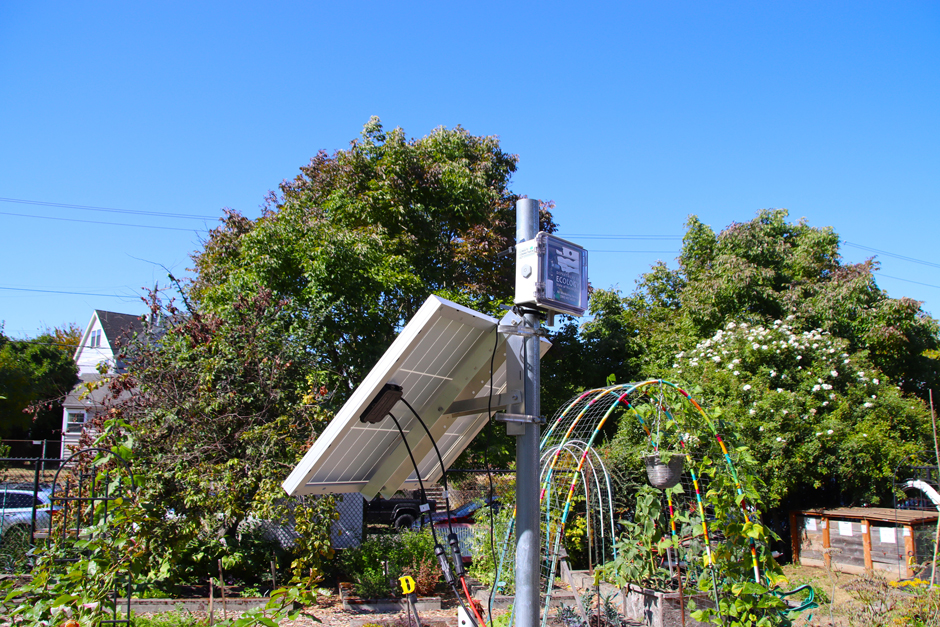
A low-cost in-house air quality monitoring device (called a SensWA) installed near a community garden. (Credit: Washington State Department of Ecology)
Washington is a large state with a variety of ecosystems, stretching from lush rainforests and towering mountains in the west to vast grasslands and deserts in the east. The state’s nature is important for its 8 million residents, who rely on many different ecosystem services.
An important ecosystem service is air quality, which is monitored in the Evergreen State by the Washington State Department of Ecology (Ecology). This is especially important in Washington and many areas in the American West, where wildfires pose a risk to air quality.
Wes Davis is an environmental specialist within Ecology’s air quality program, and he helps maintain a network of air quality sensors across the state. Hundreds of instruments, from large BAM sensors to low-cost ambient monitors, have been placed around Washington to collect and transmit data. And in a state with vast swings in air quality, maintaining this network is vital.
A low-cost in-house air quality monitoring device (called a SensWA) installed near a community garden. (Credit: Washington State Department of Ecology)
Washington’s Air Quality Monitoring Network
Davis explains that Ecology has created a network of dozens of air quality monitoring stations.
The Ecology department collects data, sets guidelines for this network, and operates a state-wide telemetry system, but works with regional offices, Tribes, and local agencies to maintain the network.
“Data is collected on site by our logger nodes […] and then all of the data on the Washington network is collected via data logger and then transmitted back to our central database here in HQ,” Davis says. “And then from there, it’s streamed to the public or used for research purposes.”
The public can find the monitoring sites and access their data through Ecology’s air quality monitoring map, which shows the calculated Air Quality Index for each site. This index is calculated using the rolling 12-hour average of the most hazardous pollutant at each site.
“It’s a convenient way to communicate to the public the most present hazard that they should make decisions based upon,” Davis says.
Davis himself works as a repair technician, often fixing faulty instruments at Ecology’s headquarters near Olympia or troubleshooting with regional operators, helping to keep the statewide system functioning.
“That may be replacing a component, that may be a system coming back to the lab for repair. It may be, depending on the situation, traveling to a site to swap in a new instrument or to perform a repair in the field,” Davis explains. “It’s very situation-dependent.”
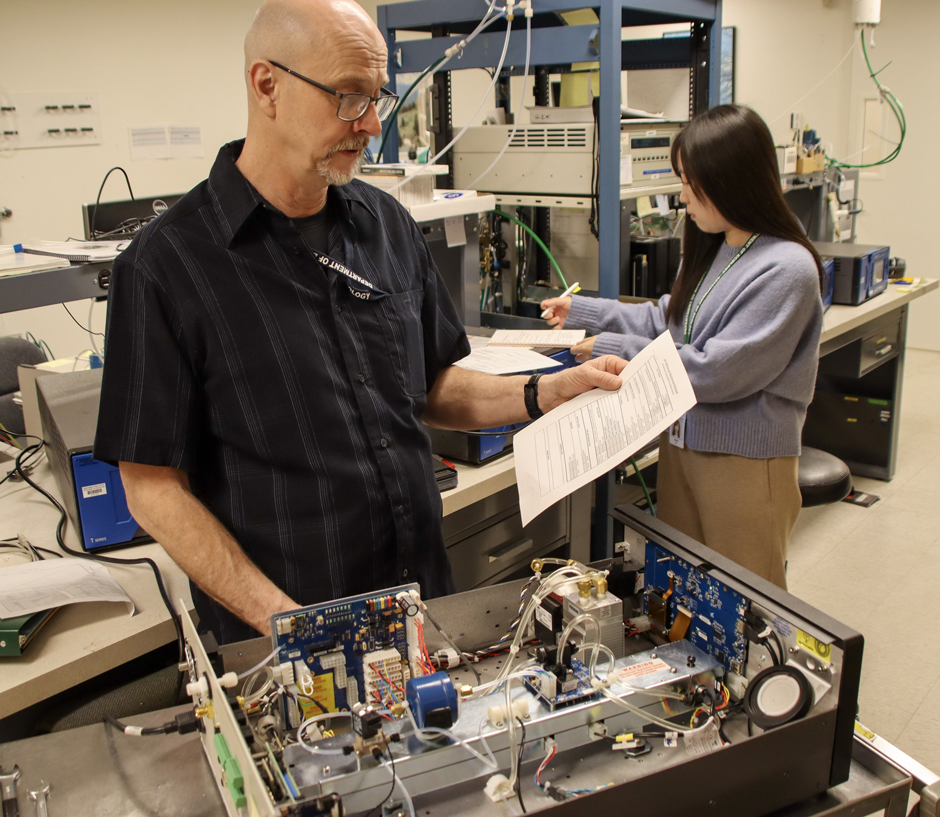
Davis’s colleagues, John Wolbert and Qianna Xu, performing seasonal maintenance on an ozone monitor. (Credit: Washington State Department of Ecology)
With dozens of sites across the state, the instrumentation will differ, and Davis works with many different sensors. However, he says that several of the same basic parameters are measured at each site.
The primary air quality indicator that the Ecology department measures is fine particulate matter (PM2.5). Davis explains that ambient air is continuously sampled, filtered, and measured for an ambient mass concentration of PM2.5. Some sites also contain instruments that measure concentrations of gases like ozone, carbon monoxide, and nitrogen oxides.
Davis says that background weather conditions are also measured at most sites, along with air quality. Air temperature and pressure are recorded with ambient sensors, and Vaisala anemometers measure wind speed and direction.
“It’s context for what we’ll see from the instrumentation,” says Davis, explaining how weather conditions can help Ecology understand why they’re seeing certain air quality trends in certain places. “We operate across a very wide variety of localized environments and climates, and that all comes into play.”
Despite sites located across the state, they’re not evenly spread out. Davis explains they’re often located in population centers, with less out in Washington’s vast wilderness.
“These sites are typically going to be located at something like a fire department, a school, a library, a police department, a public partner that we can rely on for the foreseeable future,” Davis says.
Therefore, both local weather and geography play a role in air quality measurements. In Seattle, the releases from various industrial processes mean Ecology analyzes filter samples for organics and metals. Meanwhile, in the eastern part of the state, the arid landscape may cause dust contamination within the instruments.
Even with the challenges of maintaining such a large air quality monitoring system, Ecology employees know the benefits are important.
Taylor Van Cise, the Air Quality Program’s communications manager, says their monitoring network is most vital during the wildfire season, when fires hundreds of miles away can still impact Washingtonians.
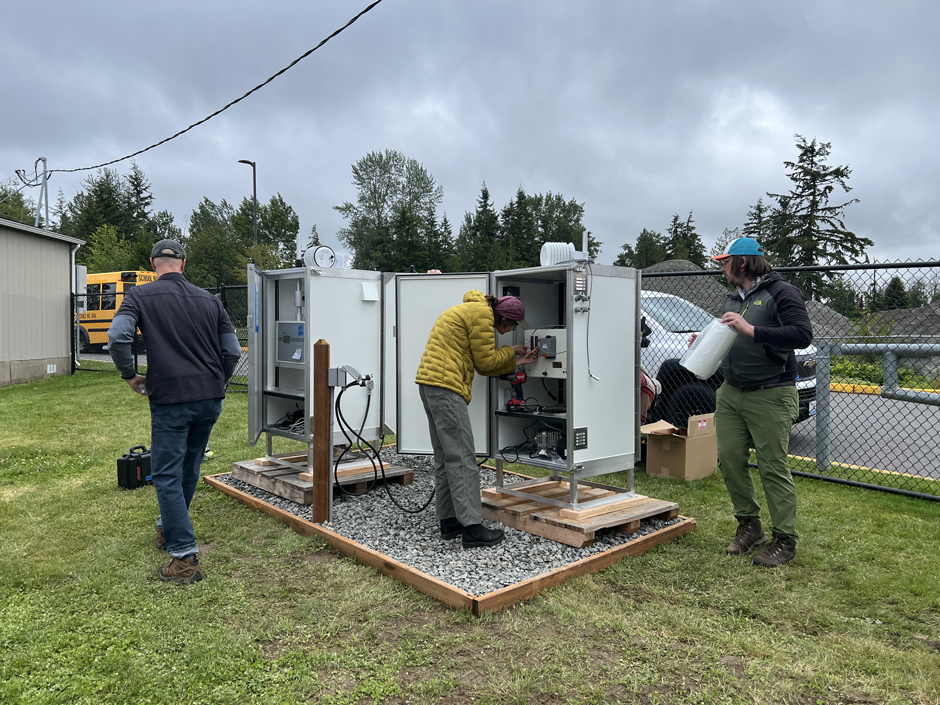
A crew from the Northwest Region Office installing equipment at a monitoring site. (Credit: Washington State Department of Ecology)
Air Quality Monitoring During Wildfire Season
Washington’s wildfire season often runs from June to October, according to the state’s Emergency Management Division. Van Cise says this is when their network is most utilized.
“When we have a bad wildfire season, we’re seeing maybe a million visitors a summer on that map. And that’s just directly to that link, it’s not necessarily the shared view of it elsewhere,” Van Cise says.
He explains that other organizations use Ecology’s data during this time. State divisions like the Department of Natural Resources link to their page, and local news stations will use the data for weather forecasts.
With such high usage in the summer, Davis says the Air Quality Program changes its routine. He’ll still fix instrumentation as needed, but bigger projects are pushed to the side to prioritize keeping the website up to date.
“Those times of year where we’re seeing higher values, we effectively treat that data as more valuable because it’s more likely to affect people’s health,” Davis explains. “So, we’ll push off decisions to do maintenance or swap out a system, which gets pushed off to a certain time of year.”
That certain time of year is the winter and spring, or the non-wildfire season. Van Cise and Davis both understand and enjoy the fact that Ecology’s Air Quality Program is extremely public-facing.
Even if wildfire season is when most Washington residents utilize the air quality index, the monitoring system operates year-round, backed by a powerful telemetry system.
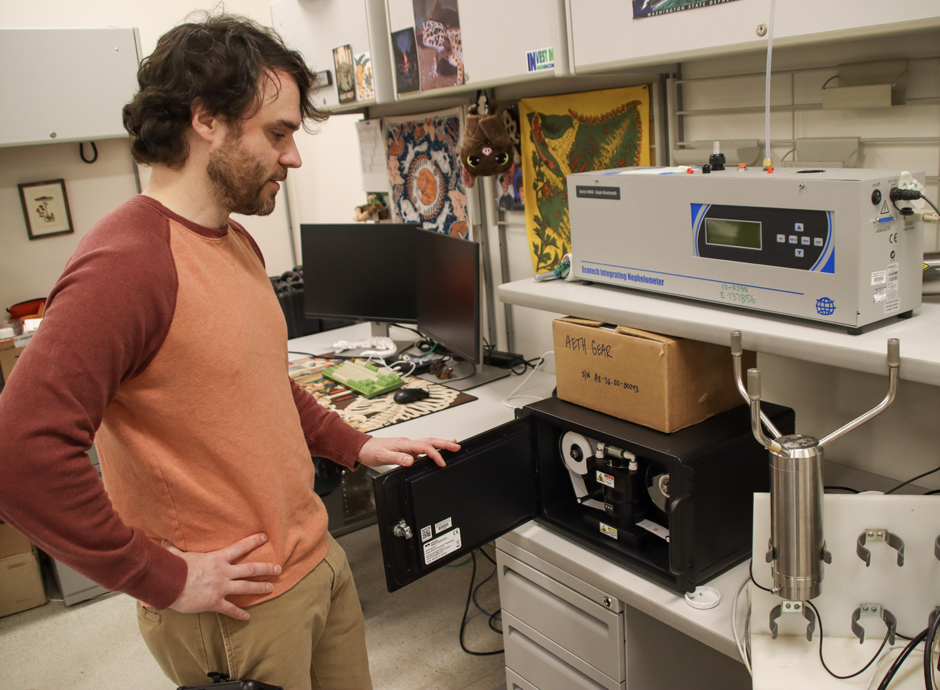
Ecology’s Wes Davis examines an aethalometer, used to measure black carbon. (Credit: Washington State Department of Ecology)
Air Quality Monitoring for Public Health
Davis says the Air Quality Program can operate such a large network because of the benefits of remote, continuous monitoring.
“It lets us generate data while we’re sleeping,” Davis says. “It’s a lot of work to get things set up, but once you get them set up, it’s a very efficient way to generate a lot of data.”
Many of Ecology’s regional partners only need to check on their local sites once a month, though some higher traffic areas, like Seattle, go out more often.
Davis says these local operators are key to ensuring the entire network runs smoothly, and their experience is especially useful in more remote areas.
“The local expertise of our operators is so important because they have that knowledge and experience, and they know their sites better than anybody,” he says.
Ultimately, Davis says he enjoys working with a monitoring network that impacts millions of Washington residents. He likes that the vast network is targeted toward high population centers and that the system can run 24/7 without intensive maintenance.
Although wildfire season is when most Washingtonians think about air quality, Davis likes working with a team year-round that can supply important public health data.
“I’m really proud of the work we do, and I think we generate a massive amount of value to the public.”
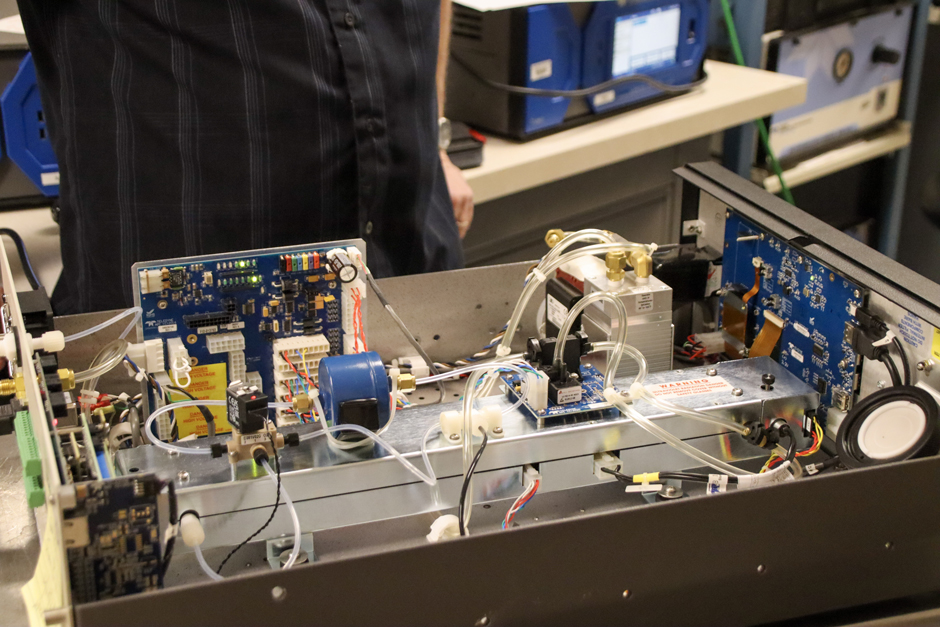
The interior of an ozone monitor used by Ecology at its flagship Seattle station. Operators maintain the pump and other components ahead of the summertime ozone season. (Credit: Washington State Department of Ecology)





0 comments