

Water Quality Monitoring in the Wisconsin Northwoods
In the Northwoods of Wisconsin, the summer mornings creep serenely over a forested landscape checkered with freshwater lakes and streams. In the early light, limnologist Carol Warden wakes and gets ready for the day. Her office is the Northwoods, a perfect place for limnology, especially considering it has one of the highest concentrations of lakes in the entire world.
She arrives at the University of Wisconsin’s Trout Lake Station by 8 a.m., early enough that the lake surfaces may still be calm. Warden meets with a team of other station researchers, and they head out to a nearby lake to collect fish samples. Identifying, measuring, and weighing each fish they collect in the nets, their day stretches long into the afternoon.
As the late summer sun begins creeping toward the treeline, they return to the station where lab work, or, sparingly, some rest awaits. As night falls upon the Northwoods, Warden may find herself back on the water, conducting electrofishing surveys until 2 a.m. On another night, she will travel to a local community center to discuss how wildlife benefits from shoreline habitat restoration.
The rustic Trout Lake Station is nestled in the Wisconsin Northwoods, where the wilderness is a backdrop for devoted researchers working to understand the waterbodies that dominate the landscape.
Sample methods include the collection of physical parameters such as water temperature and dissolved oxygen, biological parameters such as zooplankton and chlorophyll, and they also collect a whole suite of water chemistry. (Photo Credit: Carol Warden.)
Long Term Ecological Research Stations
In 1981, two researchers from the University of Wisconsin-Madison founded the Trout Lake Station as part of the Long Term Ecological Research (LTER) network. The network includes dozens of other research stations across the country where long-term monitoring is supported by National Science Foundation grants.
Trout Lake was one of the network’s original sites. Nowadays, seven different lakes are part of the long-term monitoring project in Wisconsin, and water quality parameters like temperature, dissolved oxygen, and sedimentation rates are measured alongside biotic factors like zooplankton abundance and algae presence.
Warden has been involved at the station since 2010, and in 2021, she took over as one of the lead researchers for the long-term monitoring project.
“Over the last 45 years, there’s only been the four of us collecting this data through time,” Warden says. “So I think that speaks volumes to the type of work and the passion that we have towards learning about our fresh water and how to protect it.”
Since its start in 1981, the station has expanded beyond its original mission. Today, dozens of researchers use the station to access the many water bodies in Wisconsin’s Northwoods. From studying macroinvertebrate responses to shoreline restoration to hosting undergraduate summer research projects, the Trout Lake Station is a hub of aquatic research.
And supporting nearly every project are decades of long-term monitoring that have characterized these lakes. Warden appreciates how her work offers background information to the other projects at the station and explains that it also offers insights into the local ecosystem that would previously go unnoticed.

Paul Schramm, a research scientist with UW Trout Lake Station’s Long Term Ecological Research project, downloads data from an instrumented buoy on Trout Lake in Northern Wisconsin. (Credit: Carol Warden)
“A lot of projects set up through, say, the Department of Natural Resources or things like that, or university projects, are short-term,” Warden explains. “A graduate student is on a project for maybe five years, and they learn a lot in that time, but we didn’t have a good vessel for seeing those super long or even medium long trends.”
But now, they do. Warden and another colleague are fully committed to the long-term monitoring. During the spring, fall, and summer, they take temperature and dissolved oxygen profiles of the lakes every two weeks with a YSI ProDSS Multi-Parameter Water Quality Meter.
Water chemistry samples are also taken to understand the abiotic factors in these lakes. To conduct sampling in the field, Warden and her team use Geotech filter capsules to filter on-site.
Meanwhile, in the background, lake buoys continuously record water quality parameters, which are downloaded daily and added to a long-term data set on each lake.
Special long-term projects also creep into Warden’s busy schedule. In the summer, they spend four weeks fully entrenched in fish research, where much of the electroshing and net sampling occurs.
Moreover, as the anointed “in-house zooplankton expert,” Warden spends many days hunched over a microscope, working to understand the zooplankton population trends and changes in these lakes.
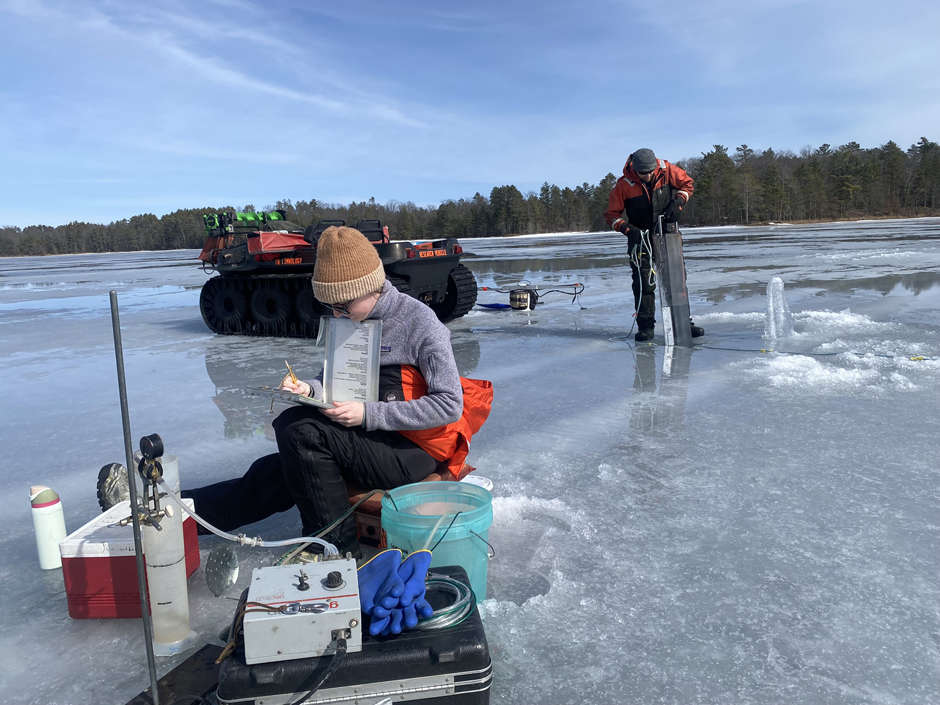
Another unique aspect of the Trout Lake Station is that it operates year-round, a rarity in climates where lakes freeze over. Buoys must be submerged, travel is more difficult, and data is only collected every four weeks, but the insights wintertime provides into how lakes are reacting to a changing climate are invaluable.
“We have a really robust set of information through wintertime in these places that freeze, that isn’t readily available in a lot of other places,” Warden says.
The long-term and year-round monitoring has led to important discoveries, and Warden and her colleagues are actively using their data to protect the valuable Northwoods ecosystems.

Instrumented buoys collect real-time data throughout the open-water season on Trout Lake as part of the Long Term Ecological Research project at UW Trout Lake Station. In November, scientists retrieve the buoy from the lake just before the ice forms. (Credit: Carol Warden)
Applying Long Term Data to Protect Lakes
Long-term monitoring of ice-out timing at the Trout Lake Station has shown that ice is melting faster on the lakes. In the past few decades, the duration of the lakes’ freezing over has shortened, leading to a host of ecosystem challenges.
“When the ice goes off early, that lake sets up a warmer layer of water that goes deeper and is earlier in the season than normal, and that directly has an impact on some fish habitat,” Warden explains. “So if you’re in lakes that have cooler, cold water fish, you’re going to see a difference in what habitat is available for them during the summer months.”
Warden says this is due to shorter winters in the region, a likely result of global warming. Yet, without a long-term data set to compare current ice cover to, they probably wouldn’t have noticed this trend or understood its impact on the local fish species.
Another winter impact on the Northwoods lakes is the presence of road salt. Despite the region’s remoteness from population centers, roads still cross through the woods and are salted when snow and ice cover the land.
“Some of our lakes that we sample regularly are next to highways, and we can see those chloride levels rise, which you might not capture if you’re only sampling that lake for three or five years,” Warden says.
Chloride washing into lakes can change the pH and may harm fish development during the egg stage. Now that their data has shown these rising chloride levels, a researcher at Trout Lake is working with the Wisconsin Department of Transportation to limit the salt washing into lakes. She is investigating the least amount of salt that can be safely applied to the roads, so that chloride levels can drop while keeping drivers safe.
The data from Warden’s long-term monitoring project is already being applied to improve Northern Wisconsin’s ecosystems. And, while they continue to protect and learn more about the spectacular wilderness, Warden and her colleagues take time to ensure the entire community understands their work.

Scientists with the North Temperate Lakes-Long Term Ecological Research project at UW Trout Lake Station pump water chemistry samples through a Geotech 0.45-micron filter. These samples are collected year-round on seven lakes surrounding UW Trout Lake Station. (Credit: Carol Warden.)
Community Outreach in the Wisconsin Northwoods
For the past decade, Warden says that Trout Lake has emphasized public outreach. Not only does the station host researchers from around the country, but it also offers rustic cabins and meeting spaces for schools and community members to learn and engage with the research station.
Schools use the place for field trips, and recently, it hosted an open house for researchers at the station to share their work with peers. Yet, what Warden believes sets the Trout Lake Station apart from other research stations is the close ties it has with the rural community.
“There’s all sorts of opportunities and connections that you can make,” Warden says. “Being set in a rural setting is really unique, because we can reach out to the community in ways that are very personal and personable.”
Warden has helped a friend who stocks walleye by taking a temperature profile of their lake, so that they, too, can understand how their fish are responding to a changing ecosystem. And when a local knocks on the door of their station, unsure what the new aquatic plant is on their property, Warden and her colleagues say they are happy to identify it for them.
“Showing up when people ask you, [and] making a point to help them out is what really makes the difference in them understanding the importance of this data collection,” Warden says.

Water sampling occurs all year at the Trout Lake Station, one of its many unique aspects. (Credit: Carol Warden.)
Conclusion
Despite the decades of funding and impact that Trout Lake’s research has had both within and beyond its community. With changes in funding for public entities, Warden says that she and her colleagues don’t know what the future holds.
“Every time I go out to a lake upon someone’s request, it’s free to them,” Warden says. “Every time I go to a school and teach a class, it’s free to them. Every time I walk into a lab, it’s free to them because of this National Science Foundation grant.”
But, for now, they will continue as they always have and dive headfirst into their research. New undergraduates will come to the station, bright-eyed and eager to start their own project. Community members will continue asking for their help, and Warden says that they will continue learning about the ecosystems outside their door for as long as possible.
“We’re one small spot on the map, but we’re doing great big things.”

Water sampling occurs all year at the Trout Lake Station, one of its many unique aspects. (Credit: Carol Warden)





0 comments