

When Rivers Run Orange: Monitoring Acid Mine Drainage in Elk County
Acid mine drainage in the tributaries and mainstem Bennett Branch Sinnemahoning Creek in Pennsylvania has made the river run orange several times over the last several decades, a visual representation of the deterioration the waterway has experienced as a result of the region’s history.
In recent years, various treatment approaches have been implemented in the Bennett Branch’s tributary as a means of helping the waterway and native species recover, including the installation of wetlands or lime treatment systems.
While treatments have helped improve conditions in the tributaries and main creek, these approaches require regular maintenance in order to remain effective. Additionally, new treatment strategies may need to be implemented in order to fix pop-up drainage in new areas.
In order to identify the need for repair or the replacement of existing treatment systems, or the need for the construction of a new treatment system in a different part of the watershed, the Elk County Conservation District continuously monitors local tributaries of the Bennett Branch Sinnemahoning Creek.
Elk County Conservation District Watershed Technician, Micaela, is rinsing the sonde to remove any silt buildup prior to cleaning and calibration. (Credit: Jake Pistner / Elk County Conservation District)
Monitoring Acid Mine Drainage and Improving Conditions in Bennett Branch Tributaries
Micaela Lefever, Watershed Technician for the Elk County Conservation District, oversees monitoring efforts in the area. A Clearfield County native, Lefever grew up volunteering with her father on various environmental projects.
“From basically the time I was six years old, I started doing this work as a volunteer. Whether it was just going out and walking along and watching, or helping to move some little rocks, it just helped me to really appreciate and love the outdoors. And as a result of that, I knew that I didn’t want to sit behind a desk all day, every day,” states Lefever.
According to Lefever, since starting her job at the Elk County Conservation District, she hasn’t had a boring day. She explains, “Some days I’m behind a desk writing grants or sorting through water quality data. Other days I’m out sampling water or doing construction projects like stream habitat improvements.”
Monitoring and restoration efforts in the county are community-driven, meaning that Lefever’s days are spent answering calls from locals reporting issues in nearby rivers and streams, then going out to the area to assess the problem and come up with a solution.
An example of this is a more recent project on Dents Run, a tributary of the Bennett Branch, which carries a large amount of acid mine drainage into the creek.

Dents Run. (Credit: Jake Pistner / Elk County Conservation District)
Continuous Water Quality Monitoring on Dents Run
Drainage from nearby coal mines has led to the creation of sulfuric acid, which dissolves metals like iron and aluminum in rocks, flooding Dents Run—and its tributaries—with acid and heavy metals. These contaminants impact aquatic species’ health and water quality conditions.
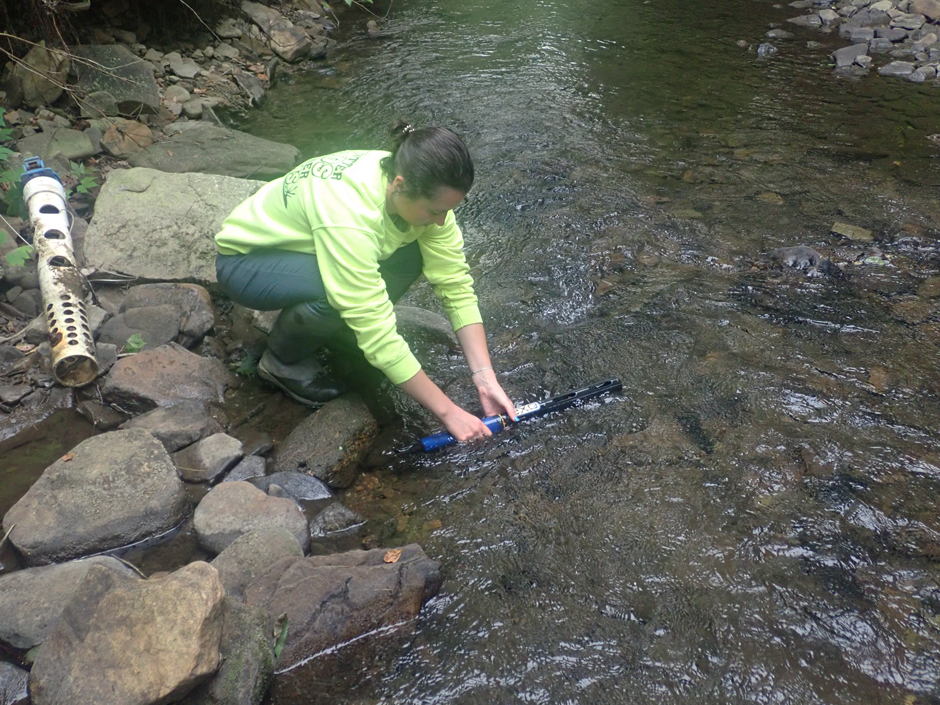
There are currently about 15 different treatment systems in Elk County, both passive and active, that need to be maintained. In order to ensure that these systems are functioning properly, Lefever uses YSI EXO1 sondes to measure water quality near treatment sites to evaluate if they are effectively mitigating acid mine drainage.
Lefever has three sondes that she moves around the watershed over the course of the year, with the exception of winter due to ice conditions. The rest of the year, monitoring Dents Run presents some unique challenges due to the high variances in flow the waterway experiences.
These variances can result in the sonde being totally submerged as a result of heavy rainfall or left in the air due to the water level dropping.
Aside from risks to the equipment, variable flows can also impact measurements. Low flow conditions result in high concentrations of acid and metal entering the waterway. In contrast, high flow conditions can severely dilute concentrations, making it harder to notice acid mine drainage.

Elk County Conservation District Watershed Technician, Micaela, is removing one of the sondes from it’s protective housing to clean it, calibrate it, and download the data. (Credit: Jake Pistner / Elk County Conservation District)
To combat this, the sondes measure pH and conductivity continuously for a few months before they are moved to a new site in the watershed in order to capture conditions under different flow conditions. Data is reviewed on a monthly basis.
Low pH indicates that the water is acidic and that the treatment strategy may need to be replaced or maintained. Similarly, high conductivity may indicate the presence of heavy metals, which also points to assessing the treatment system upstream.
Depending on the sonde measurements, Lefever will conduct spot sampling using individual sensors elsewhere in the tributary as well as grab samples for lab analysis so that the team can create targeted solutions to the specific problem.
Lefever also monitors areas that have been largely unimpacted by acid mine drainage to ensure that these areas remain healthy and that discharge hasn’t popped up.
In cases where issues are detected and a treatment system will be added or improved, the sondes usually remain deployed for a longer period in order to evaluate any changes after intervention.

Elk County Conservation District Watershed Technician, Micaela, is calibrating the sonde using pH 4.0 buffer solution. (Credit: Jake Pistner / Elk County Conservation District)
Community-Led Restoration in Dents Run
While acid mine drainage has impacted the region for decades, the Elk County Conservation District’s role in treatment and monitoring of the watershed is newer, with the Dent’s Run project starting only in April 2024.
Though new, the district manages all of the current treatment structures in the area as a result of a lot of the previous management agencies no longer existing, breathing life into this long-standing effort to heal the Bennett Branch.
Of course, true recovery wouldn’t be possible without the community, so the conservation district works to provide educational outreach to community members to encourage involvement in the region’s recovery.
“Ultimately, if you educate people, they’re more likely to care about it, and then hopefully, they’ll be interested in protecting it as well,” states Lefever.
She continues, “If I can inspire one little kid to be interested in the stream the same way I was, or teach some adult that didn’t know why our streams were running orange, why that occurs and how we fix it—then that’s huge.

Winslow Hill Viewing Area overlooking the hills of Benezette. (Credit: Jake Pistner / Elk County Conservation District)






0 comments