

From Paddles to Phytoplankton: Studying Vermont’s Wildest Lakes
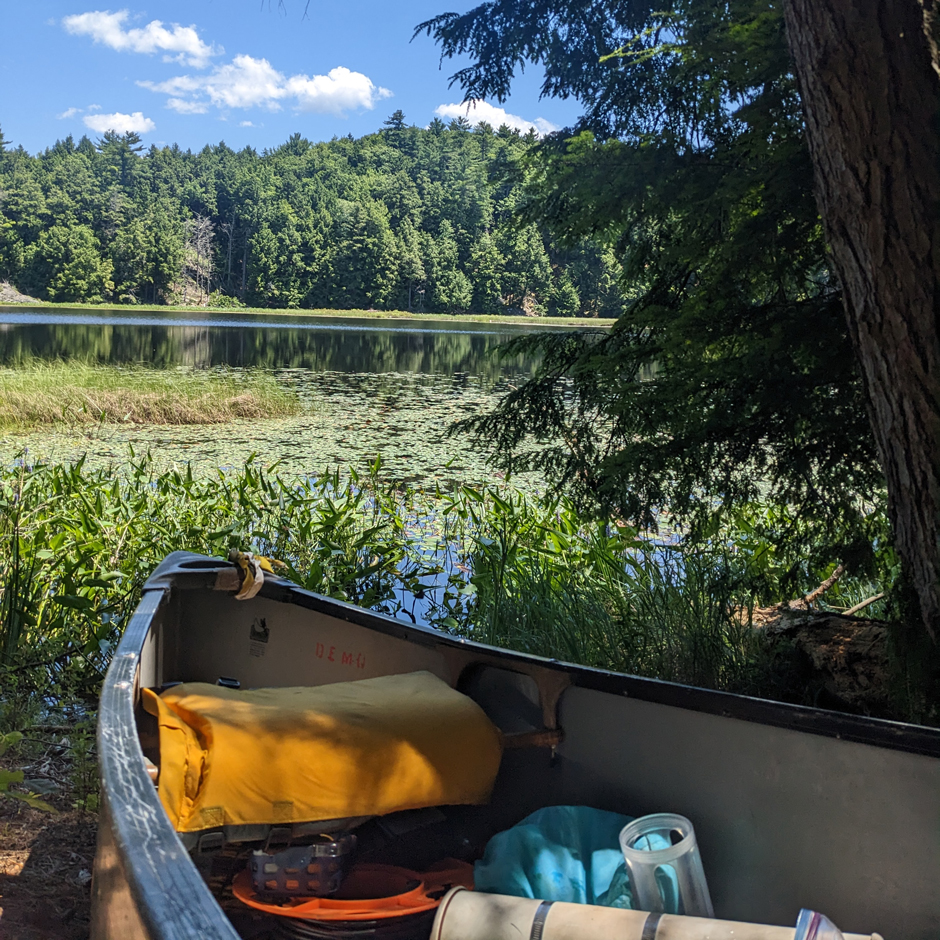
The canoe at Spruce Pond, Orwell. (Credit: Rachel Cray)
For six months of the year, Rachel Cray, a third-year PhD student at the Vermont Limnology Laboratory at the University of Vermont, lives between a microscope and her laptop, running data. For the other six months, she is hiking and canoeing four of Vermont’s lakes, collecting bi-weekly water samples.
Cray studies algal phenology across four lakes in Vermont, US, that have low anthropogenic stress—or in other words, are very remote.
Funded by the National Science Foundation Career Award to Dr. Mindy Morales, the lakes Cray researches part of the Vermont Sentinel Lakes Program, which studies 13 lakes in the area and, in turn, feeds into the Regional Monitoring Network, which operates in the Northeast and Midwest US.
Cray’s work focuses on phytoplankton, algae that live in the water column, using these four lakes as a control for understanding the myriad of factors that affect algal communities, including the effects of direct human disturbance, such as road salt run-off, construction and pollution, and stochastic disturbances like climate change.

The canoe at Spruce Pond, Orwell. (Credit: Rachel Cray)
Phytoplankton as Ecosystem Sentinels
“Phytoplankton act as ecosystem sentinels, or the canary in the coal mine of their ecosystems,” Cray says.
As “some of the most dynamic life forms,” phytoplankton–microscopic algae–rapidly alter their biomass, metabolism, and even their life cycles to respond to ecosystem change.
Consequently, they are central to lake stability and biochemistry. “Lake health as a whole is heavily influenced by phytoplankton, in my opinion, and we’re really interested in what alters that phytoplankton community,” Cray asserts.
Putting the Work into Fieldwork
Cray uses a mix of low-frequency and high-frequency sampling methodologies to study phytoplankton phenology.
Two of her four study lakes are so remote that there are no roads in the entire watershed, and they require “hiking in with a canoe and all of our gear.”
This is no easy feat–carrying ”two backpacks, 66 pounds of gear and a 66 pound canoe” for a 30-minute hike, before collecting 25 pounds of water and making the 30-minute hike back to the truck.
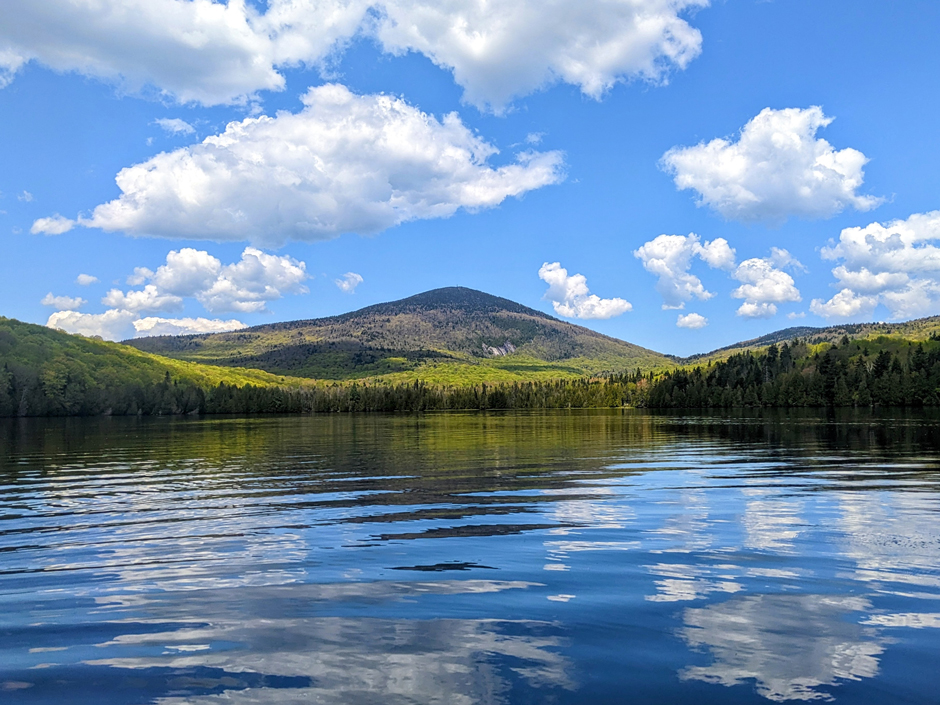
Bald Hill Pond, which Cray confidently calls “the most beautiful pond ever.” (Credit: Rachel Cray)
Cray’s other two study lakes have boat launches, meaning no hiking is required. Nonetheless, by the end of her doctorate, she estimates she will have “driven the circumference of the Earth” to reach her sampling locations.
The remoteness of these lakes is part of what makes this research so important. Cray explains that while many studies have investigated more accessible locations, “no one’s looked at this data at this high of a frequency for lakes that are this remote in Vermont.”
Manual Data Collection in Remote Vermont
From May to October–Vermont’s ice-free season–Cray is in the field manually collecting bi-weekly data.
She uses a multi-parameter water quality sonde to take measurements at three locations on each of her four lakes, capturing data from more and less disturbed areas. She records nine parameters–temperature, depth, dissolved oxygen (both milligrams per liter and percent saturation), chlorophyll a, redox potential, conductivity, chloride and phycocyanin.
An understanding of nutrient levels–particularly nitrogen and phosphorus–is important because of their impact on “many different factors of algal growth, reproduction, [and] stability.”
Water samples are taken at similar locations to get representative samples of phytoplankton communities. With these, Cray identifies the phytoplankton species present under a microscope and calculates their biomass.
So far, she has identified over 250 species of phytoplankton–an “incredible diversity” that is a product of these lakes’ remoteness, but she notes, still only a “tiny subsection of what’s there.”
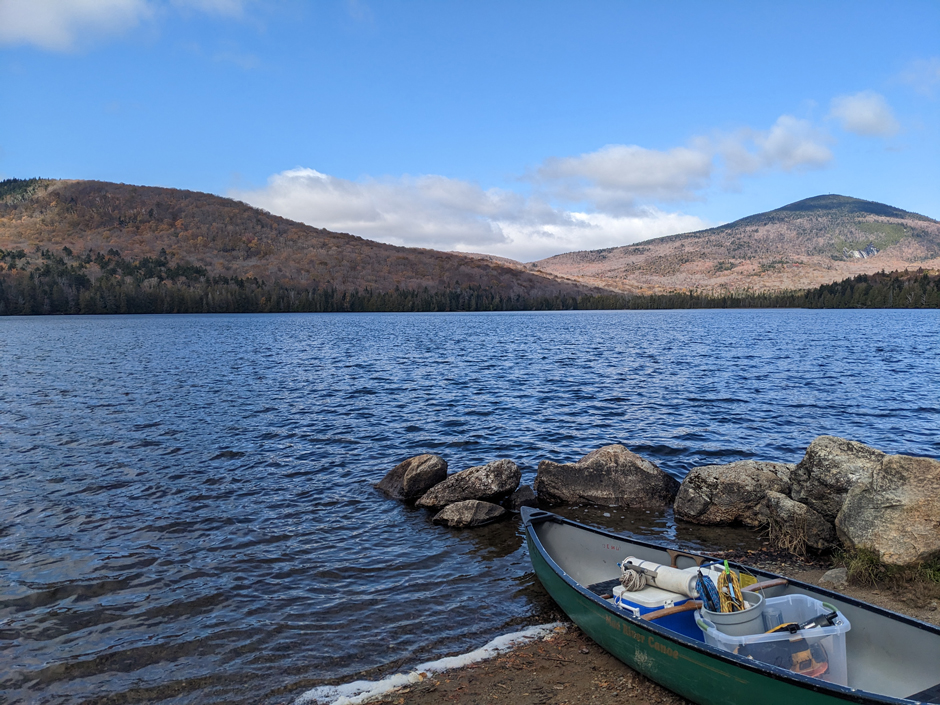
Bald Hill Pond, Westmore, with the equipment-laden canoe in the foreground. (Credit: Rachel Cray)
Transforming Research with High-Frequency Data
In 2024, just before catastrophic flooding washed through Vermont in mid-July, Cray deployed a buoy at the deepest point on each of her lakes, which vary from 3m to 18m deep.
Each buoy has two PME miniDOT Dissolved Oxygen Loggers, one 1m from the surface and another 1m from the bottom. The miniDOTs take readings of temperature and dissolved oxygen every 10 minutes, providing high-frequency data from a single location.
Cray is excited to pull the buoys this summer and access the data stored onboard. “These give us data that’s never been looked at before,” she highlights, “allowing us to look at dissolved oxygen and temperature over the entire year in multiple locations throughout the water column to determine how these are shifting.”
This data has the potential to transform understanding of these lakes. Of Cray’s four study lakes, three are dimictic, meaning that they mix in the spring and fall, then stratify in the summer.
Details on mixing regimes have remained elusive, but she is hopeful that the high-frequency data will provide new insights.
“So I can tell you to the minute and the hour when my lakes are icing off and when they’re mixing. […] I’ll be able to tell exactly how dissolved oxygen and temperature are shifting to the minute of the flooding happening, which has not been taken before.”
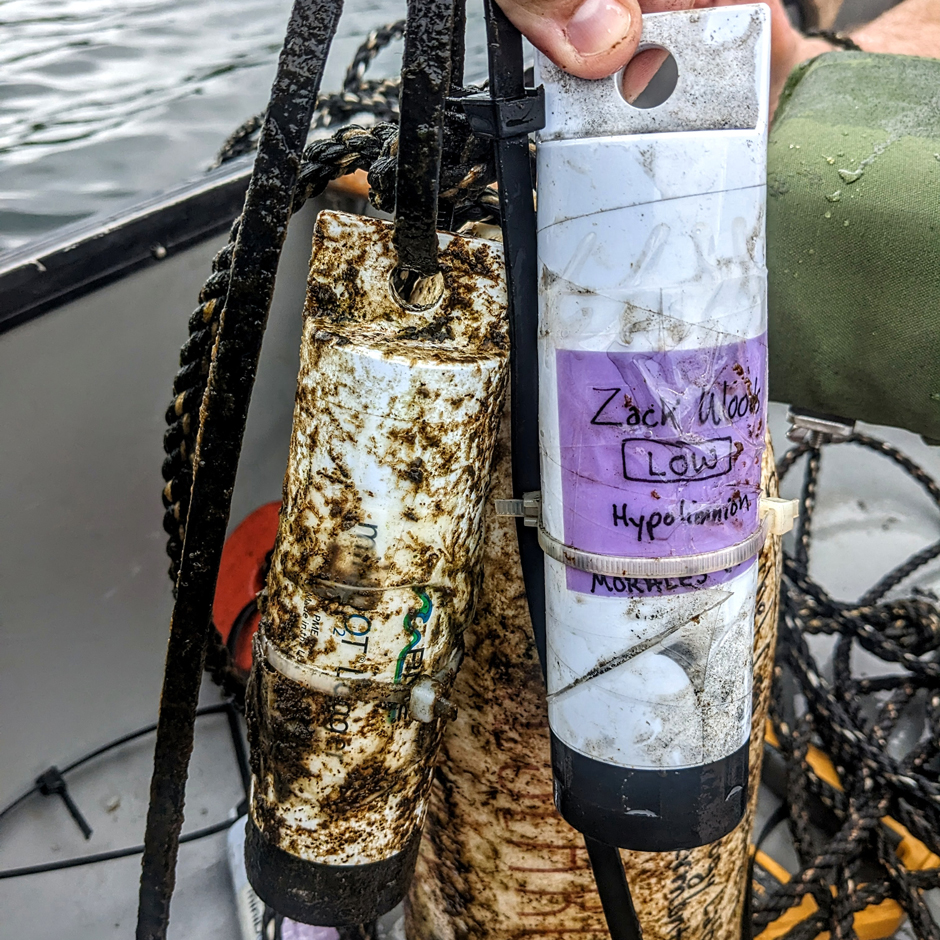
Two miniDOTs pulled from Cray’s site at Zack Woods Pond. The algae-covered sensor was 1m from the surface, and the algae-free one was 1m from the bottom, where conditions are cold and dark–less favorable to algal growth. With this data, Cray is able to see “the exact minute the lake turned over last fall.” (Credit: Rachel Cray)
Understanding Flooding and Phytoplankton Communities
Understanding the impact of extreme weather–particularly precipitation–has become a focal point for Cray’s research.
With two major flooding events in the last two years, Cray describes the data as both “fascinating and horrifying,” as events previously seen only once every one or two centuries are predicted to become as frequent as once every 25 years.
At the four lakes she studies, Cray has observed “some interesting shifts in both taxonomy and the functional traits statistically as a result of flood intensity.”
Mixotrophy–the ability of algae to both perform photosynthesis and phagocytosis (eat solids) simultaneously–is emerging as the dominant regime post-flooding.
Mixotrophic communities do not appear to follow the “expected community shifts that you would see in response to normal climatic patterns like the sun and summer.” Instead, she suggests, “It’s almost like a permanent spring.”
Cray hopes for a flood-free year in 2025, which will provide data on how these lakes “normally shift in mid-summer, when you don’t add in 12 inches of water in 24 hours.”
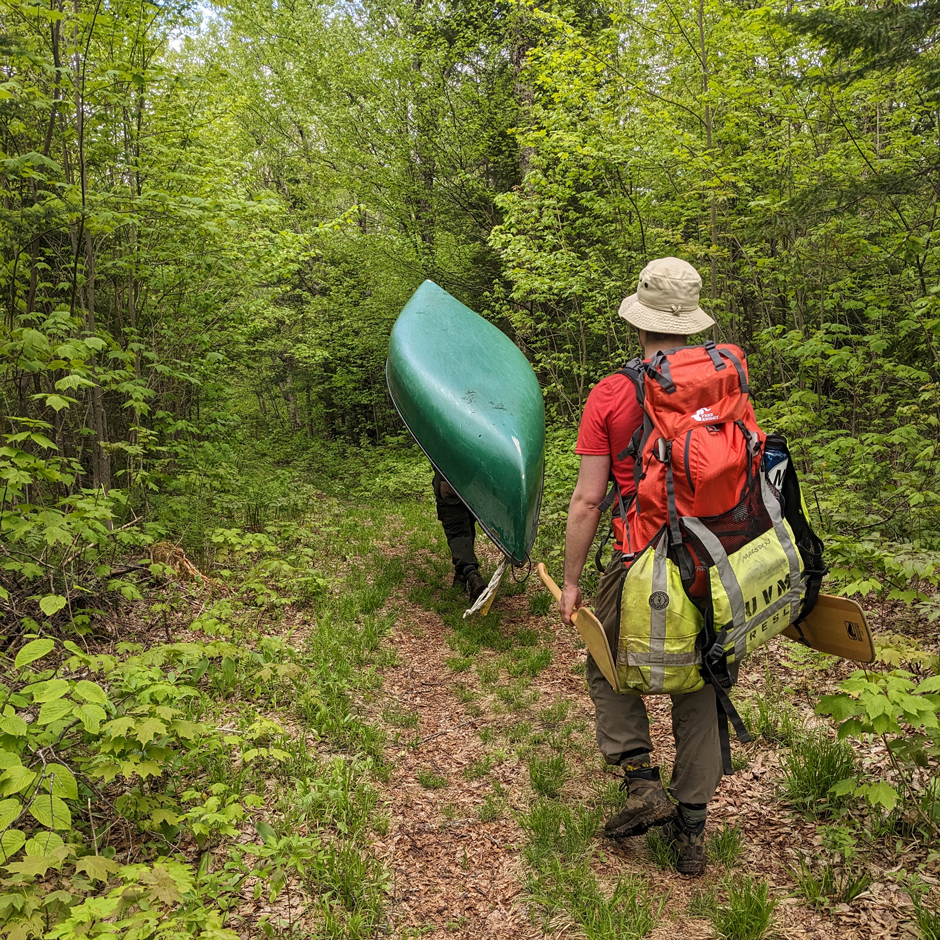
Portage in action. Cray and her team hike into a remote lake ready for another day of fieldwork. (Credit: Rachel Cray)
Beyond Vermont
Low- and high-frequency data are revolutionizing our understanding of Vermont’s remote lakes, with potential applications far beyond.
“I love my study sites,” Cray effuses. “They’re cool, but one little pond and how it’s affected by the flood isn’t the end all.”
“For this project, we want to use this data to make a phenology disturbance framework to make predictions about how similar lakes are going to shift,” she continues.
Coupled with data from colleagues in her lab, “we can use it to make predictions that are scalable across both space and time based on different disturbance effects, and predict feedbacks that are recurring across the entire temperate zone.”
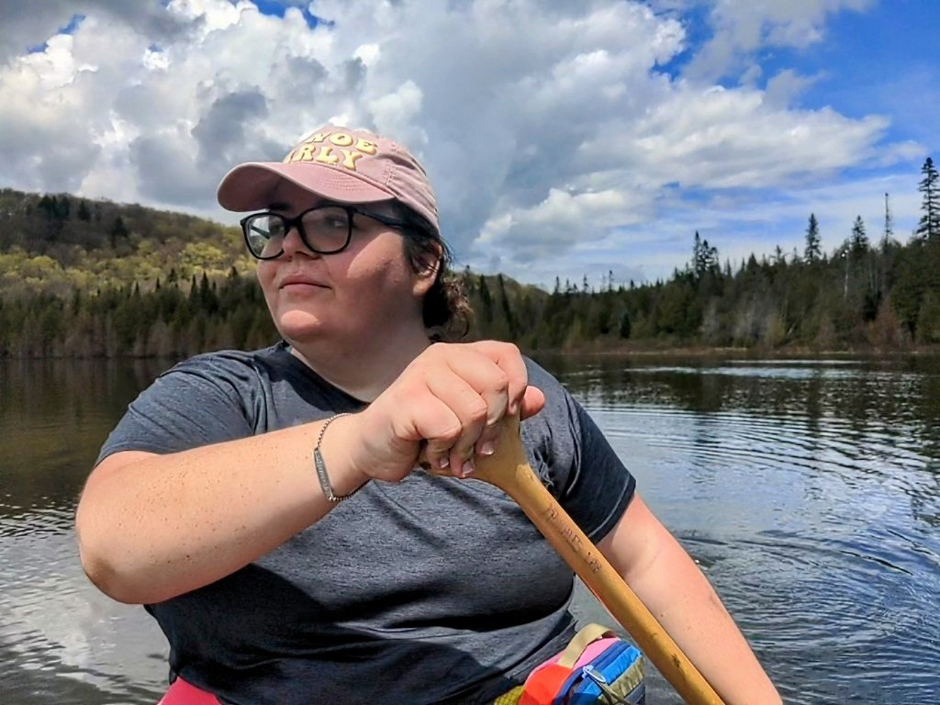
Cray paddles across a remote lake. (Credit: Rachel Cray)






0 comments