

Harnessing Fluttering Foils: Vortex-Induced Vibration Energy from Lab to Sea
“We know in theory that it’s possible, but obviously, in practice, it doesn’t always pan out that way.” Spenser Boyd, Assistant Professor of Mechanical Engineering, is in his office at Webb Institute. This small, private college based in Glen Cove, New York, is uniquely specialized and only awards degrees in Naval Architecture and Marine Engineering.
Boyd, who teaches everything from physics and thermodynamics to engineering economics, is referring to a vortex-induced vibration (VIV) energy generator, which can—in theory—harvest energy from currents.
Through a combination of student research and grant-funded projects, Boyd is involved in a project laying the foundations for the field deployment of a prototype VIV energy generator—and a new NexSens buoy that monitors ocean conditions at a potential test site is helping take the team one step closer.
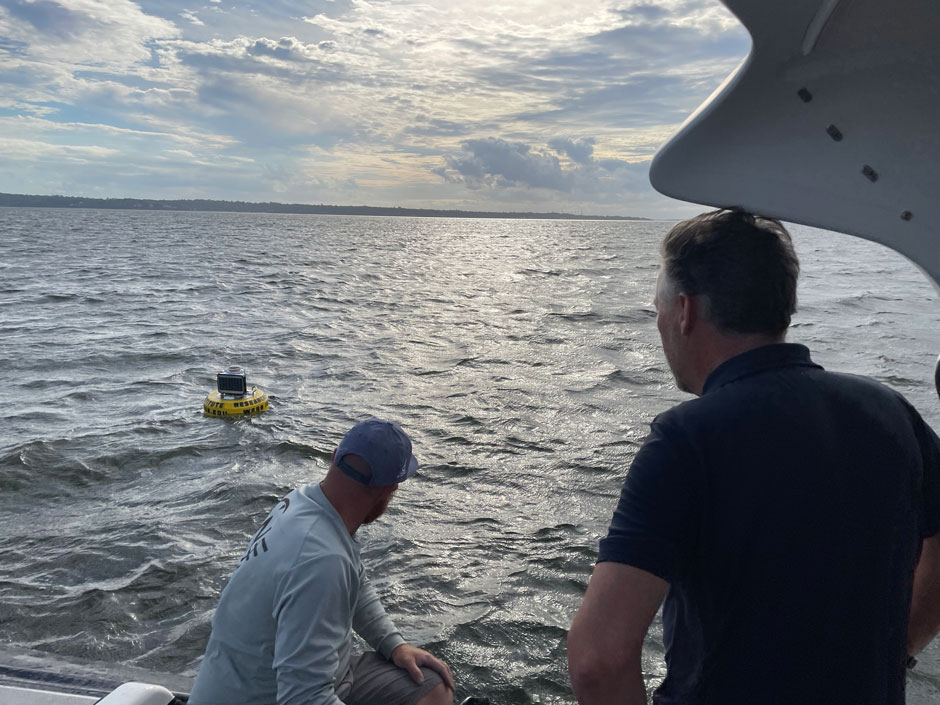
The buoy has been successfully piloted and will be redeployed in Spring 2025 for its first full season of data collection. (Credit: Spenser Boyd)
VIV Energy Generation
The VIV system of energy generation was pioneered by researchers at the University of Michigan. It mimics the techniques used by wave energy converters to capture oscillatory and reciprocating motion, but instead harvests energy from currents themselves.
Boyd likens the VIV system to a flag fluttering in the wind–except this is a submerged, rigid ’flag’, called a foil. When conditions are right, the flow coming off the submerged foil separates, and its symmetry creates vortices that cause it to oscillate perpendicular to the flow—known as fluttering.
“The idea is that if it’s bouncing back and forth, we could put some sort of generator, or linear [generator] on— something that we could use essentially as a little energy developer,” Boyd says.
There are potential benefits to these systems over other water current harvesting devices like turbines. Boyd notes, “These flutter foils can start moving in a relatively low flow current, down to around 0.5 m/s”—meaning in some environments, they could provide more net energy over long timescales.
VIV Research at Webb Institute
Early VIV research was largely speculative and didn’t go much further than demonstrating that a cylinder—the simplest object that you can get to do the oscillation—would flutter in flow.
University of Michigan alum and Webb Institute’s Research Director, Dr. Richard Royce, wanted to explore practical power generation and more efficient shapes.
Research into VIV started at Webb around a decade ago. Using the in-house testbed, students built an apparatus to keep an object submerged within a circulating flow of water, and observe flow over it—but this faced challenges, including tuning motion, balancing forces, and maintaining reliable operation in experimental setups.
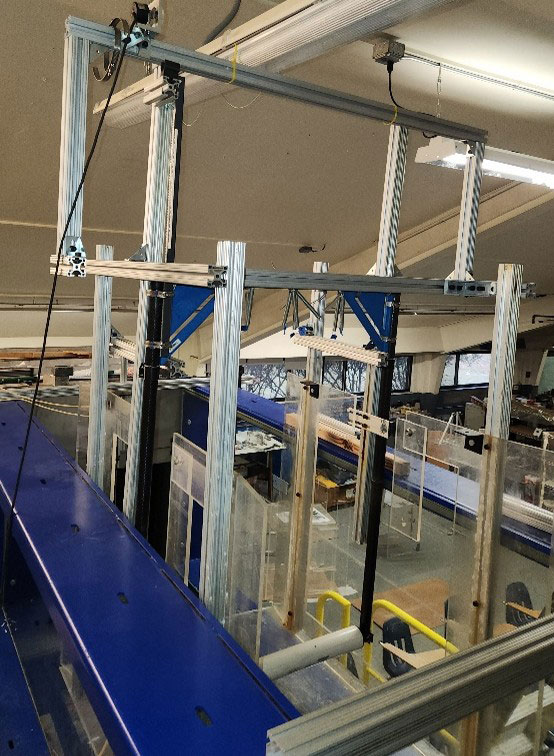
The flow channel testbed at Webb Institute, showing the prototyped frame.(Credit: Spenser Boyd)
Expanding the VIV Project
Nonetheless, this first attempt laid the groundwork for renewed efforts that began in 2022 when Webb fielded its first team for the Department of Energy’s Marine Energy Collegiate Competition (MECC) with a project focused on VIV.
Funding from the MECC enabled prototyping to begin on an A-frame-like structure mounted on a vertical frame, which houses a free-moving foil between the two vertical sections. An additional grant is helping to extend this project to draw research-level data and lay the foundations for the field deployment of a VIV device.
“We’re fixing the frame a little bit,” says Boyd, “But the main thing that we’re doing is adding on instrumentation, so we’re building out a mechanical device to do the proper power takeoff, and then we’re going to add instrumentation for the flow speeds, densities, and pressure differences over the foil.”
An expanded system will enable testing of other configurations, including vertically stacked foils and multiple foils arranged in sequence, and explore how the motion of an upstream foil affects energy capture downstream.
Preparing for Real-World Testing
“It’s one thing to do all this in the lab, where we can explore all sorts of controlled parameters, but it’s another to actually try to demonstrate it, to prove it out in real life,” Boyd states.
“We need to know what the environment looks like,” he says simply.
To even begin contemplating a field deployment, the team needs to have “better data, or at least a lot more granular data, about what to expect in terms of flow velocities, flow directions and water conditions for a place where we might actually try to deploy it.”
This led Boyd to explore environmental monitoring equipment. While Webb Institute enjoys a seafront aspect, “Long Island Sound isn’t the most amenable body of water,” and he wanted a system that was versatile, easy to deploy, and cost-effective.
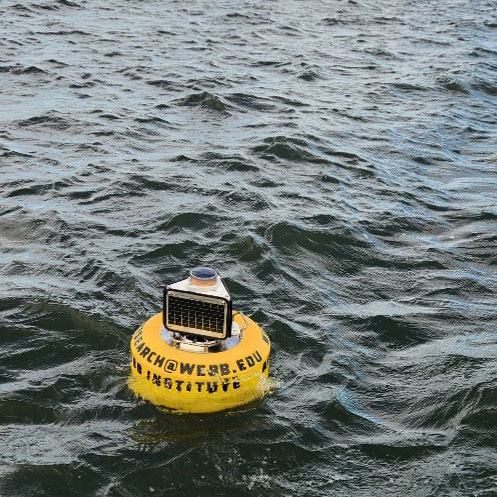
The CB-75 buoy is the smallest in the NexSens offer, and its ease of deployment was an important factor when choosing the best platform. (Credit: Spenser Boyd)
Data Buoy Deployment
Boyd opted for the CB-75 buoy–the smallest in the NexSens offer, which was deployed around half a mile offshore in 30-40 ft of water and equipped with an Aanderaa 5400P acoustic doppler current profiler (ADCP).
“Our goal was granular data,” Boyd clarifies. ADCPs typically provide current profiles from cells, each about half a meter, and spaced generously throughout the water column. “This means that all that space in the middle is lost to us, but one of our devices could live within that space.”
By compressing the distance at which measurements are taken so each cell overlaps with at least half of its neighbour, the team has achieved much greater data granularity.
With the data, Boyd helps to gain insights into current direction—which could inform the placement of devices to maximize coverage—and the velocity profile, “the direct analog to how much energy we get out.”
The buoy was deployed in Fall 2025 for a short test and will be redeployed in the spring for its first full season of data collection.
“We could basically start bringing that right into the lab to set up our test conditions based upon that information. So we can then do variable flows of the appropriate velocities that we see. We can mimic changes in direction by just changing the flow in the single direction that the [test] channel exists in, and then start mimicking better real life conditions for it,” Boyd explains.
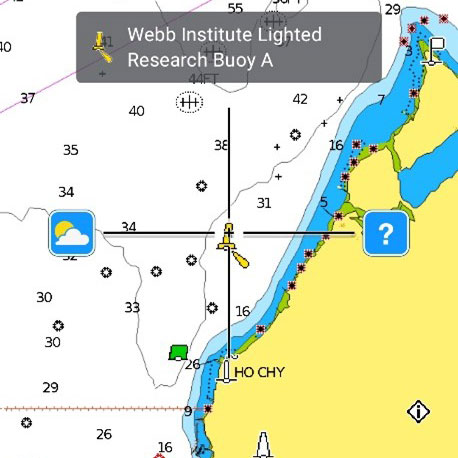
Location of the Webb Institute buoy. (Credit: Spenser Boyd)
A Diverse Range of Applications
“Now that we have the buoy, it’s a platform,” Boyd says. “We’re looking for all sorts of ways to best take advantage of this hardware.”
The team aims to incorporate a wave sensor and water quality monitoring equipment. Measurements of water chemistry, biochemistry and temperature will complement data from a planned land weather station on Webb’s pier.
“Our goal beyond just this current profiling project, is to build out our own little in-house environmental data stream—a whole platform that has all this data.”
While the end use of this data is still uncertain, Boyd is confident that “if we build it, they will come.” With full access to a bank of environmental data, students can work on projects that utilize real-life measurements.
Data may also be used to support data analysis work that’s increasingly part of a curriculum evolving to meet the industry’s needs.
Beyond Webb, Boyd also hopes that data can be made available via an online public portal, something that could enable partnerships and collaborations with other institutions and the community.
An Exciting Future
VIV energy generation is a burgeoning technology with exciting possibilities.
As it transitions from technical drawings to laboratory tests and real-world testing, data from the buoy system will support students and researchers at Webb Institute to understand environmental patterns and variability—providing insights that support and inform their continued research and studies.
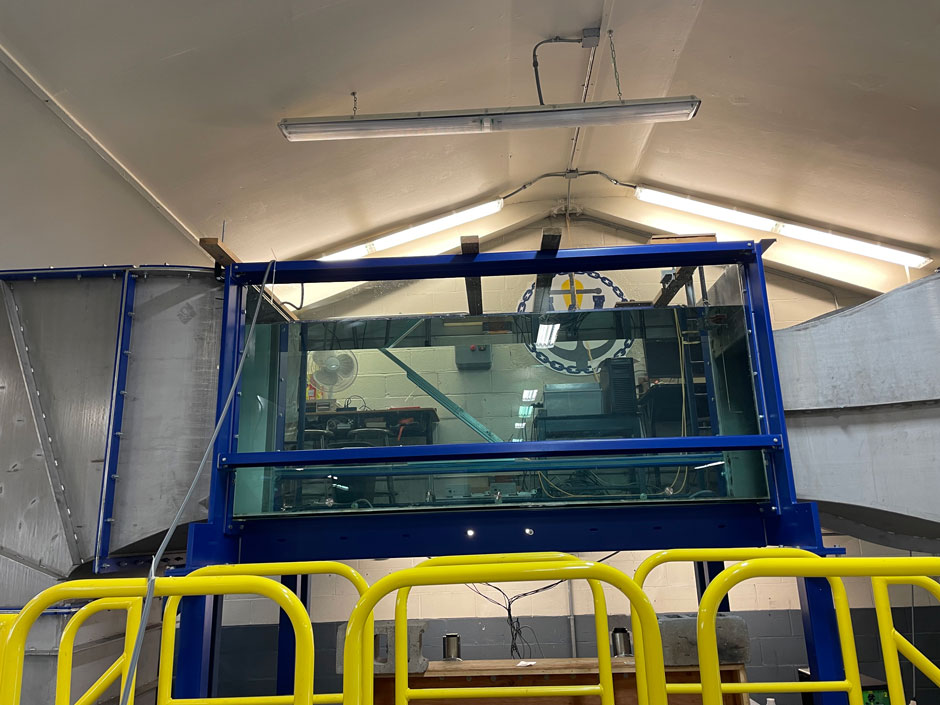
Based on the environmental measurements collected by the buoy, researchers will be able to replicate these for testing of systems in the Webb Institute’s flow channel. (Credit: Spenser Boyd)






0 comments