

Wave-Powered Buoy Deployed in Puget Sound
While the development of solar-powered monitoring systems has improved access to real-time environmental data, solar power is still limited by low light conditions, such as poor weather, nighttime, or high-latitude environments.
To supplement these incumbent power solutions at sea, Ocean Motion Technologies has developed a small-scale ocean wave energy system that can be directly integrated with existing data buoy platforms.
Not only does wave energy supplement solar power during periods when the buoys are limited by light availability, but it also allows data buoys to perform beyond their current power capacities.
The additional power can support advanced features in maritime monitoring, such as supporting more power-hungry instrumentation or operations, as well as autonomous underwater vehicle (AUV) docking and data transfer stations.
Recognition of these limitations and the need for more advanced monitoring solutions is what led Jack Pan, Chief Executive Officer and Lead Oceanographer, and the rest of the team at Ocean Motion Technologies to develop their wave-powered big-ocean-data solutions—one of which is integrated on a NexSens CB-1250 data buoy in Puget Sound.

Ocean Motion’s wave-powered NexSens CB-1250 data buoy in Puget Sound, Washington (03/2025). (Credit: Jack Pan / Ocean Motion Technologies, Inc.)
Testing Version 2 of the Wave-Powered Buoy
The Puget Sound deployment was intended to advance three ongoing projects. First, Ocean Motion was testing Version 2 of their surface wave energy converter (WEC), designed to power commercially available data buoys.
Second, the team was evaluating the capabilities of their AUV docking station, which is integrated and cabled directly to the buoy. Finally, the team was testing a customized data acquisition and telemetry system, which also functions as an advanced wave-sensing device.
According to Pan, the primary goals of the deployment were to demonstrate how innovative, integrated monitoring systems “work together seamlessly to enable robust, autonomous ocean monitoring and big data collection at sea.”
The development of these wave-powered buoys and the projects involved in this deployment directly support the Powering the Blue Economy initiative and advance the “Ocean of Things” paradigm.
“Our firm collaborates with industry leaders like Fondriest Environmental, as well as Federal Agencies such as the U.S. Department of Energy, the National Science Foundation, NASA, and the U.S. Navy, advancing technologies essential to achieving the vision of the ‘Ocean of Things,’” states Pan.

Gravity Marine’s vessel assisting Ocean Motion and Sunfish with buoy and AUV dock recovery. (Credit: Jack Pan / Ocean Motion Technologies, Inc.)
Ultimately, the additional power capabilities of wave-powered buoys offer increased monitoring potential in the blue economy, as well as benefiting other sectors like defense.
Pan explains, “For defense applications, our enhanced ocean monitoring technologies provide critical intelligence, surveillance, and reconnaissance (ISR) capabilities, strengthening coastal security, and national defense infrastructure.”
Test Deployment in Puget Sound
The Puget Sound deployment offered an ideal test site as the buoy was placed in a sheltered area that offered controlled conditions for initial testing. However, an unexpected storm resulted in strong waves impacting the newly deployed system.
“Interestingly, this unexpected event proved to be highly valuable, effectively serving as an unplanned extreme-condition stress test. The storm allowed us to validate the resilience and robustness of our wave-energy systems under challenging conditions,” states Pan.
The event demonstrated the durability of their systems as well as provided important insight into the power generation potential of the Ocean Motion WECs in high-wave conditions—“at times producing even more power than our best estimates.”

An Ocean Motion engineer capturing live data transmission from their wave energy systems on the data buoy. (Credit: Jack Pan / Ocean Motion Technologies, Inc.)
Designing Wave-Powered Buoys
Because these systems may be deployed in freshwater or marine environments, durability was a key consideration during the design process at Ocean Motion, balancing between cost-effectiveness and the practicality of their final products.
Pan explains, “Designing equipment to withstand harsh ocean conditions inherently comes with uncertainties.”
To mitigate these unforeseen challenges, the Ocean Motion team worked with Fondriest Environmental and their deployment partners at Gravity Marine to conduct rigorous marine monitoring, characterizing the operational environment in order to improve their systems in future iterations.
At the core of the system is Ocean Motion’s modular wave energy system integrated directly onto the NexSens CB-1250. The integrated wave sensor captures wave height, direction, and period. Top-side meteorological sensors included an Airmar 200WX-IPX7 WeatherStation, and underwater, a Sea-Bird Scientific HydroCAT CTD collects water quality data.
The multiparameter system captures wave, weather, and water-quality measurements in real-time, which is then made available to the team remotely.

Ocean Motion mechatronics engineer, C. Wilmers, observing the launch of their wave-powered CB-1250 buoy. (Credit: Jack Pan / Ocean Motion Technologies, Inc.)
While this test deployment utilized a customized telemetry unit, some future commercial deployments are expected to use NexSens X-Series loggers and WQData LIVE. Their team has also used these systems in the past during a 2023 deployment at the same location.
In collaboration with Sunfish, an AUV docking station was tested during this deployment, enabling reliable subsea docking, battery charging, and high-speed data transfer capabilities. Additionally, a Deep Trekker remotely operated vehicle (ROV) and the Sunfish vehicle captured visuals of underwater conditions. A topside environmental camera recorded surface conditions.
In order for these instruments to reach their full potential, supplemental wave energy plays a key role in ensuring continuous power at all times of the day. Pan explains, “If you can suddenly generate a little more power, say, hundreds of watts, then all of a sudden, you can do remarkable things in the ocean.”
With every test deployment, the Ocean Motion team tries to integrate more sensors, improve their system performance, and increase power output to push the limits of the state of the art in the bluetech sector.

The deployment team was composed of members from Ocean Motion Technologies, Gravity Marine, and Sunfish. (Credit: Jack Pan / Ocean Motion Technologies, Inc.)
Capabilities of Wave-Powered Open-Water Platforms
The ability to power open-water platforms with wave energy is a particularly attractive concept in multiple fields, particularly as the network of ocean and freshwater measurement systems continues to grow along with offshore developments.
For some users, the primary requirement is remote, real-time access to environmental data, as well as the flexibility to monitor current conditions spontaneously.
For others, the priority is generating sufficient power to support large-scale data collection, even if continuous remote access is less critical. Both scenarios typically involve power-intensive instrumentation, which makes wave energy solutions particularly valuable for enabling extensive aquatic data collection.
“For example, deploying novel instruments such as in-situ imaging flow cytometers or a large suite of common water quality sensors—used in supporting remote sensing, biological monitoring, and algorithm development—can quickly consume the power produced by these wave modules,” explains Pan.
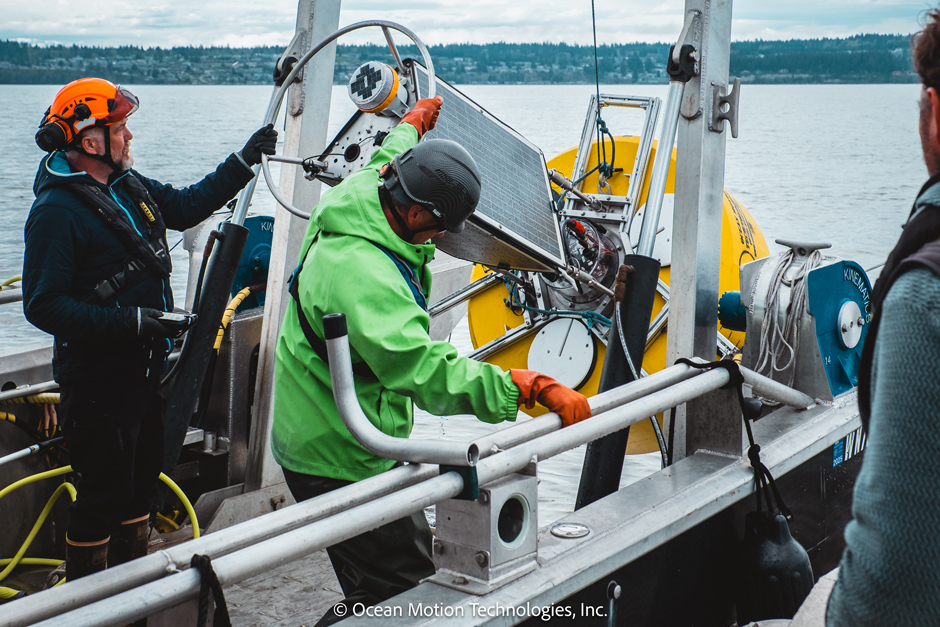
Gravity Marine supports Ocean Motion in the recovery of NexSens CB-1250. (Credit: Jack Pan / Ocean Motion Technologies, Inc.)
He adds that, from a power-budget perspective, scalability is key: “You can increase power output by adding more wave energy modules to a single buoy or by connecting multiple buoys into a larger, distributed array. This approach improves spatial and temporal coverage and reduces the power burden on any single buoy.”
Ultimately, the inherent scalability of wave energy technology and its potential to overcome current limitations in open-water power generation underscore its significance within the broader objectives of the Powering the Blue Economy Initiative.
According to Pan, seeing the technology that the Ocean Motion team has spent years carefully developing finally reach the stage where it improves how we observe and interact with the aquatic environment is immensely rewarding.
“One of the most gratifying aspects of our work is the opportunity to be involved in nearly every stage of the process–from initial brainstorming and conceptual ‘napkin sketches,’ to rigorous field deployments, and finally, seeing our technologies become real-world solutions,” explains Pan.
He continues, “Supporting our talented team and collaborating with dedicated partners to transform ambitious ideas into tangible and effective products is incredibly rewarding. It’s especially meaningful to witness something we have envisioned evolve into a dependable solution that our industry colleagues actively use and appreciate.”

RHIB operation in Puget Sound. (Credit: Jack Pan / Ocean Motion Technologies, Inc.)






0 comments