

Reconnecting People and Nature: Restoring Lake Macatawa
It is well known that we are in the throes of the sixth mass extinction–this time caused not by great natural catastrophes, but by the far-reaching impact humans have had on the planet.
What is much less discussed but–literally–much closer to home, is the extinction of experience. Extinction of experience refers to human interactions with nature, now diminishing with accelerating urbanization, and the barriers, physical and otherwise, that people build between themselves and the natural world.
Yet the connection between people and nature is essential for our mutual health. Nature has long been recognized as having a positive impact on human wellbeing and, correspondingly, those who feel an emotional connection to nature are more likely to advocate for its protection.
The Outdoor Discovery Center (ODC) Network is a non-profit organization that aims to advance outdoor education and conservation, and comprises a network of 14 divisions scattered throughout Western Michigan.
Since it was established in 2000, the ODC Network has served more than 1.3 million people by providing hands-on outdoor learning experiences and enhancing connection to the natural world through its hundreds of acres of carefully restored nature preserves.
Cole Ockerse is the ODC Network’s Watershed Technician, a role that focuses on water quality projects with a “comprehensive lens,” with responsibilities as varied as watershed water quality monitoring and working with municipal partners to reduce stormwater impacts.
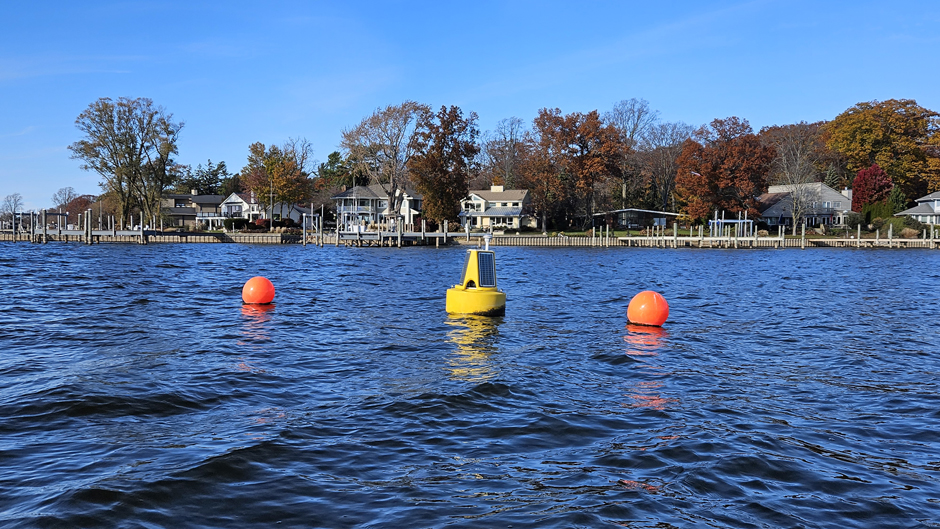
The buoy in the water, against a sunny autumn backdrop. (Credit: ODC Network)
Project Clarity
Lake Macatawa, in Ottawa County, Michigan, is around 6 miles long, and its watershed possesses the tell-tale fingerprints of human-modification–from deforestation by early European settlers to a recent industrial history.
Project Clarity, Ockerse explains, is an initiative “that focuses on community education and best management practice implementation to improve the water quality of Lake Macatawa.”
Historic deforestation and draining of natural wetlands have caused high sediment loads in Lake Macatawa, resulting in ecological imbalance that suppresses plant growth and the presence of fish species and other wildlife.
The project has already reduced phosphorus in the lake by 62% and kept an estimated 46,000 tons of sediment out of the lake every year, but the gradual restoration of this vital ecosystem is an ongoing process.
As part of Project Clarity, and through a partnership with the Ottawa Conservation District and the Ottawa County Water Resources Commissioner, county-wide environmental monitoring has begun.
Ockerse says, “The goal has been to protect and improve surface and groundwater quality in the watershed and in our county by filling in data gaps in existing monitoring data, allowing land managers to make effective restoration decisions.”
Simply put: “We can’t implement effective management decisions without solid data to back them up.”
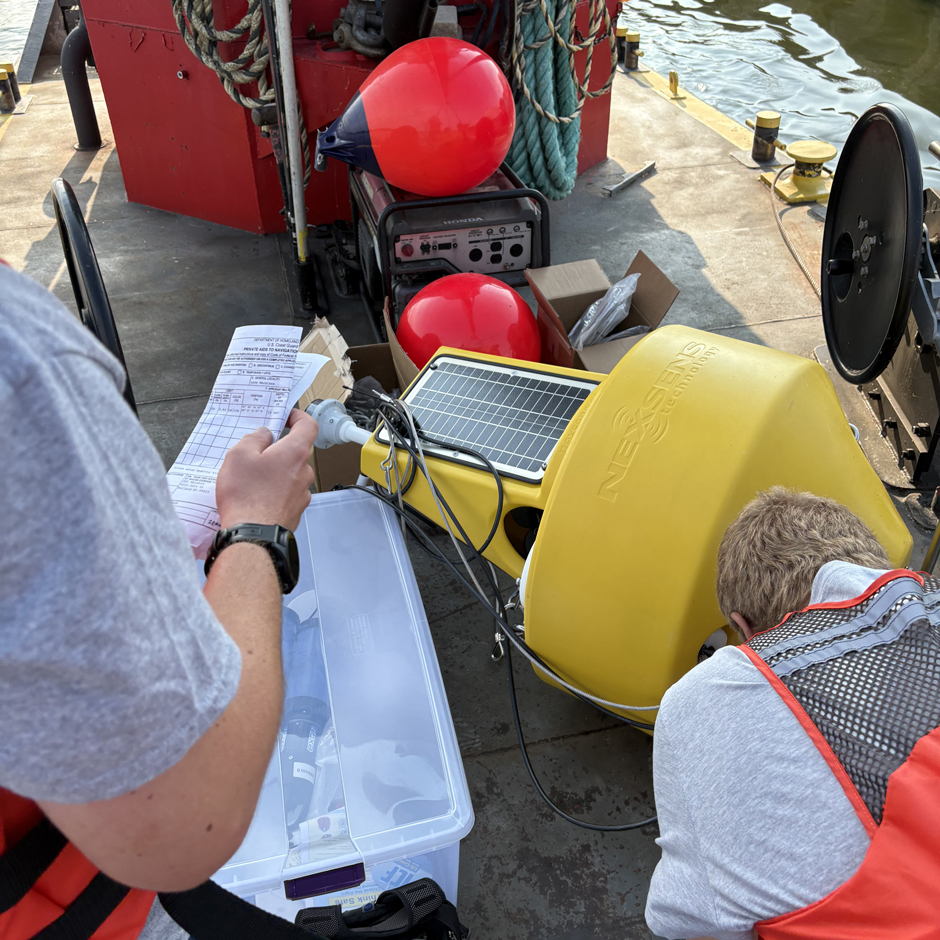
Final assembly before deploying the buoy. (Credit: ODC Network)
Monitoring Lake Macatawa
In July 2025, the ODC Network team deployed a NexSens XB-200 buoy towards the middle of Lake Macatawa in a no-wake zone.
The buoy carries a NexSens X3 data logger and two YSI EXO2s Water Quality Sondes suspended at two different depths and measuring for nine different parameters–temperature, conductivity, pH, dissolved oxygen, oxygen reduction potential, turbidity, phycocyanin, chlorophyll, and fluorescent dissolved organic matter.
Ockerse highlights, “After working through the setup and some minor kinks, the NexSens data buoy has been relatively hands-off. Other than the bi-weekly visits for calibration and cleaning, we don’t have to be out in the field every day collecting data as the telemetry sends it right to our dashboard.”
The team aims to deploy the buoy annually, from mid-April through October, to complement the ODC Network’s wider environmental monitoring efforts.
“Along with the buoy in Lake Macatawa, we also have five more sondes placed throughout our major tributaries in the Macatawa Watershed,” Ockerse states.
“These sondes are not quite as comprehensive as the ones on the buoy, leaving out the parameters in relation to total algae–however, they allow us to see the inputs to our lake and help us identify those critical areas.”
“There are so many choices to be made within a watershed and not enough money to implement every action we want to do,” he continues. “By having great data, we can both implement the best practices in our most critical areas, as well as monitor the effectiveness of those actions after they are implemented.”
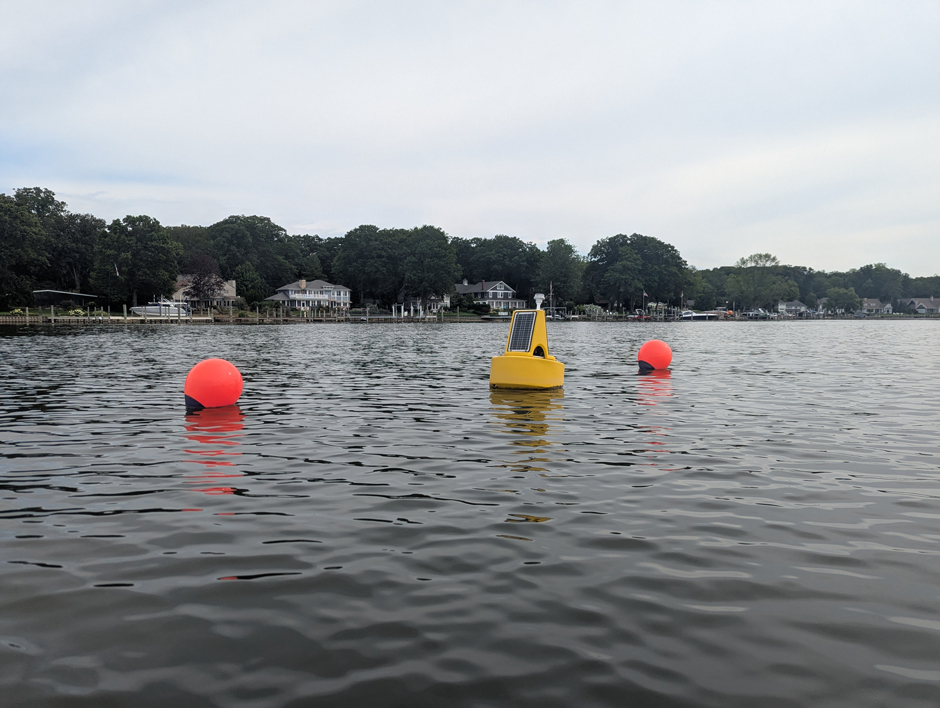
Buoy in the water on Lake Macatawa. (Credit: ODC Network)
Working Together to Share Insights
The ODC Network’s numerous partnerships, extensive data collection, and long-term monitoring programmes come together to paint a comprehensive picture of the watershed, its challenges, and restoration.
The ODC Network has partnered with the Hope College Global Water Research Institute, which has been conducting water quality monitoring at various locations throughout the watershed since 2020, and the Grand Valley State University’s Annis Water Resources Institute, which has conducted in-lake and in-stream water quality monitoring since 2013 to monitor the effectiveness of wetland restorations.
As an organization rooted in community, the ODC Network also conducts macroinvertebrate monitoring in streams throughout the Macatawa Watershed annually through the Michigan Clean Water Corps (MiCorps).
“We’ve been doing this program for 13 years, and it’s another great way to gather data throughout our watershed while incorporating public education, as it seeks out volunteers to help out on the monitoring days,” Ockerse remarks.
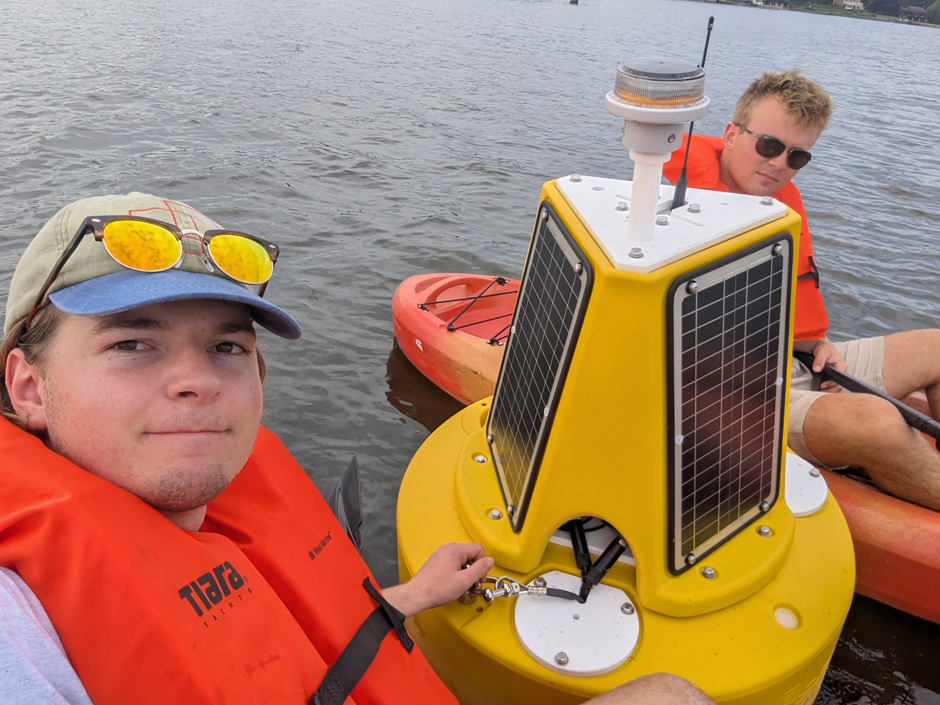
Bi-weekly buoy maintenance. Cole Ockerse is on the left, and summer intern Tristan Overway is in the background. (Credit: ODC Network)
Ambitions for the System and Macatawa Watershed
The Lake Macatawa buoy is still a new addition to the ODC Network’s monitoring efforts–”We used the first season as a time to work out the kinks and figure out an effective monitoring and calibration schedule,” Ockerse reflects.
Despite this, the data is already being fed into the ODC Network’s partnerships and restoration work.
“Faculty from Hope College have been working with us to look at the data from this first year, while comparing it with their own,” Ockerse explains. “We intend to use the data to track trends over time and progress toward meeting water quality goals.”
There are already interesting trends visible from the buoy’s first season on the water. “It has confirmed a lot of what we already know–Lake Macatawa struggles with high turbidity and often high amounts of algae,” Ockerse says.
However, there has also been an unexpected insight–“Dissolved oxygen levels were not as bad as we expected them to be in the lake.”
Ockerse summarizes, “Overall, our plan is to continue gathering and analyzing data to help guide management decisions as they directly pertain to activities in Lake Macatawa, such as impacts of dredging and suitability of pursuing in-lake treatments, like alum application, to improve water quality. We are also working through a plan this winter for how best to share data with the public.”
Although the buoy is still being embedded into the ODC Network’s regular schedule of monitoring, it contributes to an overall system of monitoring that is greater than the sum of its parts, and a project that will have a profound effect on the local economy, environment, and community.
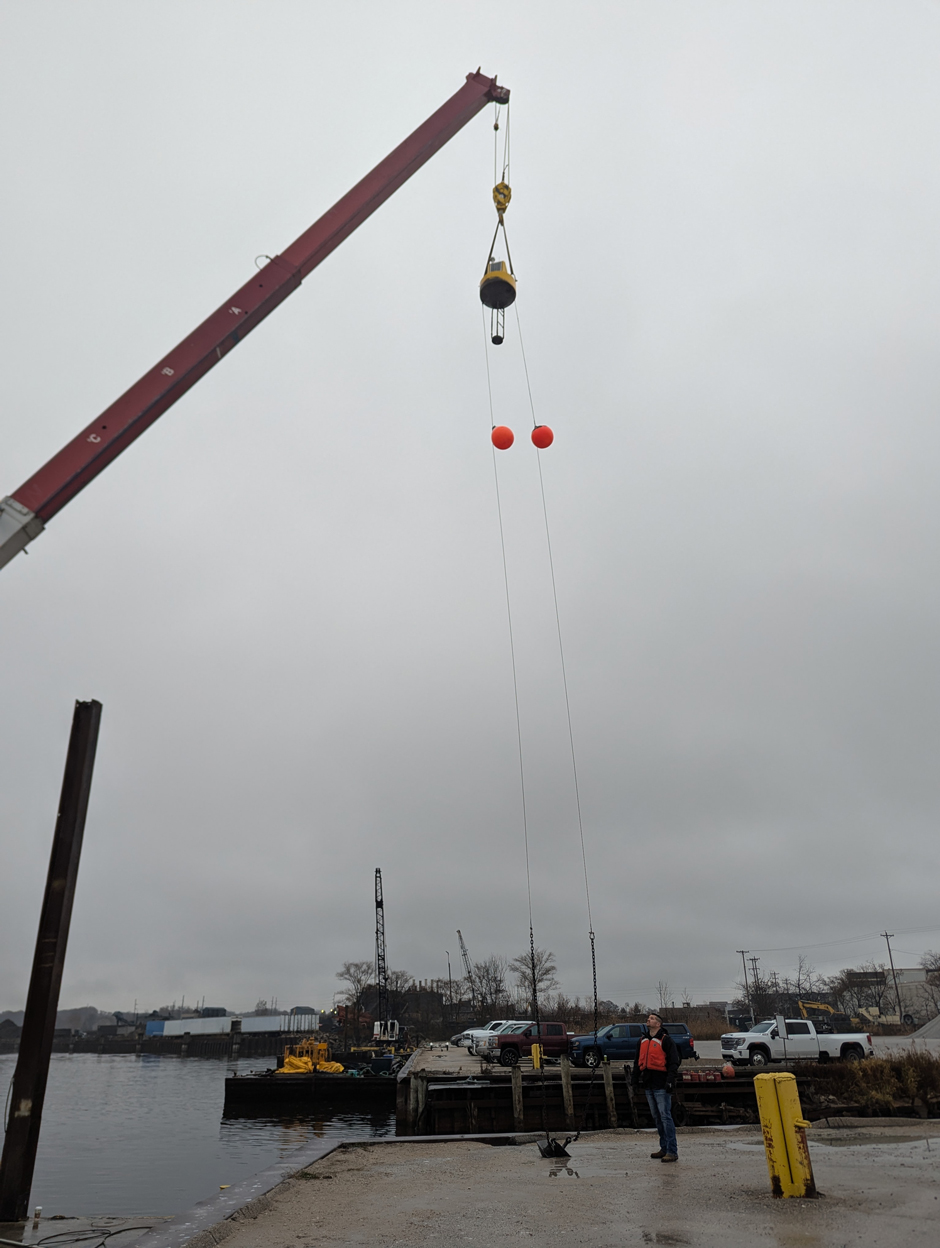
Buoy being lifted out of the lake by a crane. (Credit: ODC Network)






0 comments