

Seagrass and Water Quality Monitoring Protects a Unique Florida Preserve
During the summer months, Morgan Edwards wakes up early to mull over the day’s weather forecast. This time is vital; if the weather is cooperating, she’ll spend the entire day on the water within Florida’s Nature Coast Aquatic Preserve (NCAP).
Edwards is a biological scientist at the University of Florida who conducts water quality and seagrass monitoring in one of Florida’s newest aquatic preserves. She’s been working in the region for years, which stretches along the Gulf Coast from Crystal River in the north to the Anclote River in the south.
In 2021, she was assigned to work in the NCAP, which the Florida Department of Environmental Protection manages. It only came under protection the year before, but its new status means managers have the resources to better understand, and ultimately protect, the 450,000-acre chunk of ocean.
With agreeable weather, there’s a good chance she’ll be working from sunup to sundown, dipping in and out of the water as she gathers vital new data.
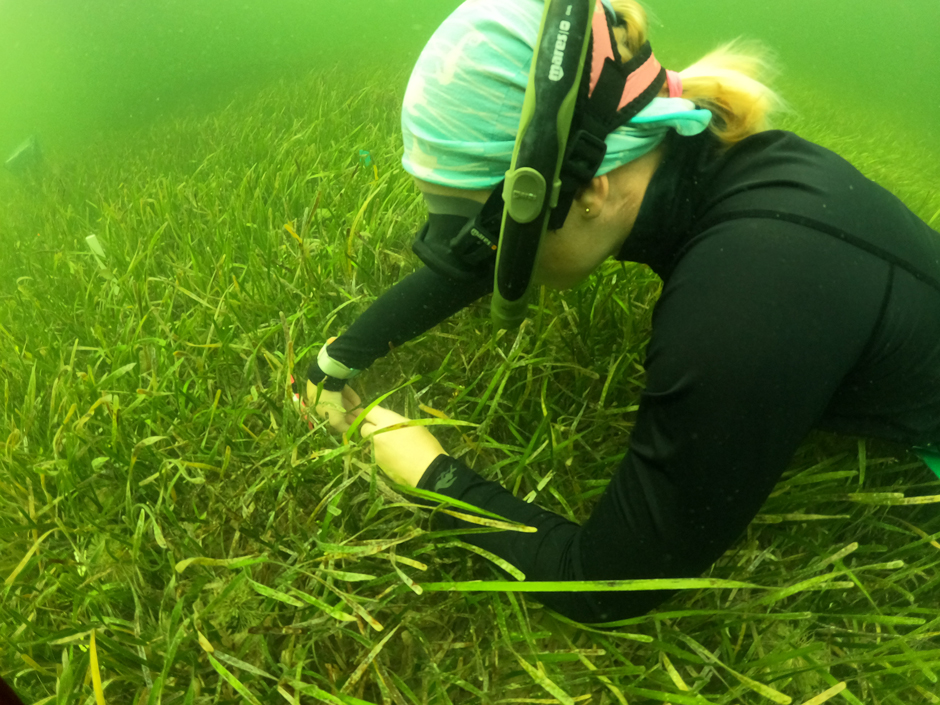
Dr. Enie Hensel makes a small puncture in Thalassia testudinum blades for growth analysis. (Credit: Morgan Edwards)
Creating and Protecting the Nature Coast Aquatic Preserve
Florida has designated 43 aquatic preserves dotted around the peninsula, from the panhandle to the Keys. The Florida Department of Environmental Protection (FDEP) says these preserves protect “some of the most biologically diverse and ecologically significant natural areas in the state.”
Edwards is inclined to agree with this definition in the Nature Coast.
“This section of coastline is a mosaic of seagrass meadows, mangrove islands, salt marshes, and sponge beds,” she says. “But it’s the expansive seagrass meadows that are kind of the flagship resource of the preserve.”
She explains that the NCAP has one of the largest seagrass meadows in the entire Gulf. These meadows are vital for water quality, as they help sequester carbon and prevent sediment resuspension. They’re also an important biotic part of the ecosystem, providing food for manatees and habitat structure for animals.
The importance of Nature Coast’s seagrass was well known locally, but Edwards says there was a gap in protection along this section of coastline. In response, a group of nearby residents banded together to raise awareness and petition for a preserve in their home.
“Aquatic preserves are designated through state legislation, and the Nature Coast Aquatic Preserve really came into existence because of support from local businesses, conservation groups, and local governments,” Edwards explains.
Once designated, these preserves receive funding from the state to monitor and, if needed, restore the ecosystems. The directives are laid out in a management plan, and in the NCAP’s case, the community input was heavy.
“There were multiple public meetings when the management plan was being created, so everyone had a chance to say what their biggest concerns were,” Edwards says, adding that seagrass was at the top of the list.
The FDEP contracted some of this work to the University of Florida, and Edwards stepped into her new seagrass and water quality monitoring position.
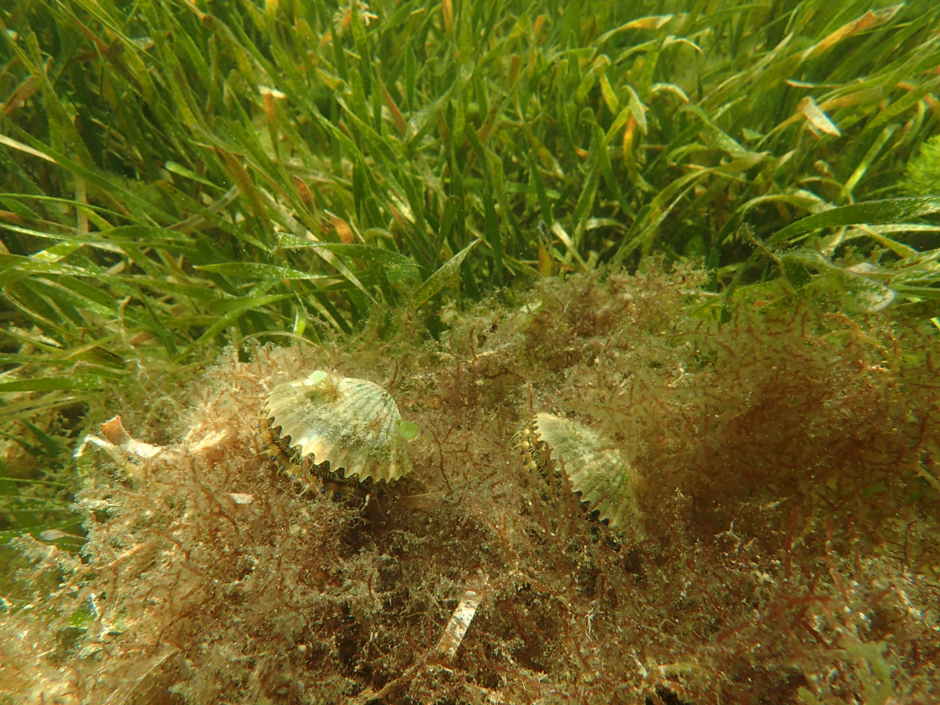
Scallops in a seagrass meadow in the Nature Coast Aquatic Preserve. (Credit: Florida Department of Environmental Protection)
Monitoring Seagrass and Water Quality Together
“The seagrass monitoring and the water quality, they go hand in hand,” she says.
From June to August, during the peak of the growing season, she’ll visit 150 seagrass sampling sites in the preserve.
Here, she and her team use quadrats to measure percent cover, canopy height, and biomass. They’re also taking tissue samples and sediment cores to characterize seagrass condition. She also collects tissue samples from fish and invertebrates living within the seagrass.
Throughout the year, she visits the preserve’s 90 water quality sites monthly, collecting samples to analyze for total nitrogen, total phosphorus, chlorophyll, and color.
She says they also use a YSI ProDSS to measure abiotic parameters like temperature, dissolved oxygen, salinity, and pH. Finally, she uses a LICOR LI-1500 to measure light attenuation in the water column.
“So the water quality sampling informs FDEP on whether or not areas within the preserve are meeting nutrient criteria that [the state] sets for them,” Edwards says.
She continues, “It also tells us why we might be seeing certain patterns in seagrass growth and composition, and so the health of the seagrass meadows depends on the water quality.”
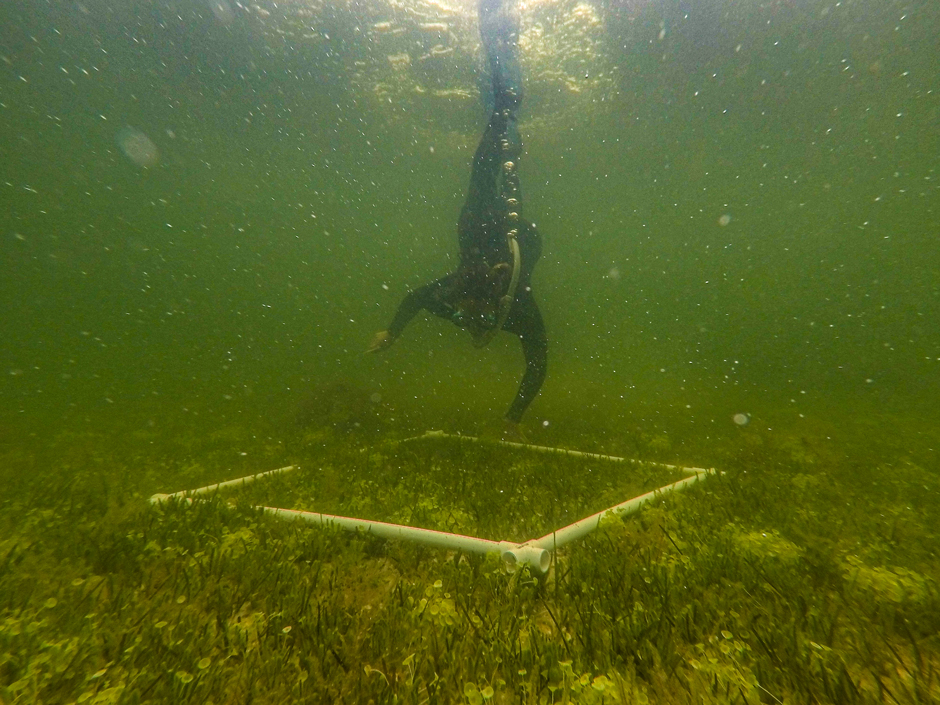
Biologist Morgan Edwards assesses the percent cover of seagrasses and algae within a quadrat. (Credit: Morgan Edwards)
She and her team compile data into reports and presentations to share with the FDEP, which is responsible for making decisions and managing the preserve. This water quality data is also available to the public, who can explore the current conditions and historical data at all 90 sites.
Edwards has noticed that phosphorus plays an interesting role in the NCAP. It’s highest in the north, and she believes this is because the river feeding into the Gulf here has the largest watershed.
“There’s actually this natural phosphorus gradient that goes along the Nature Coast, where we have higher levels of phosphorus in the north, and then they kind of drop steadily as you move south,” Edwards says.
She says some of her water quality sites in the north are trending up in phosphorus levels, and this monitoring program helps FDEP keep an eye on this stressor. If they determine a site isn’t meeting nutrient criteria, they will take action if necessary. However, overall, the NACP’s water quality is good.
What’s more difficult to discern is how well the seagrass is doing. Unlike water quality, Edwards says there’s little historical data in the NCAP to compare current seagrass conditions to, since the preserve is so new.
However, that’s why she enjoys her work monitoring these important ecosystems, as the long-term data it will provide could be important for future management decisions.
“In order to understand whether or not you’re actually seeing increases and decreases or anything, you have to collect a lot of data continuously to do that,” she says.
Despite the long days of field work, Edwards and her team also spend a lot of time engaging with the public. Although many locals understand the importance of their work, she believes that outreach and education are still important for the Nature Coast.
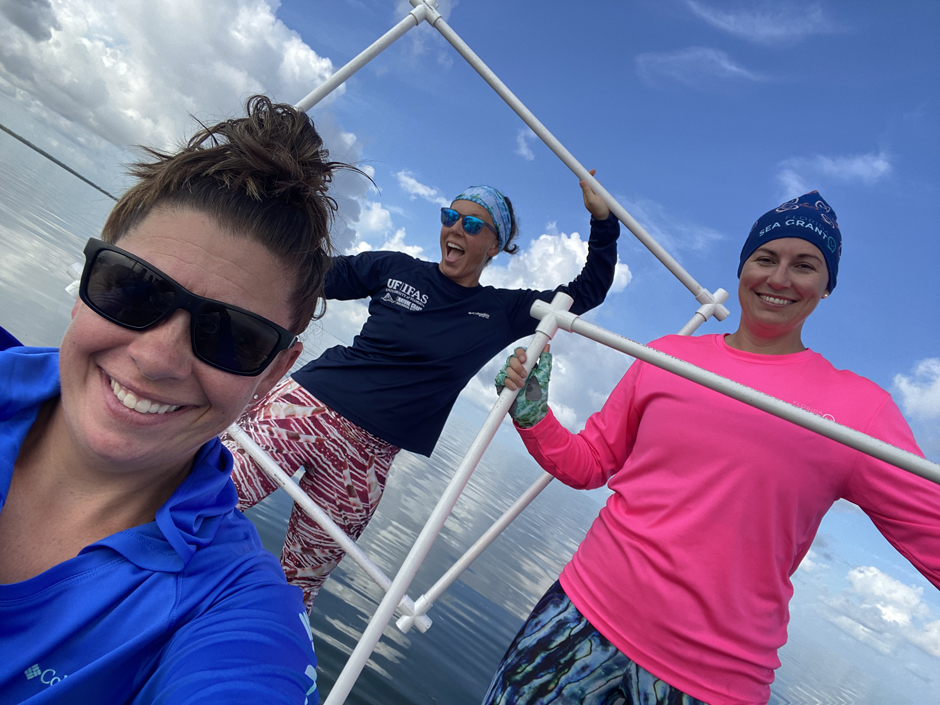
Jamie Hammond, Morgan Edwards, and Dr. Savanna Barry have a little fun on the boat. (Credit: Morgan Edwards)
Outreach and Education Efforts Benefit the Preserve
Local fishers and business owners value the Nature Coast’s incredible seagrass meadows and all their ecological benefits. This natural resource draws tourists and boosts the economy, but tourists may not realize the value of these meadows.
Edwards says one of their biggest outreach initiatives is communicating the danger of seagrass scarring. This occurs when boats enter shallow waters and their propellers cut into the meadows, which are connected by rhizomes growing underneath the sandy seafloor.
“If you have a motor go through that and actually cut up the rhizomes, you create this weak spot in the meadow,” Edwards explains. “And then when you get a big storm, like a hurricane, and you get a lot of wave action and intensity, it makes it easier to rip up a big patch of the grass.”
The NCAP’s management plan details the FDEP’s concerns about seagrass scarring. The Florida Sea Grant, affiliated with the University of Florida, uses a “Scars Hurt” campaign to raise awareness of this issue.
Edwards participates in outreach events on behalf of the NCAP and has used Scars Hurt material to speak on the dangers of seagrass scarring. At other outreach events, she’ll talk about her job, explaining the preserve’s ecosystems and emphasizing why her monitoring efforts are so important.
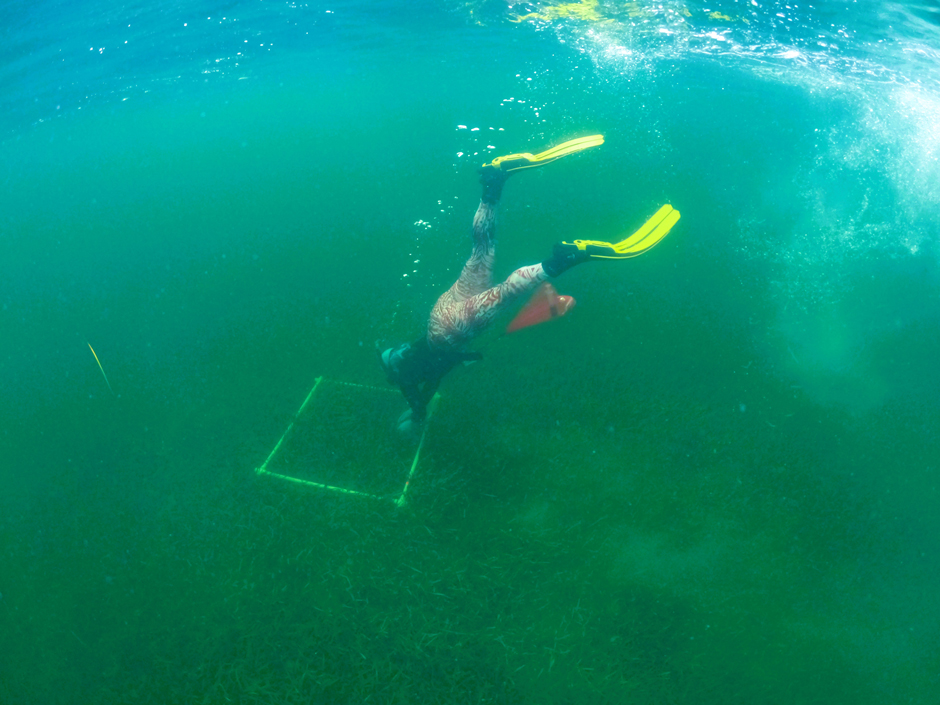
PhD student Finella Campanino collects sediment from within the seagrass quadrat for isotope analysis. (Credit: Morgan Edwards)
UF was recently awarded a grant to collaborate with the FDEP to ramp up its outreach, and Edwards says part of that will be used to purchase virtual reality headsets. This way, after some video footage is captured, people can “swim” alongside Edwards in these seagrass meadows.
“[People] can see what it’s like to be a seagrass scientist and just pop them in some of the different habitat types, so that they can experience it firsthand,” Edwards says. “Because a lot of people haven’t actually made it out to those areas and see all of that stuff for themselves.”
Ultimately, all the work that Edwards and her colleagues do is with one goal in mind: protecting the NCAP.
“The goal is to keep the resource as pristine as possible for future generations and the organisms living in the preserve,” she says.
Sometimes this involves inputting data into a computer for hours, or lab analysis, or presenting data at a public meeting. Sometimes it’s talking with a tourist. And other times, Edwards work inspires her to wake up at the crack of dawn and collect field data all day.
“That’s one of the cool things about the job. No one day is exactly like the other,” she concludes.
Edward’s work was funded in part through a grant agreement from the Florida Department of Environmental Protection, Office of Resilience and Coastal Protection. The views, statements, findings, conclusions, and recommendations expressed herein are those of the source(s) and do not necessarily reflect the views of the State of Florida, NOAA, or any of their subagencies.
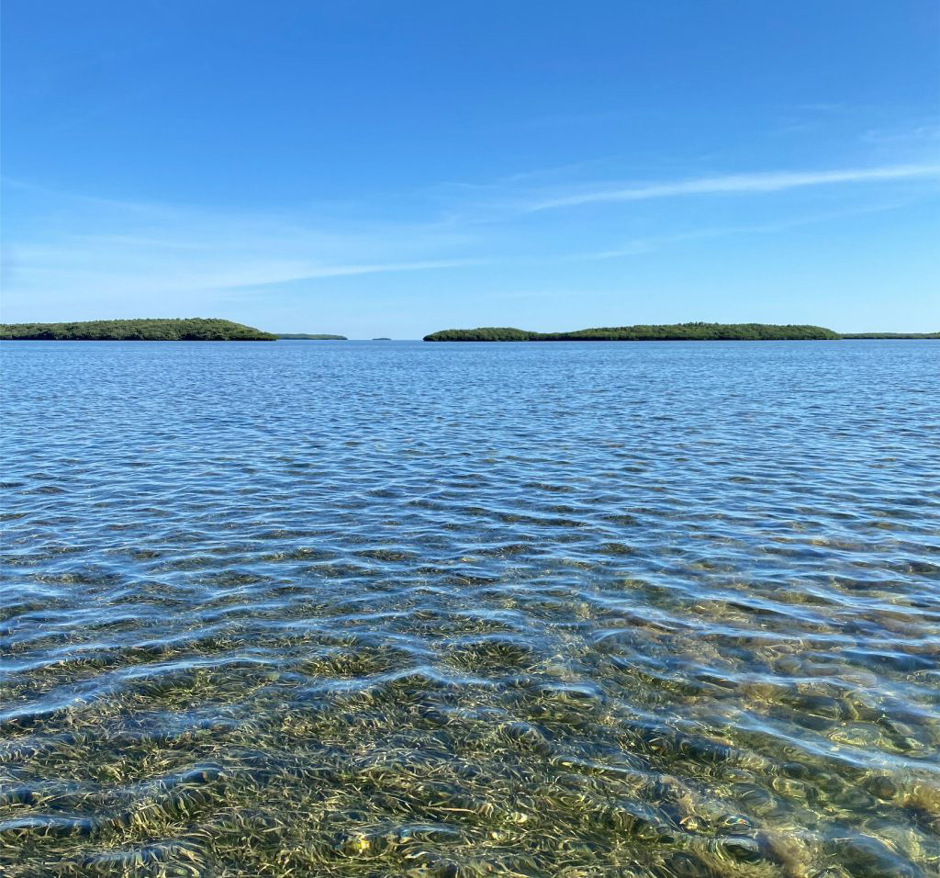
The Nature Coast Aquatic Preserve has hundreds of thousands of acres of seagrass meadow. (Credit: Florida Department of Environmental Protection)






0 comments