

Source Water Monitoring: How Fayette County Finds the Highest Drinking Water Quality
Safe drinking water is vital for public health infrastructure, and providing cost-effective water treatment is a top goal of drinking water utilities. To reduce these costs, counties like Fayette, Georgia, rely on source water monitoring to evaluate water quality before it reaches the treatment plant.
Fayette County Water System serves about 90,000 residents and pulls water from multiple reservoirs in the area. This variety of sources offers unique benefits for the county.
They have built a system that minimizes cost and maximizes choice–two water treatment plants, multiple water pumps, and multiple reservoirs.
Two of the reservoirs have intake structures that allow water treatment staff to choose which level of the water column has the best quality, within 2-foot increments. This system allows the operators to choose the best drinking water source for tens of thousands of residents at nearly any time.
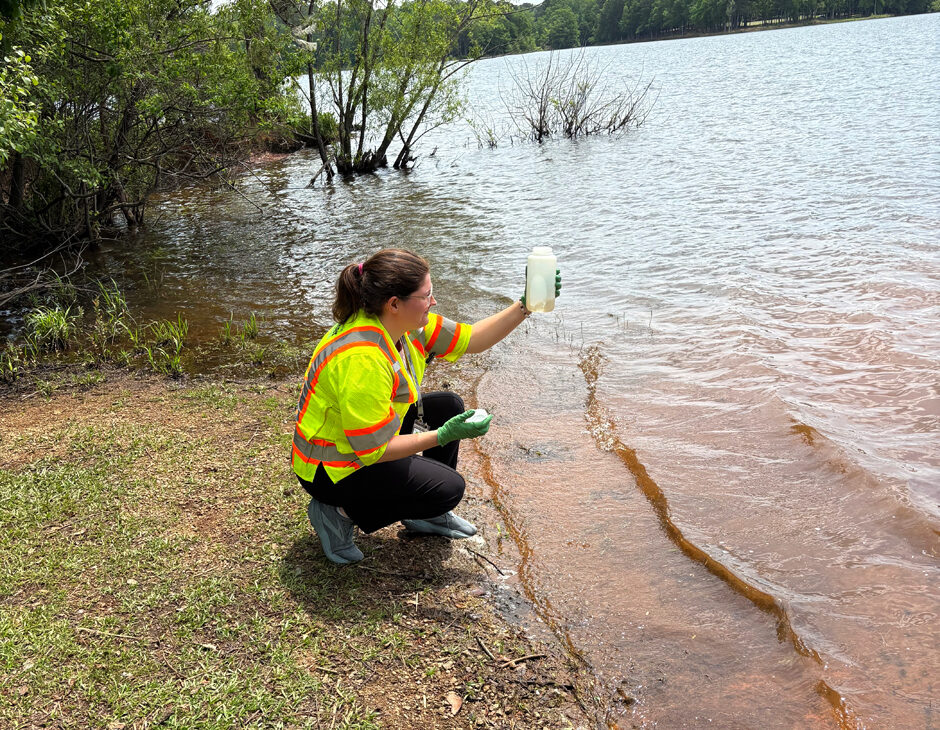
Emily Larrimore responding to a customer request reporting scum on the lake. (Credit: Jason Sears)
Source Water Monitoring Across Fayette County
Fayette County bases its drinking water treatment on finding the best water quality among its four reservoirs: Lake Kedron, Lake Horton, Lake McIntosh, and Lake Peachtree. According to the Fayette County Water System’s Lab and Compliance Specialist, Emily Larrimore, choosing where the county draws water from is discussed on a case-by-case basis dictated by quality.
Fayette has two water treatment plants, and both plants pull from multiple reservoirs. Therefore, if one reservoir is experiencing high turbidity due to storm runoff or another water quality issue, the county can simply shut off the pump from that reservoir. Then the treatment plant will pull from the reservoir with the best water quality, and it will be the most efficient to treat.
“We do a lot of monitoring to choose which of our source water is the best at that time,” Larrimore says.
For example, Larrimore can go out and test a reservoir in the morning and then inform operations staff which area in the water column can offer the best water quality. This occurred recently on Lake McIntosh, where a sudden change in the hypolimnion depth was observed following summer mixing.
Larrimore discovered that McIntosh’s hypolimnion had moved 5-10 feet closer to the surface than it was only a week earlier. McIntosh also experiences surface algae, rendering the surface water difficult to treat. With the surface off limits and the hypolimnion raised, the space to pull good quality drinking water from the epolimnion had suddenly shrunk.
“If the issue is throughout the water column, sometimes we end up ceasing pumping from Lake McIntosh into our water treatment plant’s daypond,” Larrimore says. “And then we switch over to a pump from Lake Horton to choose a different source.”
The reservoirs showing the best water quality are chosen, treated, and then the treated water is distributed to the county. Sometimes they draw from all four reservoirs, and sometimes they have to pick one, but Larrimore says the highest-quality water is always what’s sent to their residents.

Lake Horton Dam Intake at sunrise. (Credit: Benjamin Martin)
Using Source Water Monitoring to Determine Drinking Water Quality
Monitoring water quality is the first step to choosing the best drinking source, and Larrimore says that grab sampling occurs every week at each reservoir around the county.
Larrimore and her coworkers test for metals like iron and manganese with a Hach Spectrophotometer, and conduct comprehensive water quality measurements with a YSI ProDSS, looking at temperature, pH, turbidity, dissolved oxygen, and more.
Water quality testing is important in Fayette, not only to find the best drinking water between reservoirs, but also within the lakes themselves.
On the two largest reservoirs, McIntosh and Horton, water quality varies greatly within the lakes. Fayette has systems in those two reservoirs to pull water from specific points in the water column.
“Sometimes, the algae at the surface is high, but maybe five feet below is fine,” Larrimore says. “So we have a system on both of those major lakes so that we can choose a [water] level within two-foot increments.”

Emily Larrimore and Intern Patrick Knight using YSI ProDSS to monitor the Flat Creek conveyance between Lake Kedron and Lake Peachtree. (Credit: Fayette County)
Fayette’s entire system is based on choice, and choosing the best water quality is a vital job that Larrimore and her colleagues take on. Larrimore says this not only gives their residents the “best product,” but also saves money on chemically treating the water in the plant.
While Larrimore says that the reservoirs are safe to pull from, extreme events still befall the water bodies from time to time. Heavy storms, nearby construction runoff, and natural disasters such as drought have hit Fayette in the past, and have only reaffirmed the importance of their monitoring efforts.
“In a drought, our monitoring would become even more important, because you have a limited quantity of water to work with,” Larrimore says. “And you have to accept the water quality that Mother Nature has given you.”
Most of the time, however, Fayette County can find and utilize Mother Nature’s best water quality on any given day. By catching problems at the source and changing where they draw water, the treatment plants can avoid the added cost of treating heavily contaminated water.

A Lake Kedron iron analysis, showing iron levels increasing as the depth of water increases and dissolved oxygen decreases. Using Hach Ferrover Iron Accuvacs. (Credit: Emily Larrimore)
Partner Organizations and Building Public Trust
In tandem with the consistent sampling and water quality evaluations, Fayette County also relies on partners to help fill gaps in the data. Larrimore says that an important partner of theirs is the Southeast USGS office.
The USGS has continuous monitoring stations across the country, including in Fayette County. Beyond their four reservoirs, the county occasionally pulls water from the Flint River to supplement Lake Horton, for which the USGS also provides water quality data.
Moreover, to determine compliance with withdrawal permits, Fayette needs lake elevation and stream flow rate data. The expansive USGS monitoring system provides this extra data. Larrimore says USGS even undertakes some of the quality control on Fayette’s water quality data.
“There are so many utilities in our area that depend on those stations, and we certainly have a huge dependence on those stations, as well,” Larrimore says.
Ultimately, all the water quality data collection is used for one purpose: serving the best drinking water to the residents of Fayette County. Larrimore says that building trust with their constituents is vital, considering how important drinking water is for public health.

Emily Larrimore presenting on water quality and careers in the water industry to a school group. The image is algae under the microscope. (Credit: Fayette County)
Fayette County will continue to serve more people as the county grows and draws people from out of town to the central Georgian county.
For example, multiple blockbuster movies are being shot at Trillith Studios, where A-list actors and crews may spend weeks or months at a time. Additionally, in preparation for hosting and preparing for the 2026 World Cup, US Soccer broke ground on its National Training Center in Fayetteville in 2024.
So, from movie stars to international athletes, Fayette County water will be serving drinking water to a growing base of users.
Yet, with all the work that Larrimore and her colleagues put into providing the best quality drinking water, they hope to stay in the background. In her best-case scenario, the public knows who they are and what they do, but doesn’t have to think about them often.
“As long as everything’s running well, we are an essential service that works behind the scenes,” Larrimore says. “And when we make big changes, we want to be proactive about communicating.”
Being proactive is a common theme for the Fayette County Water System. With constant source water monitoring and the ability to quickly switch between water sources, Fayette can catch and adapt to changing water quality conditions with great flexibility. Flexibility that’s driven by collecting high-quality data, ultimately giving residents the best quality product Fayette can provide.

South Fayette Water Treatment Plant Day Pond at sunset. (Credit: Lewis Jordan)






0 comments