

What’s Floating on Lake Geneva? How LéXPLORE is Revolutionizing Lake Science
Lake Geneva (or Lac Léman) was formed some 15,000 years ago by retreating glaciers and is shared between France and Switzerland. Fringed by vineyard terraces and overlooked by both the Jura Mountains and the Alps, the lake is popular with visitors who come to enjoy the sights and recreation.
In addition to the 20,000 boats moored on Lake Geneva, it’s also home to LéXPLORE, a 10x10m pontoon that acts as a floating laboratory.
Installed in 2019, this novel infrastructure is a unique partnership between five academic institutions, managed by the Limnology Center at the École Polytechnique Fédérale de Lausanne (EPFL).
The platform provides continuous lake measurements that are being used to assess the impact of global changes and monitor the lake’s health.
Guillaume Cunillera is the Chief Technical Officer of the LéXPLORE platform. In this role, he leads the technical team and coordinates the research groups utilizing the floating laboratory.
In 2020, bored with office work, he applied for a technical role at the EPFL for the LéXPLORE platform. Cunillera felt this job was a “perfect match” for his knowledge of lake ecosystems, passion for electronics, and love of outdoor sports–“I truly enjoy fieldwork even during winter and/or rainy days,” he beams.

Lake Geneva’s depth (over 300m at its deepest point) makes it a good place to measure waves without bathymetric influences, and is sometimes called the “pocket ocean”. (Credit: Guillaume Cunillera)
LéXPLORE Floating Platform
“The LéXPLORE platform aims to provide a safe environment for deploying sensors both in the air and underwater at depths ranging from 0 to 110 meters. We can therefore measure at high spatial and temporal frequencies, at all depths and at all times, even at night or during storms.” Cunillera explains.
“We offer various power supplies, internet access, a chemical flume, restroom facilities, and more. We ensure that scientists have everything they need to stay on the platform for a few hours or even several days,” he continues.
The platform features a “wide range” of sensors and vertical profilers–installed on the platform or within the protection perimeter. Their uses fall into two broad categories.
Firstly, “The Core dataset.” This corresponds to all the fundamental parameters measured by LéXPLORE’s instruments.
“That includes all the basic parameters with sensors that belong to us, that we maintain and calibrate,” Cunillera says–including a temperature chain, weather station, or ADCPs, for example.
“All collected data is accessible through our data portal, Datalakes.ch; this website is available to everyone—scientists and local residents alike—who may be interested […]. For scientists, this resource is particularly beneficial as it allows them to focus on their specific research data while having easy access to essential background information,” he emphasizes.
Secondly, scientific projects. Cunillera outlines, ”We host a variety of sensors used by different research groups, ranging from profilers, fish sonar, microplastic pumps, and more. They can be anything depending on the research group’s focus.”
“We have just received the application for the 68th project on the platform since 2019–a little less than half of them are finished now,” he adds.
Additionally, private companies can also use the platform to test their products, for example, optical modems and remotely operated vehicles (ROV).
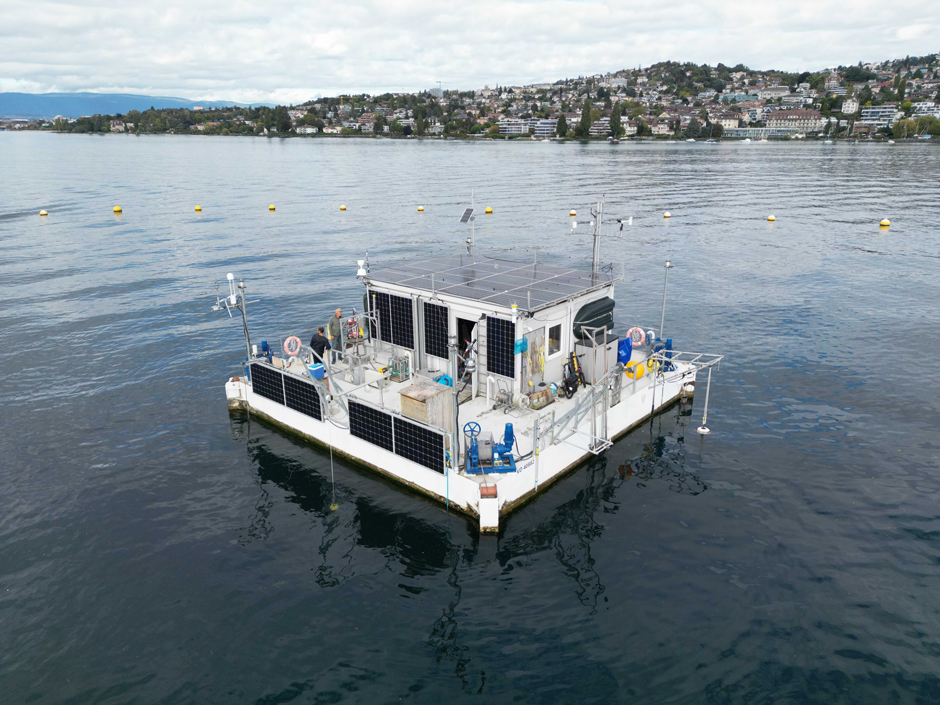
LéXPLORE’s 10x10m platform and perimeter are packed with technology. Its unique dataset allows modelling the key processes in the lake, enabling prediction of the lake’s evolution and the impacts of environmental changes. (Credit: Guillaume Cunillera)
The LéXPLORE Wave Buoy
Part of this impressive floating science platform is a NexSens CB-450 buoy. Equipped with a SeaView Systems SVS-603HR sensor and an X-Series data logger, its primary purpose is to provide data on wave characteristics.
The wave buoy was installed on the protection perimeter of the LéXPLORE platform between two secondary buoys, and was “quite straightforward”.
“The NexSens system fits perfectly in our core data sets,” Cunillera highlights, “And several researchers need those data.”
Currently, the buoy’s SVS-603 takes hourly measurements. Over approximately 19 minutes, the sensor records over 2,000 data points, which are averaged and sent to the host modem on the platform. Data is translated and sent to the data portal. The next hour it starts again.
In the future, Cunillera wants to increase the sampling frequency of these measurements to get a better view of incoming waves.
“We would ideally like to adjust the resolution of the measures based on several factors, such as wind values from our weather station, voltage of the battery, or special events,” he states.
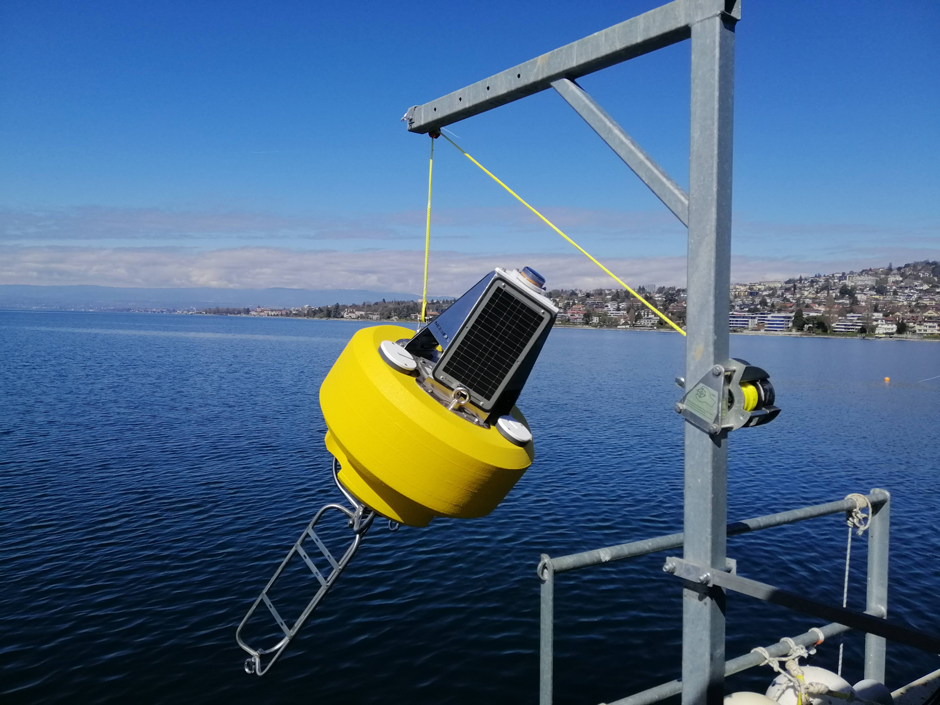
The NexSens CB-450 buoy being prepared for deployment. (Credit: Guillaume Cunillera)
Progressing Lake Science
As with other data collected from the platform, buoy data can be accessed on the Datalakes portal.
Cunillera shares the manifold uses of the buoy data, starting with the platform’s technical team, who use it “to follow and have a better understanding of the [impacts of] strong wind and storm events on the infrastructure.”
Scientists working on the Wind2Waves project–which studies the evolution of the directional wave energy spectrum–use data from the buoy as well as that collected from their own system and sensors.
Several other projects use the data, with research questions ranging from how to assess primary production in the lake through optical in-situ measurements and satellite observations, to investigating the relationship between temperature in the first few micrometers and centimeters of water depth, and understanding the carbon cycle and gas exchange at the air-water interface.
Research undertaken at the platform and using data from its sensors has applications beyond Lake Geneva itself.
With a long history of environmental monitoring, the LéXPLORE platform represents a cutting-edge advancement in data collection on Western Europe’s largest lake. In response to climate change and anthropogenic pressures, it’s enabling scientists to measure and better understand how the lake and its surrounding ecosystem are evolving.
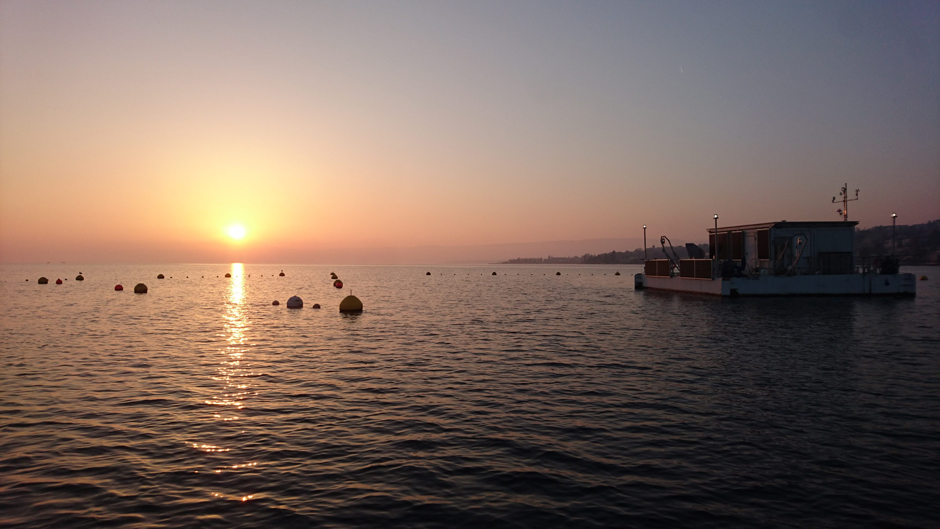
LéXPLORE platform is anchored near Pully, on Lake Geneva’s northern shore. Equipped with state-of-the-art instrumentation, it collects simultaneous measurements of physical, chemical and biological processes at high temporal and spatial resolutions. (Credit: Guillaume Cunillera)





0 comments