
Science for Science’s Sake: Monitoring Ocean Energy Availability and Gulf Stream Dynamics
Scientific research often begins with a question, sometimes driven by a specific goal or application, but many scientists believe in science for science’s sake. Marine environments and physical dynamics like the Gulf Stream are popular fields of research due to their complexity and importance, presenting a unique opportunity to learn more about previously unexplored phenomena.
Environmental researchers, in particular, see the value in these ecosystems, but many also grew up with a passion for the natural world, and choosing a field that allows them to interact with and learn about the environment around us is an easy choice.
This was the case for Mike Muglia, an associate scientist with the Coastal Studies Institute (CSI) and associate professor at East Carolina University, who started his career with a love of surfing, diving, and fishing.
This interest landed him in a physics classroom as part of his marine biology degree. There, he gained an interest in special relativity and the physical processes of marine environments.
Muglia explains, “In Western society, we grow up thinking linearly—it’s kind of ingrained. And I realized that most things in nature are cyclic, and so I wanted to retrain my brain to think that way.”

The HERO WEC being tested on the nearshore mooring at Jennette’s Pier. (Credit: John McCord /Coastal Studies Institute)
While pursuing a master’s in physics at UNC Chapel Hill, Muglia worked with a physical oceanographer studying physical processes in the Outer Banks, which led to a full-time job offer to help found CSI.
Muglia’s lab includes six to ten staff members, ranging from middle school students all the way to post-graduate students who work together and conduct observational physical oceanography research.
More simply put: the lab deploys wave, current, salinity, temperature, and density sensing instruments to develop a better understanding of the physical oceanography of the region.
The three primary research topics investigated by the lab are the dynamics of the Gulf Stream, complex current confluence in the Cape Hatteras region, and partnering with renewable ocean energy developers to identify ideal areas for harnessing wave and current energy.
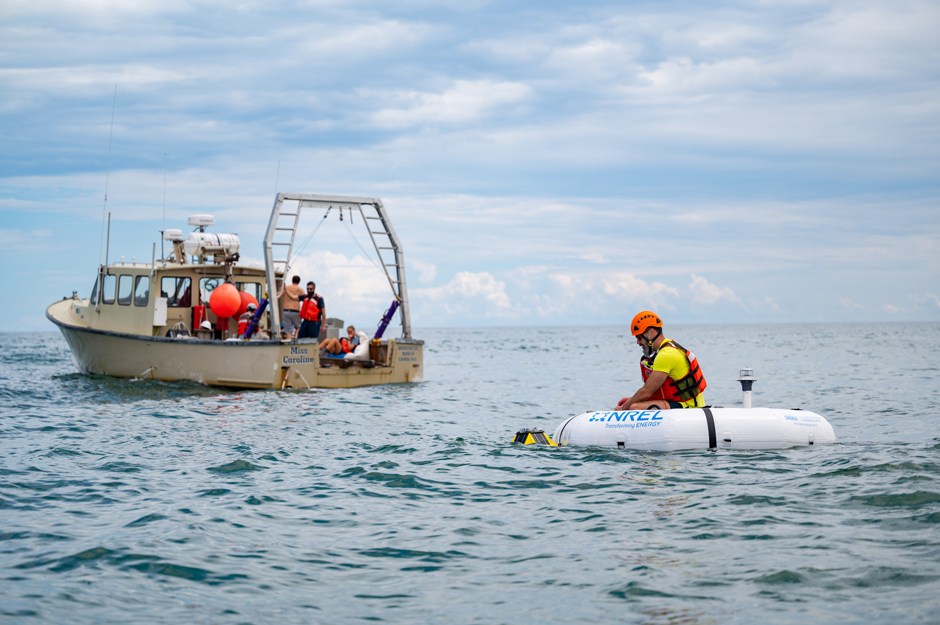
Scott Jenne from the National Renewable Energy Labs (NREL) enabling the HERO WEC at the Jennette’s Pier Wave Energy Test Site. (Credit: John McCord /Coastal Studies Institute)
Observing the Gulf Stream Off the Coast of North Carolina
Being the largest western boundary current in the world, the Gulf Stream is responsible for bringing tremendous amounts of water and heat from the south to the north.
Serving many other critical functions, Muglia notes that global sea level rise and climate change could influence the expected functions of the Gulf Stream. In particular, the exchange of bottom water formed in the North Atlantic and the warm Gulf Stream water could change due to rising temperatures.
Additionally, Gulf Stream dynamics, like where the stream leaves the shelf and goes off into the deep ocean near Cape Hatteras, are essential for climate modeling.
Most of his Gulf Stream research includes the use of ADCPs on moorings or subsurface buoys at the bottom of the ocean and land-based radars that measure ocean surface current hourly and thus Gulf Stream variability.
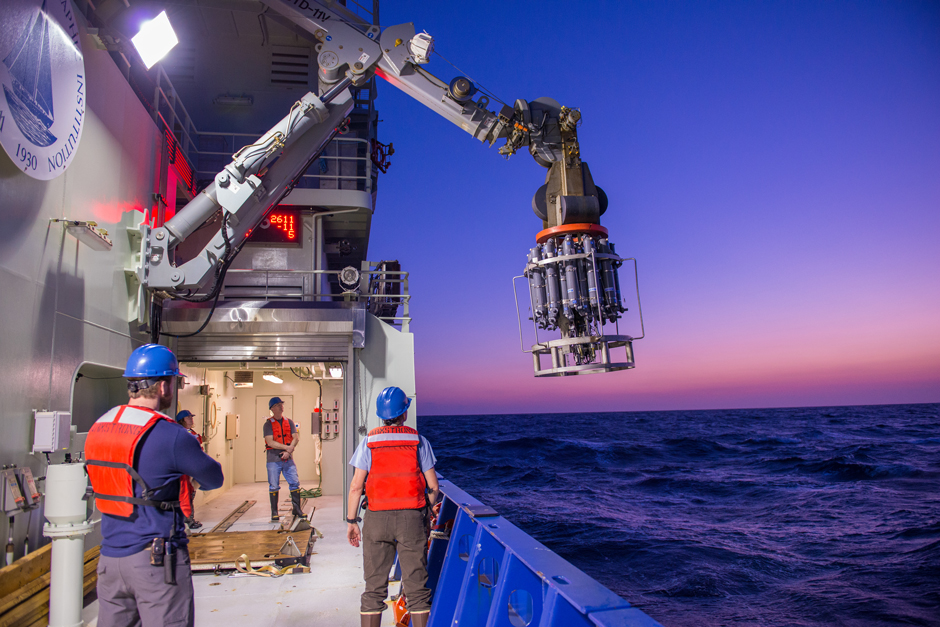
Casting with the Rosette on the RV Armstrong as part of the Processes Driving Exchange at Cape Hatteras experiment. (Credit: John McCord / Coastal Studies Institute)
The bottom-deployed ADCPs are positioned looking up toward the surface, measuring current speed and direction, and detecting if the Gulf Stream is moving over the instrument or not.
The Doppler profilers can also measure from a boat driving through the Gulf Stream, looking down at the sea floor.
Conductivity, temperature, and depth sensors (referred to as CTDs) are also commonly deployed at fixed locations or hand-cast at different sites as a means of monitoring the Gulf Stream. A variety of CTDs have been used over the years, including a SonTek CastAway, Sea-Bird HydroCAT, RBR Concerto, and open CTDs.
Spot sampling with the CastAway or Concertos captures how certain conditions change with depth, while long-term continuous deployments of the HydroCAT and open CTDs paint a picture of conditions in the Gulf Stream over time.
The open CTDs are designed and built in-house by Muglia’s lab and students as a low-cost solution. Lindsay Wentzel leads this effort with Ryan Golden and Trip Taylor, who helped modify the software to measure wave height and period.
Data from the CTDs help identify Gulf Stream waters, whether sampling is occurring in shelf water from the north or south, and density-driven mechanics of water movement. Such wave data helps inform marine renewable energy efforts.
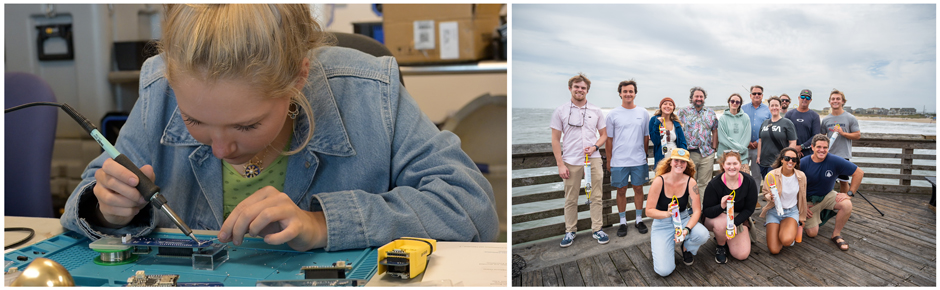
(Left) Manteo High School student Sterling Wright building her CTD in the lab at the Coastal Studies Institute. (Credit: John McCord/Coastal Studies Institute) | (Right) The Open Conductivity/Temperature/Depth (CTD) team doing test CTD casts with newly constructed CTDs from Jennette’s Pier. (Credit: Parker Kellam /Coastal Studies Institute)
Ocean Energy Research
While energy companies know how to harvest the energy, coming up with solutions for ocean deployments and finding the ideal placement can be difficult, so Muglia’s lab serves as a consultant, providing critical data and guidance.
“It’s difficult to get energy at sea and it’s expensive. So, if you have a device that can provide energy when you’re offshore, there’s a lot of value in that. […] if we’re making a transition to renewable energy, because we’re concerned about carbon dioxide and global warming, marine renewable energy complements solar and wind very well,” explains Muglia.
He continues, “When solar and wind power are down, wave energy is often up, and what the power companies want to do is levelize that energy so they’re getting consistent energy over the entire time period.”
Muglia’s lab leverages the wave data obtained from the CTDs, ADCPs, and several small wave sensing buoys to inform energy companies about where they can harvest the most energy and how to construct a solution suited for marine environments.
“All those measurements are great for understanding the oceanography here, but they also provide an observation-based characterization of the resource for someone developing renewable energy devices,” states Muglia.
He continues, “If I put a wave energy converter offshore—I want to know how big the waves get. How often are they big? What’s the wave period? What kind of energy can I expect to get from the wave field? How do I design a device to optimize getting that energy based on the wave field?”
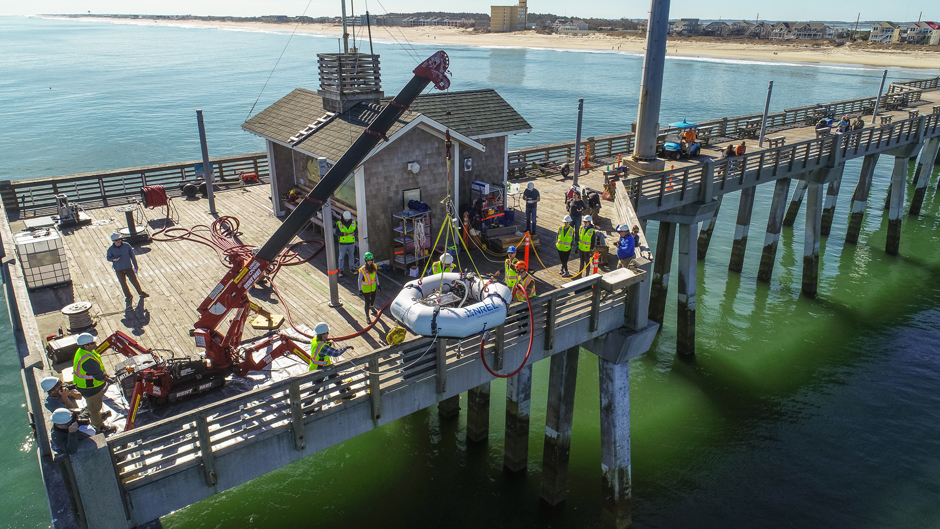
The HERO WEC deployment teams from NREL and the Coastal Studies Institute deploying the HERO WEC at Jennette’s Pier. (Credit: John McCord / Coastal Studies Institute)
In addition to the small wave buoys, a larger real-time system is also deployed off Nags Head at the Atlantic Marine Energy Center’s 11-meter wave energy test site through a partnership with Bob Heitsenrether’s group at NOAA’s Ocean Systems Test and Evaluation Program.
One of NOAA’s CURBY platforms, the system records and reports wind speed and direction, current velocities, relative humidity, barometric pressure, air and water temperature, and salinity remotely.
The data from this system is used mainly to help the public stay informed of water conditions and collect observations relevant for Wave Energy Converter testing. It also helps inform deployment and maintenance trips for Muglia’s lab and personal trips out to the water.
In this way, the two key components of Muglia’s work are complementary, benefiting the public and researching physical oceanography for the sake of learning more about the world’s oceans.
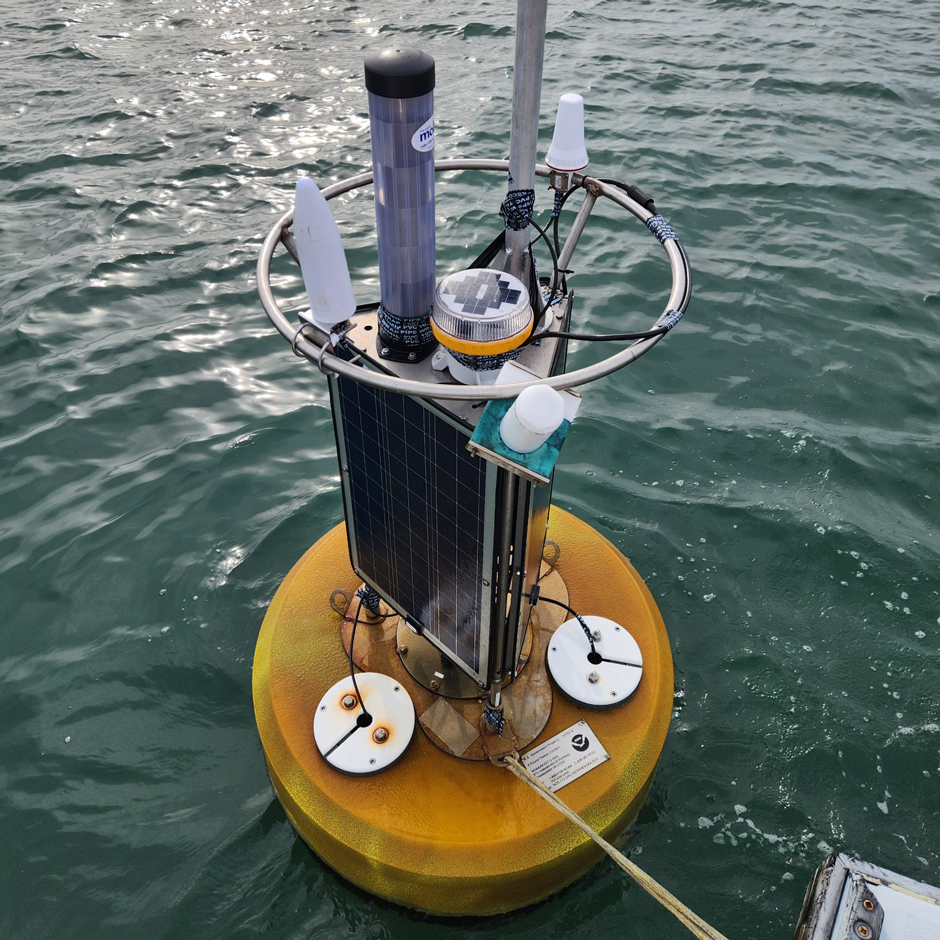
National Oceanographic and Atmospheric Administration Observation (NOAA) Buoy deployed at the Jennette’s Pier Wave Energy Test Center 11-meter test site. (Credit: Mike Muglia / Coastal Studies Institute)
Conclusion
Though these are both important parts of his work, Muglia finds his passion for the work the lab does lies in learning more about the region and ocean environments.
He explains, “As a scientist, I’m very passionate about understanding nature, and there doesn’t have to be any application for that. I’m happy to just understand something that we’ve never learned before.”
While Muglia loves being out on the water, building knowledge of physical oceanography, his time in the lab and classroom is irreplaceable.
“I love building people. I love having a kid like Maili McManus, who’s worked with our lab since she was in middle school, see her go to college and work with us for several years and watch her grow, write her letters of recommendation and try to facilitate her professional career,” states Muglia.
“Or interns like Cora McQuaid, who just got a job at Scripps and called me all giddy on the phone about it because I wrote her a letter of recommendation. To help somebody like that makes me feel great,” he continues.
Having started his career out of a love for the water, Muglia has found his place inspiring others and building a generation of scientists who will spend their lives on the water, equipped with the knowledge needed to make a difference.
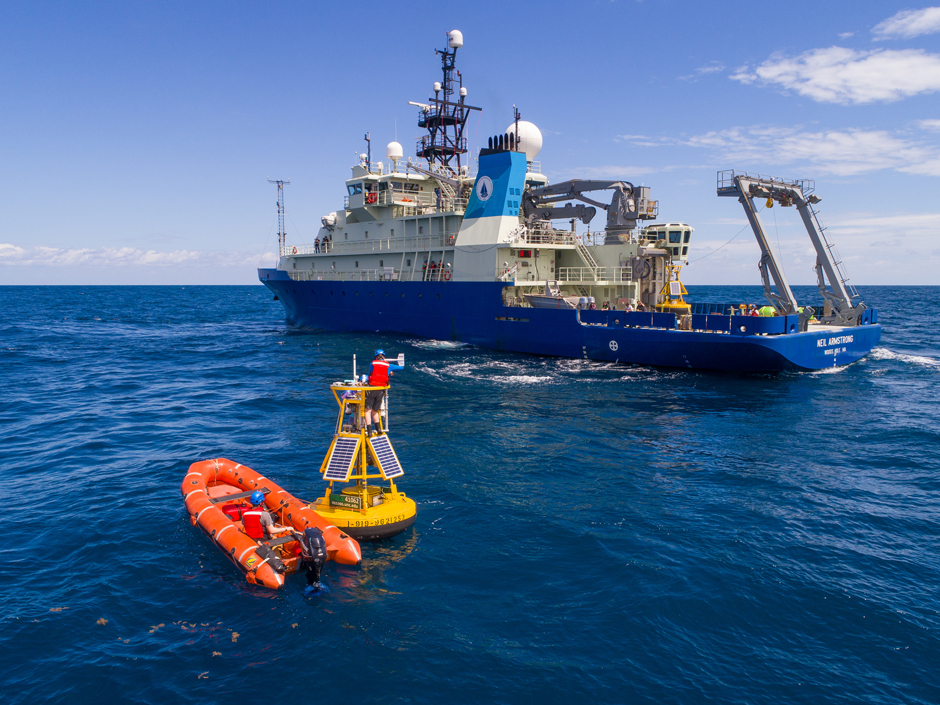
The UNC CH and CSI teams doing meteorological station repairs after a storm on a buoy about 20 miles offshore of Nags Head during the National Science Foundation-sponsored Processes driving Exchange at Cape Hatteras (PEACH) project. (Credit: John McCord / Coastal Studies Institute)





0 comments