
Coastal Rivers Conservation Trust: Community Focused Watershed Monitoring and Management in Maine
The Coastal Rivers Conservation Trust is one of many land trusts across the US dedicated to monitoring and maintaining natural resources for future generations by expanding and improving current protections based on data and community needs.
Such efforts are expansive, including watershed monitoring as well as education and outreach initiatives that keep communities informed. In order to keep all of these efforts staffed, the Coastal Rivers Conservation Trust relies on volunteers to collect data.
Sarah Gladu, Director of Community Science for the Coastal Rivers Conservation Trust, manages a group of nearly 100 volunteers, coordinating monitoring efforts across the Damariscotta-Pemaquid region.
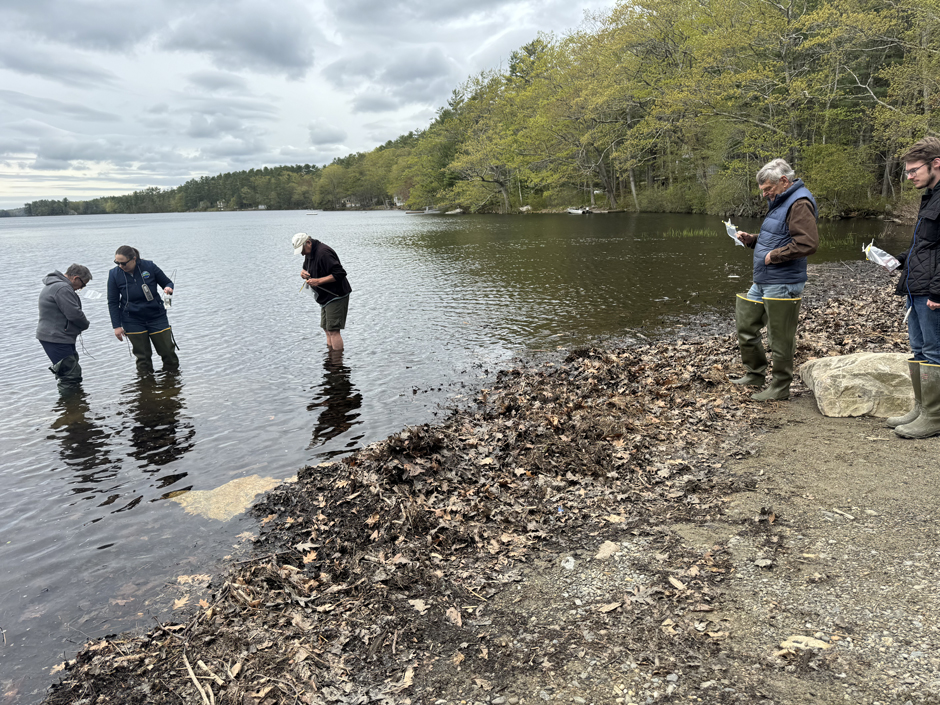
Maine Department of Environmental Protection’s Healthy Beaches Program staff train and certify Coastal Rivers’ volunteers to take samples for bacterial analysis at swim beaches throughout the summer. (Credit: Sarah Gladu)
Monitoring Efforts in the Damariscotta-Pemaquid Watershed
Two long-term, large-scale monitoring programs managed by Gladu have been collecting data on the region’s lakes, rivers, and estuaries for years.
Estuary monitoring has focused on the Damariscotta River estuary, with water column data collection occurring twice a month throughout the spring, summer, and fall using a YSI Pro-Series water quality meter to measure depth, dissolved oxygen, salinity, temperature, and pH at seven locations.
During site visits, volunteers also collect grab samples from the estuary that are then tested for nitrogen in the lab.
Gladu explains, “We have some specific concerns around nitrogen impact in the estuary because it has the capacity to exacerbate coastal acidification. So we are particularly interested in [nitrogen], but more generally in coastal acidification issues, because it plays a role in how oysters grow and it impacts many plants and animals along the shore.”
“We are collecting background data, but also we have a real interest in coastal acidification and anthropogenic impacts on the estuary,” she continues.
“The estuary is famous for the oysters that are raised here, and so it’s an important industry locally—it’s an important part of the economy. So, there’s a real use, not only for our organization as a land trust focused on stewardship, but it also can be used on the municipal level and locally to guide activities along the shore as well and inform the community,” adds Gladu.

Sarah Gladu, Coastal Rivers’ Director of Community Science calibrating a deployable OnSet HOBO logger used to gather continuous data with the Maine Coastal Observing Alliance, a network of community groups interested in understanding coastal acidification. (Credit: Joslin Gladu)
The trust also oversees pond and lake monitoring at seven water bodies in the watershed. Data is collected using the same YSI meter and a Secchi disk to record water clarity. Surface phosphorus samples are also taken to be analyzed at the State of Maine Environmental Testing Laboratory.
This data is then shared with Lake Stewards of Maine to be included in the statewide database, which is then passed on to the state’s Department of Environmental Protection to inform regulations and restoration efforts. The data is also used locally to help guide activities and education projects in the community.
There is also a new project occurring along the coast in partnership with the Maine Coastal Observing Alliance. Nine HOBO MX800 loggers are being deployed from the Harraseeket River estuary to Belfast Bay as part of a continuous monitoring program to collect water quality data along Maine’s shore.
Ultimately, the goal of these monitoring projects is to learn more about existing phenomena in the region as well as identify drivers of acidification in coastal areas of Maine.

Coastal Rivers’ Director of Community Science hands off gear to trained water monitoring volunteer, Merek Pruski, on aptly named Muddy Pond in Damariscotta. (Credit: Joslin Gladu)
Community-Oriented Work with Regional Impacts
While there are larger applications for this data, the trust’s focus lies with the community, helping to inform conservation efforts and land use plans, as well as weighing in on management practices.
Education and outreach are also important parts of this work. An example of the trust’s outreach programs is their involvement with LakeSmart, which focuses on educating homeowners on conditions in the watersheds and ways to minimize anthropogenic impacts through best practices.
Data Made Possible by a Passionate Community
These are just a few of the projects managed by the Coastal Rivers Conservation Trust. With dozens of other active projects, Gladu stresses that the programs are made possible through the hard work of the organization’s volunteers.
“We’re a relatively small organization, so in terms of environmental monitoring, it’s just me and an intern—Forest Holbrook—in the summer, and a cadre of fantastic volunteers who do a number of projects,” states Gladu.

Forest Holbrook putting the guard on the YSI Professional Pro before use in a local pond. (Credit: Kris Christine / Coastal Rivers’ volunteer)
In addition to individual volunteers, Gladu notes that several local and regional partners make the Coastal Rivers Conservation Trust what it is in terms of data collection, analysis, and presentation.
Partners like the University of Maine Darling Marine Center, the Maine Departments of Environmental Protection and Marine Resources, the Maine Coastal Program, and other organizations help enhance the trust’s local work throughout the community and region.
Volunteers and collaborators are the backbone of the trust’s work, making the large variety of programs possible through the community’s passion.
Gladu explains, “We’re fortunate in that we live in a region where the community is extremely supportive of what we do. The engagement level that we see is very rewarding—and the way that the the volunteers share back into the community, is invaluable.”
She continues, “In our communities, the volunteers who are engaged in water monitoring, talk to neighbors or friends, and so this broadens and magnifies the capacity that we have to monitor and understand water quality conditions locally.”

Volunteers Jim and Patty Alfrari take Coastal Rivers’ intern Forest Holbrook out regularly to monitor on Pemaquid Pond from their boat. (Credit: Kris Christine / Coastal Rivers’ volunteer)





0 comments