

Iowa Great Lakes: Glacial Origins to Modern Monitoring
The hummocked landscape of Iowa’s northwest is a looking glass to its glacial past, and the Iowa Great Lakes–a cluster of seven natural lakes in Dickinson County–are no exception.
Glaciers are more than enormous blocks of ice that carve their way through a landscape. They are dynamic systems in their own right, with complex sub- and supraglacial processes and intense internal forces.
Glaciers pick up a myriad of hitchhikers as they move–from boulders the size of buses, to fine glacial till–markers which endure even after they recede, leaving tell-tale signs of an icy past, if you know where to look.
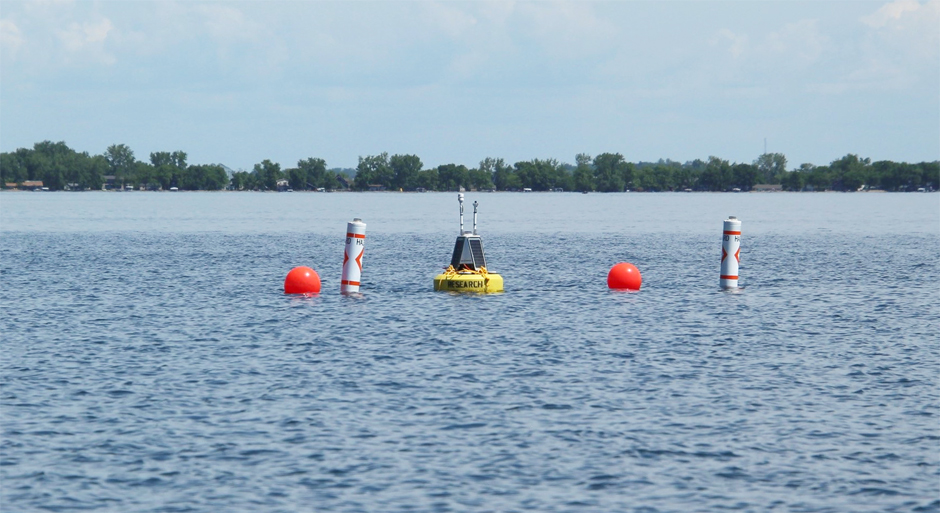
The buoy on Big Spirit Lake, a shallow, glacial lake. (Credit: Matt Fairchild)
Iowa Under Ice
When the blanket of ice retreated northwards across Iowa some 13,000 years ago, it left behind a potted kame and kettle landscape.
Kames, often conical hills or mounds, are composed of till that accumulates in a depression on the glacier surface, which is dumped as the ice melts.
Kettles, conversely, are depressions formed when blocks of ice break off from retreating glaciers and become buried in the ground. When this ice eventually melts, it leaves a hollow which, when deep enough to reach the water table, or filled by precipitation, becomes a so-called kettle lake.
“In Iowa, most of our lake ecosystems are shallow glacial lakes that have maximum depths of 8 or 9 meters,” says Dr. Mary Skopec, Executive Director at Iowa Lakeside Laboratory, a field biological station of the Iowa Board of Regents.
“However, adjacent to our campus in northwest Iowa is a chain of lakes that includes several shallow glacial lakes, but also West Okoboji Lake with a maximum depth of 40 meters,” she continues.
“This proximity of very shallow and deep glacial lakes provides an excellent setting for comparisons of nutrient processing, ecosystem dynamics, and understanding water movement in groundwater dominated landscapes.”
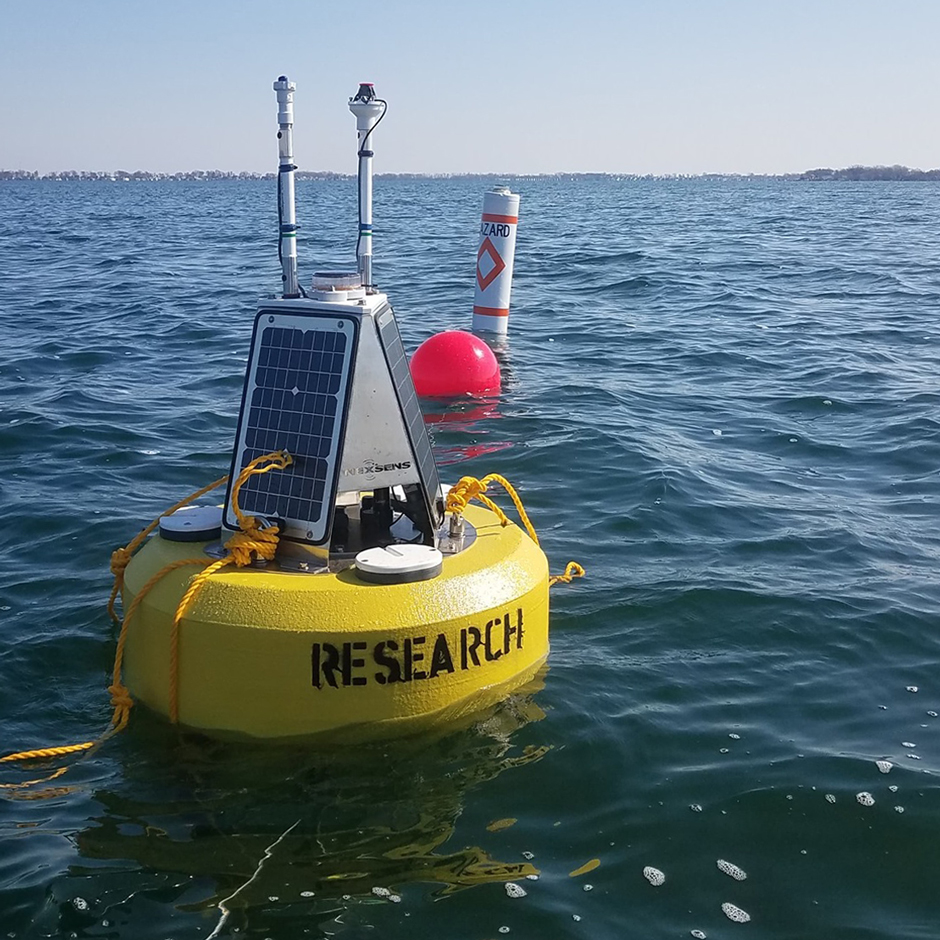
The Big Spirit Lake buoy has a more comprehensive payload, with an additional wave, light, and algae sensor. (Credit: Matt Fairchild)
Lakeside Laboratory
Lakeside’s 147-acre property is situated on the west side of West Lake Okoboji–the deepest of Iowa’s natural lakes. The site is managed by Facilities Manager, Matt Fairchild, and combines a biological laboratory and natural areas that include native prairie, wetland, woodland, and shoreline ecosystems.
Lakeside provides science classes and research opportunities for university students, offers outreach programs, and provides services through the state universities.
Skopec manages a team of summer interns that conducts research on aquatic and terrestrial ecosystems, and directs classes at Lakeside Laboratory, including the Ecology and Systematics of Diatoms, Ecology and Aquatic Ecology.
“Our research questions relate to understanding the fate and transport of nutrients in an agriculturally dominated landscape where the lakes are also a primary economic driver through tourism,” Skopec states.
Towards Enhanced Monitoring
Iowa’s shallow lakes, complicated by high turbidity, invasive species, and human pressures of recreational use, resource extraction and eutrophication, suffer from harmful algal blooms (HABs). These blue-green scums can produce harmful toxins, but robust prediction remains evasive.
“In the 1990s, the community began to invest dollars into long-term and permanent conservation efforts including wetland restoration, prairie restoration, and stormwater best management practices for the built environment,” Skopec explains.
“Our goal is to understand how these conservation practices are changing how nutrients (nitrogen and phosphorus) are moving into and out of the system and changes in the long-term storage of nutrients in the lakes,” she continues.
Over a decade ago, Lakeside Laboratory started a program of real-time monitoring using buoy systems. Skopec notes that NexSens buoys were chosen for their “proven utility in other lake systems around the world, their ease of use, ability to withstand the lake biofouling issues, and plug and play with a cloud-based data system.”
Fairchild maintains the two buoy systems. One is located in a deep-water lake system at approximately 30m on West Lake Okoboji, and the second is in a shallow lake system at approximately 9m on Big Spirit Lake.
“West Lake Okoboji started in 2015, and Big Spirit in 2020,” Fairchild says. “The main platform [on Big Spirit Lake] is the NexSens CB-450 Data Buoy. We have a SVS-603-UW wave sensor, RDO PRO-X Dissolved Oxygen Probe, a LI-190R-BL-2 LI-COR Quantum light sensor, a 200WX-IPX7 Ultrasonic weather station and YSI EXO2 Multi-Parameter Water Quality Sonde to measure pH, conductivity, dissolved oxygen, temperature, and blue-green algae.”
The West Lake Okoboji system is slightly more compact–without the wave, light, and algae sensor.
Both systems use the In-Situ RDO Pro-X Dissolved Oxygen Probe, and temperature strings deployed at approximately every 3m in the deep-water system, and every 1m in the shallow system. They also both have a NexSens X-series data logger, which enables data transmission directly to the cloud.
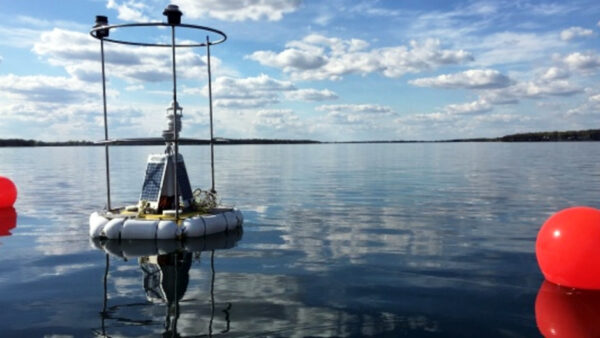
The West Okoboji Lake buoy. West Okoboji Lake is renowned for its water quality and is the deepest lake in Iowa. (Credit: Matt Fairchild)
High-Resolution Data
The two systems are deployed seasonally, from “ice out, to just prior to ice on.” With the data, the team is able to explore how deep stratification occurs and its relation to turbidity and nutrient processing.
“Each year, we hope to catch the lake’s stratification throughout the summer and then the loss of stratification,” Skopec notes. “In the deep water system, the lake stratifies all summer, while the shallow lake has short durations of stratification that are disrupted by weather systems that bring rain and wind through the area.”
And these systems do not operate in isolation. Skopec highlights, “We also have a citizen monitoring program that collects surface water samples of the lakes every other week from June to October.”
She continues, “Coupled with the sensor systems, we can link the data from the surface with phenomena at depth. We also have a program to measure harmful algal blooms and microcystin algal toxins at recreational beaches located around the chain of lakes. The sensor deployments have been used to understand the timing and severity of those blooms.”
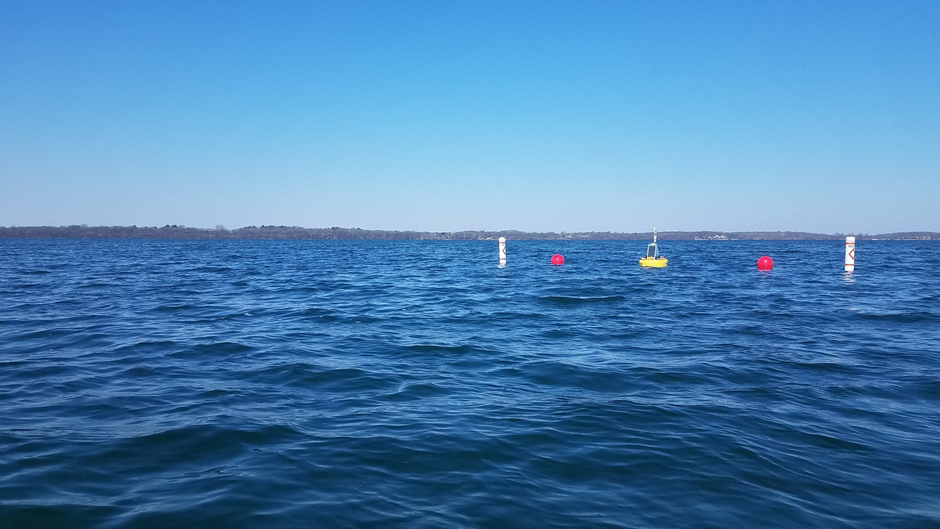
The Big Spirit Lake Buoy. (Credit: Matt Fairchild)
Insights that Inform
The data has also provided surprising insights–the high frequency of data collection has enabled the identification of short-term stratification in Big Spirit Lake–“It was interesting to see how the short-term stratifications and disruptions in the stratification due to mixing were linked to small fish kill events and harmful algal blooms in the lake,” Skopec remarks.
The long-term dataset has also enabled observation of long-term trends. On West Lake Okoboji, there have been “dramatic improvements” in water quality, including healthier oxygen levels. Now, the Lakeside team is investigating increases in pH and how this might relate to algae populations.
Beyond Lakeside’s research, data from the buoys has also been used elsewhere. For example, the county soil and water conservation district uses it to measure the performance of on-land conservation practices.
Local utility companies use it to understand potential challenges when drawing water for consumption–including where in the water column to draw water to avoid taste and odor issues–and local fishermen use it to identify depths where fish may be congregating.
“Overall, the data are vital to managing the health of these important lake systems for future generations,” says Skopec.
Looking to the future, Lakeside has ambitions of buoy deployments in all five of its major lake systems, to be able to understand how water quality changes as it flows through this interlinked system.
Furthermore, understanding the impact of recent invasives like Curlyleaf Pondweed and zebra mussels on lake nutrient processing and phytoplankton populations has been earmarked as a future research area.
Ever since they were created over 10,000 years ago by cryospheric forces, Iowa’s Great Lakes have never been static. In this latest chapter of their environmental history–one marked by human influence–this ongoing research will help us understand and protect these valuable ecosystems and natural resources, and preserve them for future generations.






0 comments