

Long-Term Monitoring in the Chautauqua Lake Watershed
With a widely developed shoreline, Chautauqua Lake experiences influxes of non-point source pollution that have historically impacted the health of the lake. The Chautauqua Lake Association (CLA) has been monitoring the lake for over two decades, reporting on changes that have occurred over the years.
A pair of local lake advocates, Jane and Doug Conroe, have lived on the lake for over 40 years and have played an important role in establishing monitoring programs and facilitating consistent data collection throughout the watershed.
Doug has been involved with the Chautauqua Lake Association (CLA) since the pair moved to the area in 1980, and is currently serving as the Executive Director.
They are both long-term volunteers for the New York State Department of Environmental Conservation’s (NYSDEC) Citizens Statewide Lake Assessment Program (CSLAP). This program is administered by the New York State Federation of Lake Associations (NYSFOLA) and is implemented locally by the CLA.
Jane also serves as the Chair of the Chautauqua-Conewango Consortium, A Waterkeeper Alliance Affiliate. She also helped establish the on-going pond monitoring program at the local Audubon Community Nature Center property.

Jane Conroe on board gathering sonde data along with one mid-winter CSLAP sample. (Credit: Doug Conroe)
Sending a Message about Chautauqua Lake
Having lived on the lake for over four decades, Chautauqua Lake is a huge part of the couple’s daily life and monitoring the lake has also become part of their lives.
Doug explains, “We deal with water quality issues all the time through the Lake Association, and living on the lake, we see them firsthand here in front of our house. So, it interests us to know what’s happening with the lake, how it’s evolving, if it’s improving, or if it isn’t.”
He adds, “Getting involved has just been a natural occurrence.”
And it’s not just local residents who are interested in water quality conditions in the lake. When NYSDEC and NYSFOLA established Chautauqua Lake as part of the CSLAP monitoring program, it sent a strong message about the state’s opinion on the lake.
“I realized then that the quality of the water was important and needed to be monitored,” states Jane.
Monitoring Chautauqua Lake Watershed
In terms of CSLAP data, the volunteer team focuses on collecting grab samples of the water for later lab analysis. The state is most interested in evaluating phosphorus and nitrogen concentrations due to the risk of nutrient loading as a result of nonpoint source pollution from multiple sources in the region.
Chlorophyll, pH, dissolved oxygen, phycocyanin, and conductivity are also measured by the Chautauqua Lake team using a YSI ProDSS.
The sonde is mainly used for ground truthing other measurements, but has also been used to help gather data in other parts of the watershed as well. The data from the grab samples and ProDSS measurements contribute to a local dataset.
The main lake is sampled about every two weeks between June and September, with the Lake Association’s sampling equipment being loaned out to other local watershed conservation groups and researchers in between. This helps monitor a larger portion of the region, capturing the impact of stressors like pollution on small lakes, ponds, and streams.
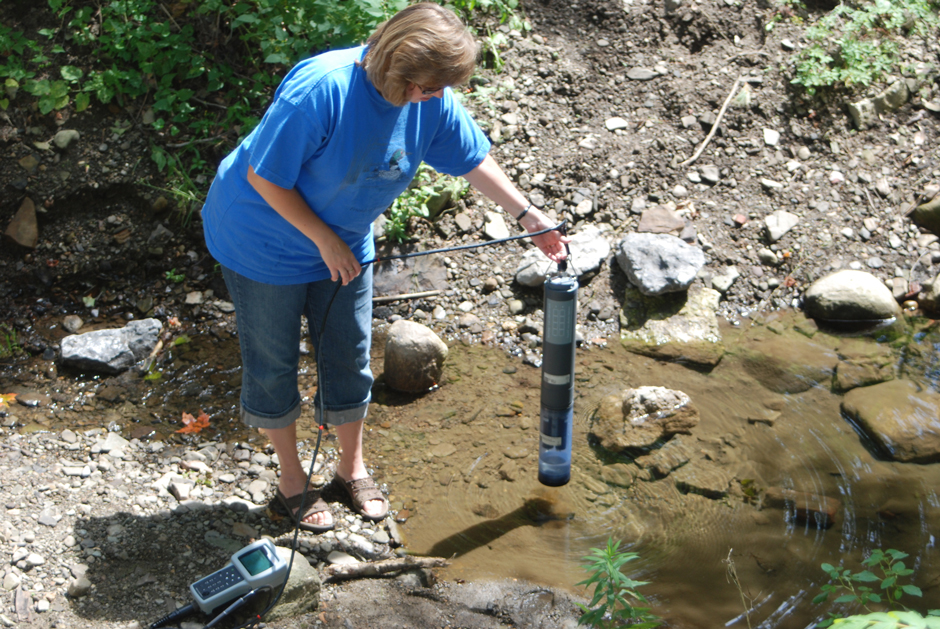
Janis Bowman using a YSI multi-parameter sonde for requested projects in both the lake and selected lake inflows. (Credit: Jane Conroe)
For example, Janis Bowman, a now retired Professor of Biology at Jamestown Community College, used the ProDSS to collect temperature, pH, dissolved oxygen and chlorophyll a data over several months for two separate projects. One of the projects was initiated by Chautauqua County to “answer the question of anoxic conditions and the existence of a thermocline in Chautauqua Lake.”
Overall, the goal of the Lake Association is to establish a consistent line of historical data and document changes in lake trends and eutrophication.
With a history of harmful algal blooms, monitoring conditions associated with triggering blooms or being indicators of a bloom, like phycocyanin, is important to protecting public safety, as the lake and its beaches are a popular recreation spot.
In smaller ponds and minor tributaries, a YSI ProPlus is typically used to collect data on the same parameters, as is the case at the Audubon Community Nature Center property. The data collected for the Audubon is used to evaluate if water resources in the 600-acre property have experienced any changes over the year, with measurements conducted every spring and fall.
Historical and Present Data Use
When the Chautauqua Lake Association joined the CSLAP program, their data were included in the state’s database.
Initially, yearly changes were noted and published in the state’s annual report. Now, with over 30 years of information, both short and long-term trends profile what is happening in the lake and can be used both locally and statewide.
Early on, this data helped set up the Total Maximum Daily Load (TMDL) for phosphorus in the lake and ever since has been used as a way of evaluating the success of local efforts to improve conditions.
Doug adds, “Having that longitudinal information is very good to see how the lake is evolving and whether actions that are happening to reduce phosphorus are indeed doing so.”
Monitoring efforts on the Audubon’s property share a similar story. Jane explains, “It was established to be baseline data, but then to continue to monitor for unusual conditions.”
She continues, “We have a land use management plan that is set up to identify threats and then be able to follow-up with the appropriate actions.” In cases where actions need to be taken, the following year’s data will reflect whether the management plan was effective or not.
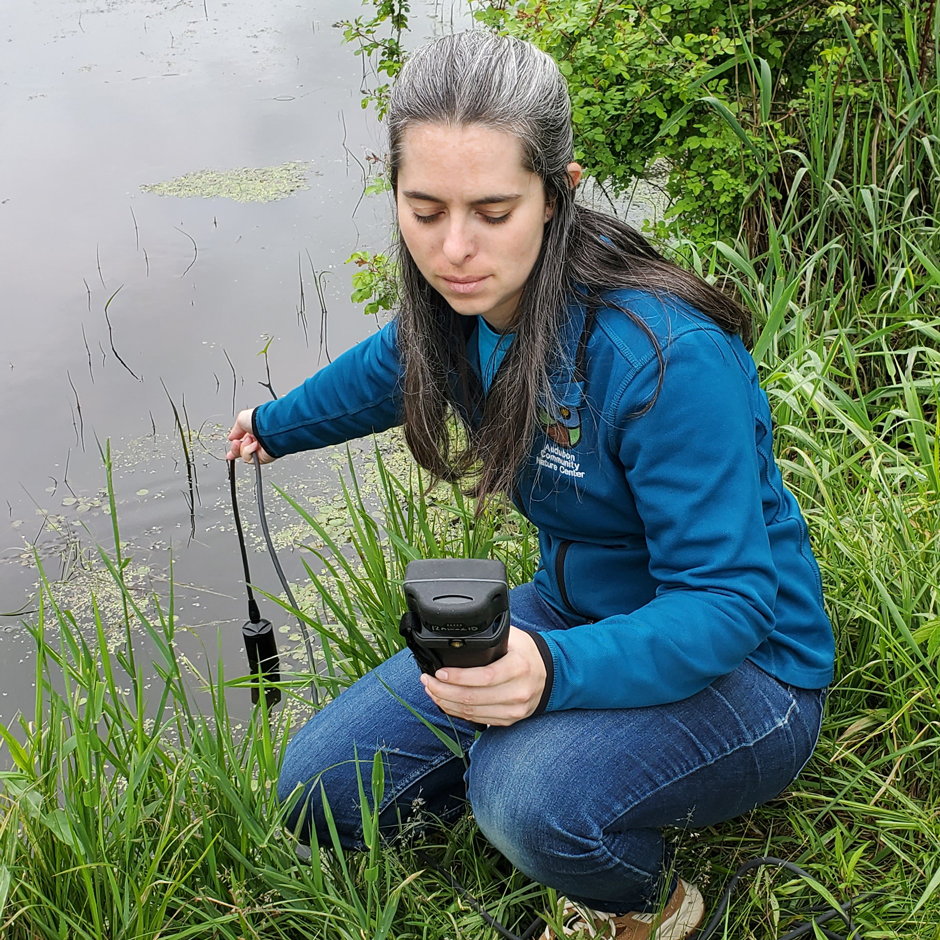
Emma Roth, Nature Educator and Animal Care Specialist, using the Professional Series Digital handheld meter at the Audubon Community Nature Center. (Credit: Jane Conroe)
Improving Conditions in Chautauqua Lake
Management efforts include a number of green infrastructure projects like tributary work, stream bank stabilizations, and the creation of rain gardens and buffer zones.
The local sewage treatment plants have all switched to tertiary output methods as an additional measure toward preventing nutrient influxes into the lake.
These land use shifts and green infrastructure efforts were initiated as a means of mitigating the damage caused by decades of pollution—40 years later, the Lake Association is evaluating historical and current lake data to see if these projects have been successful.
Doug explains, “There was huge hope that several big projects over 40 years would start to show some results. It just takes time. There’s no quick fix.”
As is the case in countless other watersheds, years of damage must be repaired with years of restoration and continuous mitigation efforts. Still, the Conroes stress that this management and continued monitoring to catch successes and issues when they occur, is necessary.
“It’s real easy not to do it. It’s real easy to let it lapse. And I’m a firm believer that we need long-term data to best understand situations,” states Doug.
Jane adds, “We don’t know what’s in the water unless we check. The water may look clear but there’s no way to really know without the data.”
A Dream for the Future
Ultimately, this data use is one of the driving forces behind why Jane and Doug have continued to monitor the watershed for so long.
Locally, the data helps evaluate the success of various land use initiatives, but also plays an important role in keeping the public informed. With public opinion sometimes driven by anecdotal and often inaccurate information about the water quality of the lake, Doug stresses how important this dataset is.
He explains, “To have factual information to say, ’Whoa, this is what’s really happening. This is what the trends are’—is huge.”
While the local applications of the data are important, Jane expresses a larger goal for the project. Due to the size of the CSLAP volunteer group, data collection can be limited, often resulting in data collection only when needed. However, Jane hopes that someday, the equipment and data can be applied on a much larger scale.
“The dream that I have is that, because these pieces of equipment are good enough—if they were used more often, then they could be part of a more long-term data set,” she states.
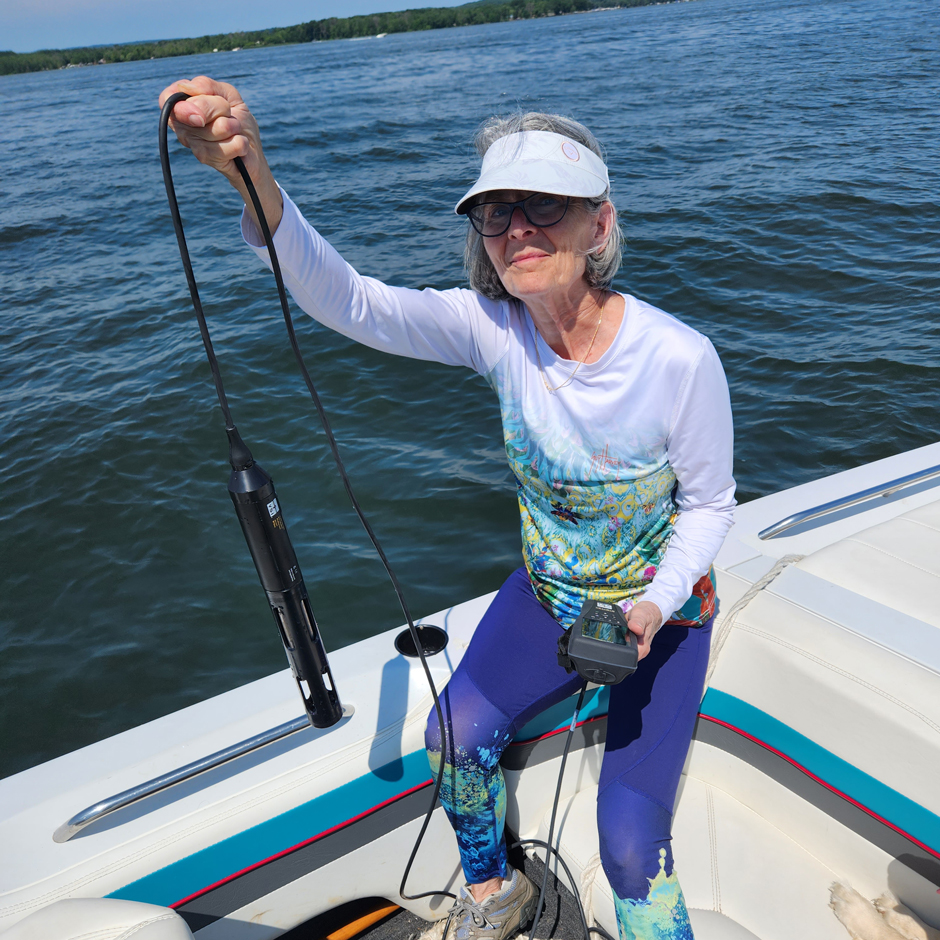
Monitoring on Chautauqua Lake. (Credit: Doug Conroe)






0 comments