

Monitoring for a Cause: How Climate Change Impacts Freshwater Organisms in Southern Appalachia
Climate change and subsequent shifts in weather events are changing aquatic ecosystems across the world. Streams drying up in droughts, floods overflowing rivers and displacing freshwater organisms, climbing temperatures making environments unsuitable for native species, and other stressors are all changing key habitats and shaping populations in impacted regions like Southern Appalachia.
Michael Gangloff, Professor of Biology at Appalachian State University, has been monitoring waterways and freshwater taxa under duress in the southeastern US for 27 years, measuring abundance, size, and condition of local taxa as well as quantifying changes to physical habitat conditions through long-term monitoring at established sites.
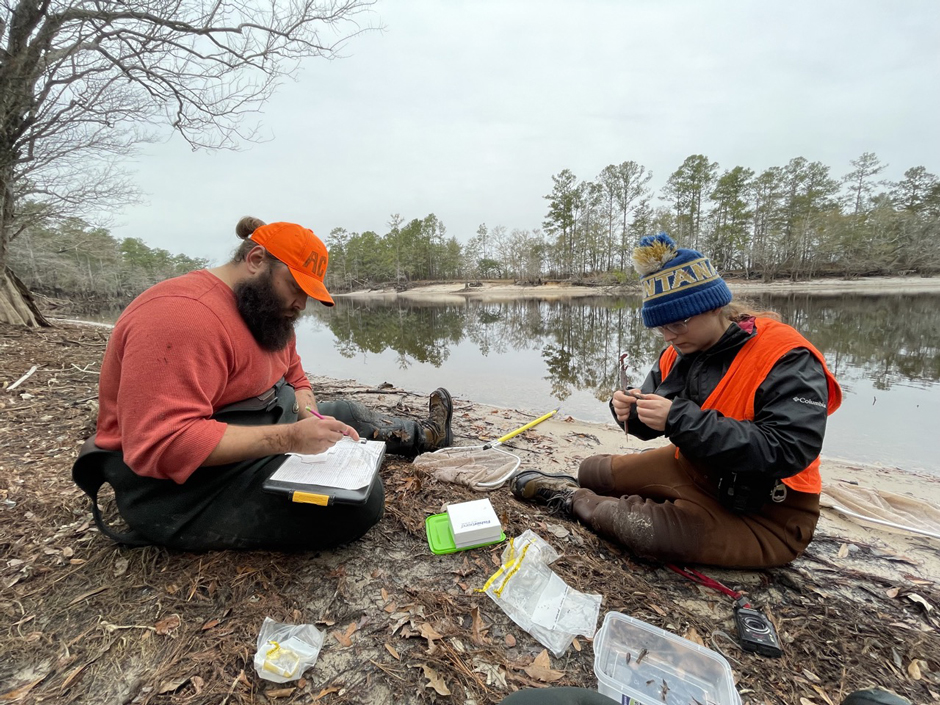
Processing Crayfish Waccamaw River, North Carolina. (Credit: Mike Gangloff)
Monitoring Waterways and Freshwater Organisms in the Wake of Hurricanes
A majority of the lab’s monitoring sites are concentrated in western North Carolina, but occasionally they investigate sites farther away. Gangloff explains, “We have worked in 6 different states during the last 5 years and so sometimes we are on the road for several days doing fieldwork.”
Having grown up in Long Island’s Great South Bay, dreaming of being a herpetologist in Alabama, Gangloff found himself working with a much larger group of species in Southern Appalachia–though he still got to achieve his dream of working with amphibians and reptiles.
He continues, “At any given time there are a range of species and habitat parameters that we are monitoring as part of my lab’s research program. […] including mussels, crayfish, insects, fishes and Hellbender salamanders.”
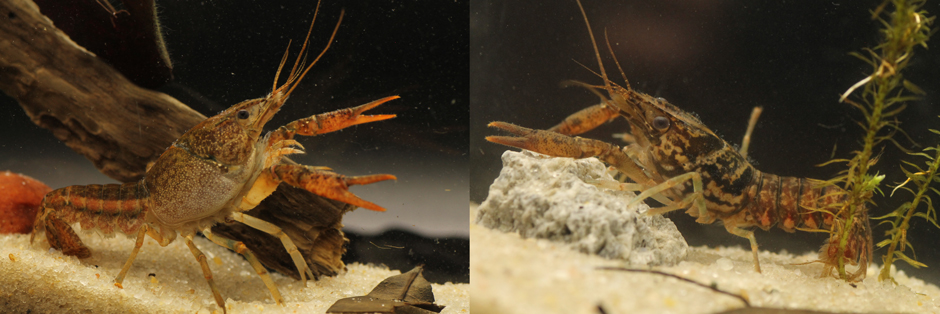
(Left) A Native Sandhills crayfish and (right) a Waccamaw Crayfish. (Credit: Elijah Thompson)
Habitat monitoring varies depending on the environment, but typically includes stream depth, current velocity, channel width, and substrate size composition at monitoring sites to observe and understand how changing land use and climate patterns are impacting sensitive taxa and habitats.
Currently, Gangloff’s lab is focused on monitoring the impacts of Hurricane Helene in western North Carolina and the surrounding areas due to the impacts the storm had on these sensitive ecosystems.
“The utility of this type of monitoring became fully evident following the destruction caused by Hurricane Helene in western North Carolina and the surrounding areas. Many streams were scoured to the underlying bedrock by the devastating floods that hit this region.” states Gangloff.
He continues, “We are currently trying to gain insights into questions like, why were some streams heavily impacted by flooding while other nearby streams were relatively unaffected?”

A hellbender sheltering in Watauga River. (Credit: Elijah Thompson)
To answer these questions, Gangloff and his team collect data at each site on an annual basis. YSI ProQuatro meters are used to collect water quality measurements, such as specific conductance, pH, DO/DO sat, temperature, salinity, TDS, and nitrate
Various instruments are used to measure depth, substrate size and channel width, including Global Water Flow Probes, meter sticks, and laser range finders.
Much of the data collection is weather-dependent, though sand, cold, heat, and increasingly salt are major stressors to the gear, particularly in winter, so additional precautions must be taken during these outings.
The team also collects grab samples that are analyzed in the lab using shaker tables and balances to quantify substrate composition. The native aquatic wildlife is also sampled during these outings—samples are brought back to the molecular lab for DNA barcoding to help identify difficult-to-identify species.

Measuring flow in the Watauga River. (Credit: Mike Gangloff)
Identifying Trends through Data
The collected data is then analyzed and compiled to track changes in stream habitat conditions resulting from hurricanes and the subsequent rebuilding of towns and cities, which introduce construction projects that can impact these waterways.
“We know that streambed substrates are super important to hellbenders and these actions are a big concern to many aquatic biologists in North Carolina and the surrounding area,” explains Gangloff.
Outside of the hurricane research, the lab’s long-term monitoring of the region is used to identify trends in rivers and streams impacted by other stressors like dams. The research also helps develop a better understanding of river recovery over time as these waterways are restored, as well as studying predictors of endangered species occurrence.

Sipsey River, Greene County, Alabama. (Credit: Mike Gangloff)
A Larger Goal for Conservation
These contribute to two of the most important aspects of the work of conservation biologists, which are to help identify elements of biodiversity as well as to identify threats to biodiversity, according to Gangloff.
“It’s super fun when you can find a species that has not been found in a particular area before and it’s even more rewarding when that turns out to be a species that is new to science,” states Gangloff.
He continues, “On the flip side, identifying threats to biodiversity is important if, somewhat de-spiriting work. While it can be demoralizing to see habitats and species lost to development or poor management, it is also pretty gratifying to be the voice crying in the wilderness that actually gets the attention of people with the power to fix the problem.”
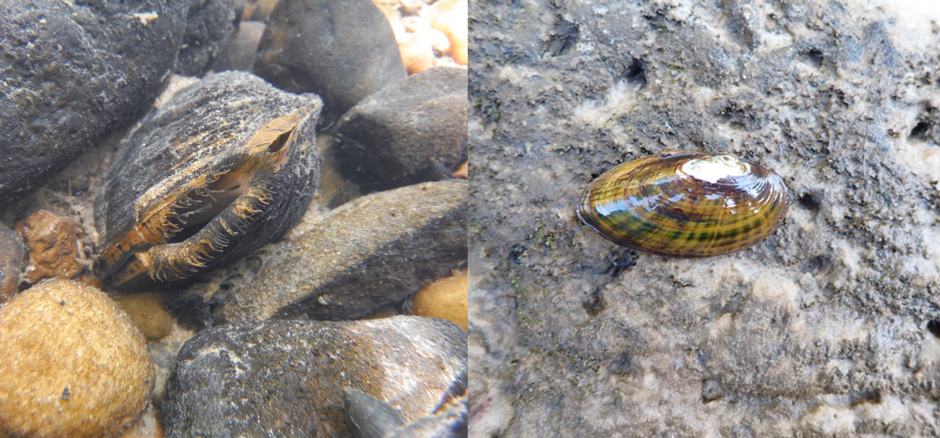
(Left) A Finelined pocketbook mussel in Bibb County, Alabama. (Right) A Hamiota australis in Conecuh River, Alabama. (Credit: Mike Gangloff)
Recently, Gangloff shares that he has been getting more involved with projects that aim to improve stream and wetland habitats for imperiled freshwater species.
“Although many of those projects are still in their first few years, it is exciting to see how quickly some ecosystems respond to restoration,” states Gangloff.
He stresses that these projects–despite being new–are critical to the larger work of protecting and conserving natural environments well into the future.
He explains, “Anyone can identify problems in nature, but posing viable solutions is a real challenge. I am hopeful that the next generation of conservation biologists will have increasingly more opportunities to track the recovery (as opposed to the decline) of freshwater ecosystems.”

Setting out crayfish experiments in the Waccamaw River, North Carolina. (Credit: ???)






0 comments