

NexSens Buoys Monitoring Floating Offshore Liquid Natural Gas Terminals in Ravenna, Italy
A new floating liquid natural gas terminal in Italy’s Adriatic Sea is making waves for the country’s energy independence. The platform was funded by Snam in 2022 as a way of boosting domestic energy production in the wake of global concerns over foreign energy reliance.
Deployed off the coast of Ravenna, Italy, the floating platform was built in order to create a hub for LNG transfer from ships to land via an underwater pipe from the terminal.
“The idea is that vessels can come in and offload liquefied natural gas offshore,” states Shawn Hinz, managing partner at Gravity Consulting LLC and managing scientist for the project.
The use of these floating liquid natural gas terminals has become more popular in recent years because these platforms do not require significant onshore infrastructure, such as port dredging or expansion, to accommodate large vessels. Hinz also notes that transferring the natural gas offshore is safer for the public.
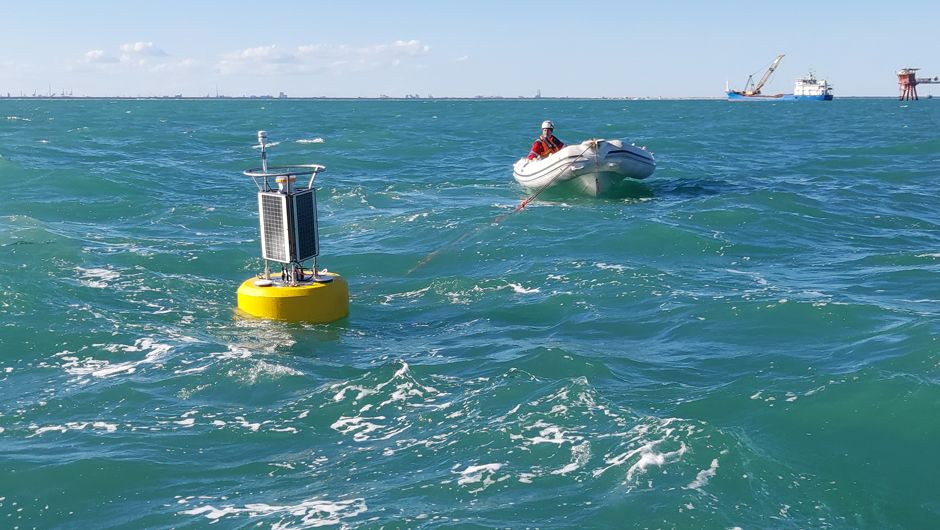
Monitoring begins with successful installation of the buoy. (Credit: Mike Voellmecke)
Construction and Navigational Monitoring Systems
While there are multiple benefits, open-ocean deployments like this come with their own set of challenges, namely met-ocean dynamics that impact initial construction and the movement of vessels during operation.
To minimize risks, Gravity oversaw the deployment of three NexSens CB-650 buoy systems near the platform. The buoys were equipped with a current profiler, a SeaView SVS-603HR wave sensor, and a topside Airmar weather station.
The buoys were also equipped with a NexSens X-series data logger with cellular telemetry. Data from the system is transferred to the cloud, where platform operators and both incoming and outgoing vessels can access the data via WQData LIVE.
The buoys were deployed prior to the platform’s construction in order to help inform front-end engineering efforts, and will remain deployed for the next ten years.
During construction, an additional NexSens buoy equipped with a YSI EXO3 multiparameter water quality sonde was deployed to measure turbidity and other water quality parameters as dredging was needed to construct the pipeline.
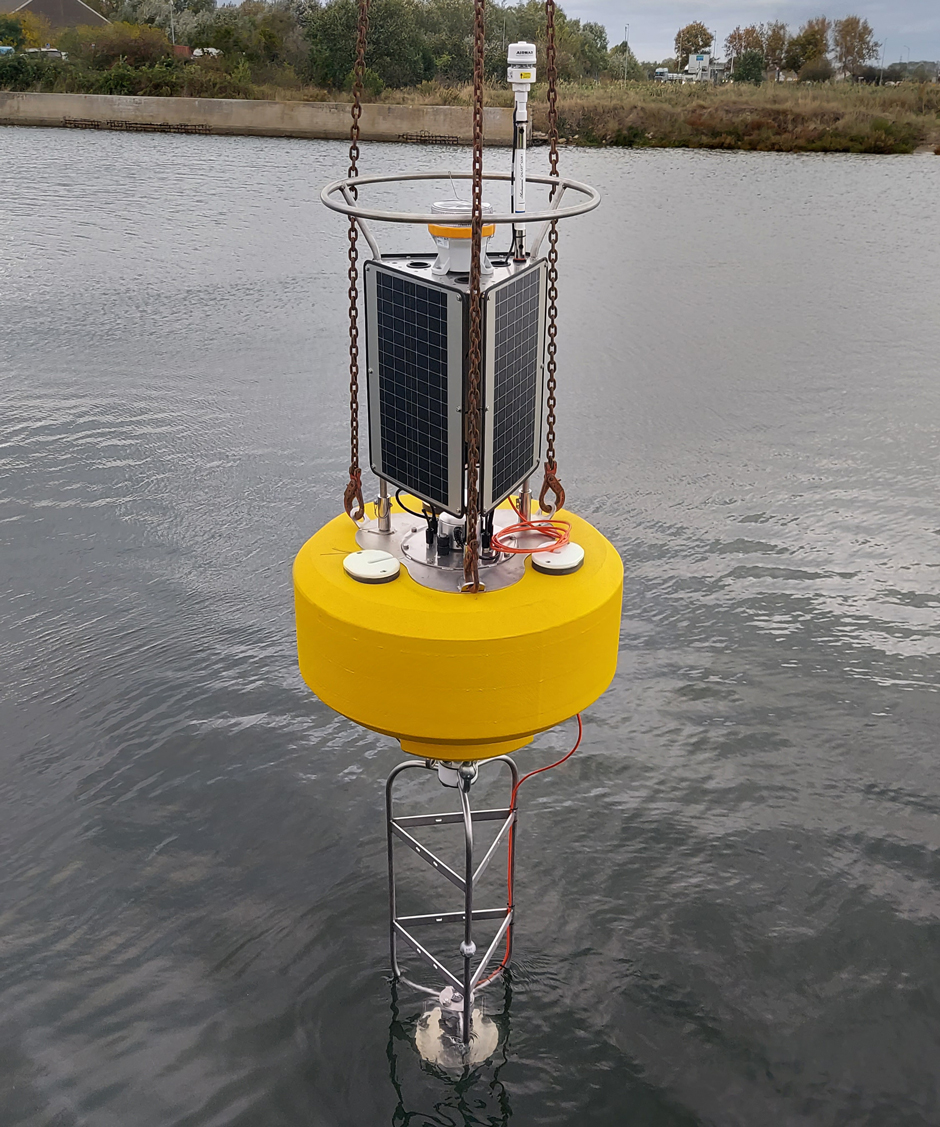
A final in-water test to confirm operation of the Doppler current profiler is performed (right). (Credit: Mike Voellmecke)
Early data revealed “the max conditions” that the liquid natural gas platform needed to be able to withstand. Hinz notes, “The Adriatic Sea is relatively small and enclosed, but if you get big storms coming from the south, the Adriatic can get very rough.”
Fortunately, both the buoys and the newly constructed liquid natural gas platform have held up well in these conditions over the last few years. “The systems have worked very consistently,” notes Hinz.
Today, the data is used to inform incoming and outgoing vessels of ocean conditions.
“The waves, currents, and wind data are critical for understanding if conditions are safe in real-time,” explains Hinz. “If there are 10-meter waves coming in, then they’re not going to bring in a ship!”
Gravity works with a local agency, Shelter SRL, to maintain the systems throughout the years and when issues occur, such as accidental vessel collisions or major storm damage.
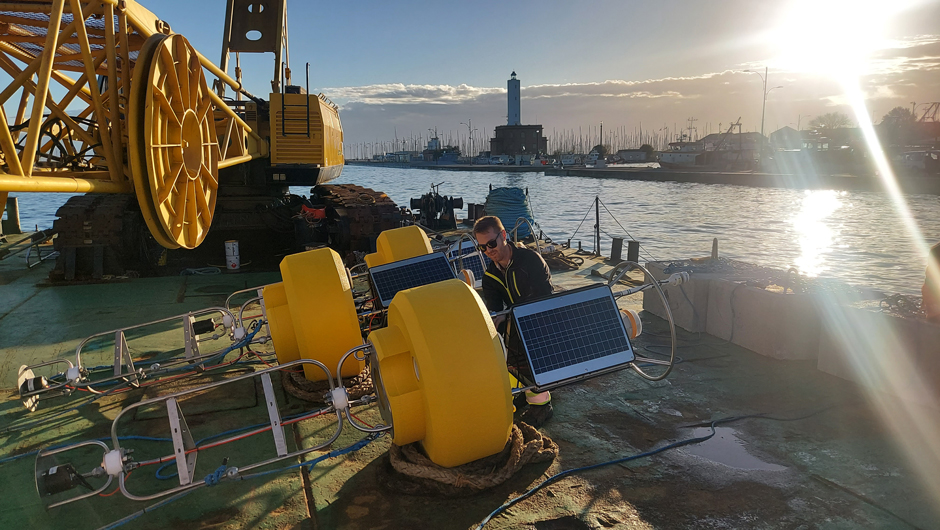
The buoys receive their final preparations as they travel to sea for deployment. (Credit: Mike Voellmecke)
Energy Security and Emerging Information
Despite the various challenges associated with open-water deployments, Hinz notes that the buoys have worked great.
“This project’s a great example of how effective these buoy systems are for full-life cycle projects like this,” explains Hinz.
He continues, “Being able to have a buoy system that is flexible with different sensor packages is critical because we can use it from front-end engineering to construction monitoring, and now for navigational purposes.”
The long-term data that the project has and will continue to collect, in addition to informing operations, has filled in some knowledge gaps surrounding the Adriatic Sea.
For example, Hinz shares that the discovery of 10-meter waves in the northern Adriatic came as a surprise to the engineering team.
Playing a role in this emerging industry and new discoveries about the environmental conditions in the region is uniquely rewarding, according to Hinz.
“It’s really rewarding to analyze the data on such a long term project and being involved with this program to support critical energy security,” concludes Hinz.
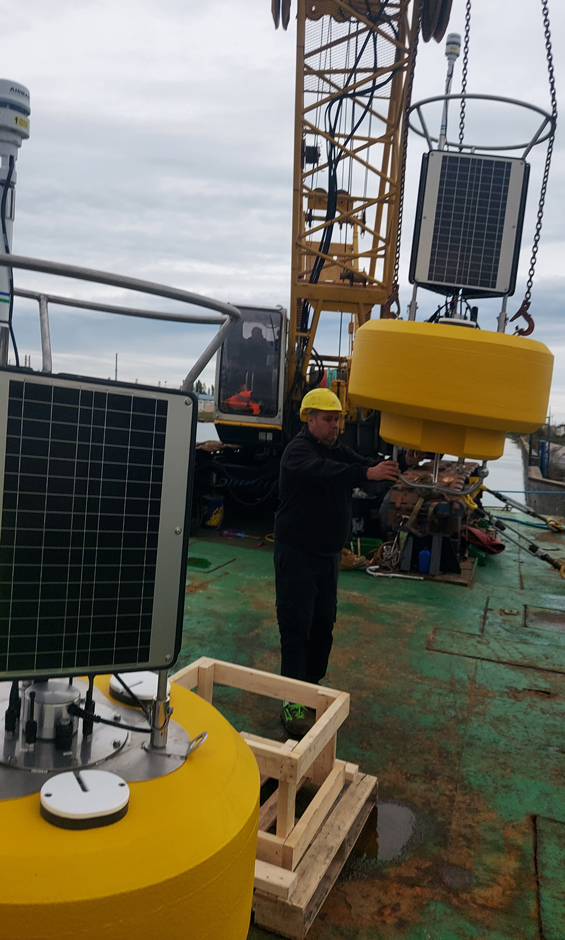
The buoys are loaded onto the barge in preparation for deployment. (Credit: Mike Voellmecke)






0 comments