

Research in the Reserve: Promoting Interdisciplinary Conservation at the Great Bay National Estuarine Research Reserve
On an early winter day in 1973, a helicopter buzzed over Durham, New Hampshire, just a few miles from the Atlantic Ocean. One of the helicopter’s guests, oil magnate Aristotle Onassis, owner of Olympic Refining, looked east of town and saw what he hoped would become the world’s largest oil refinery. Instead, he saw the Great Bay; thousands of acres of green coastal forest, mud flats, salt marshes, and estuarine tidal waters stretching over the land toward New Hampshire’s small Eastern coastline.
Onassis likely also saw a group of Durham residents staked out on the bay’s coast, ready for him to pass overhead. While out of place in the natural setting, an obvious message was spelled out in red paper: “Not Here.”
Those words took hold in the small community, as townspeople banded together to oppose the construction of an oil refinery on their local land and waters. Just a few months after that helicopter ride, despite overwhelming support from the state and various media outlets to build the refinery, residents of Durham voted resoundingly to ban the construction of oil terminals and rezone their town to allow oil production.
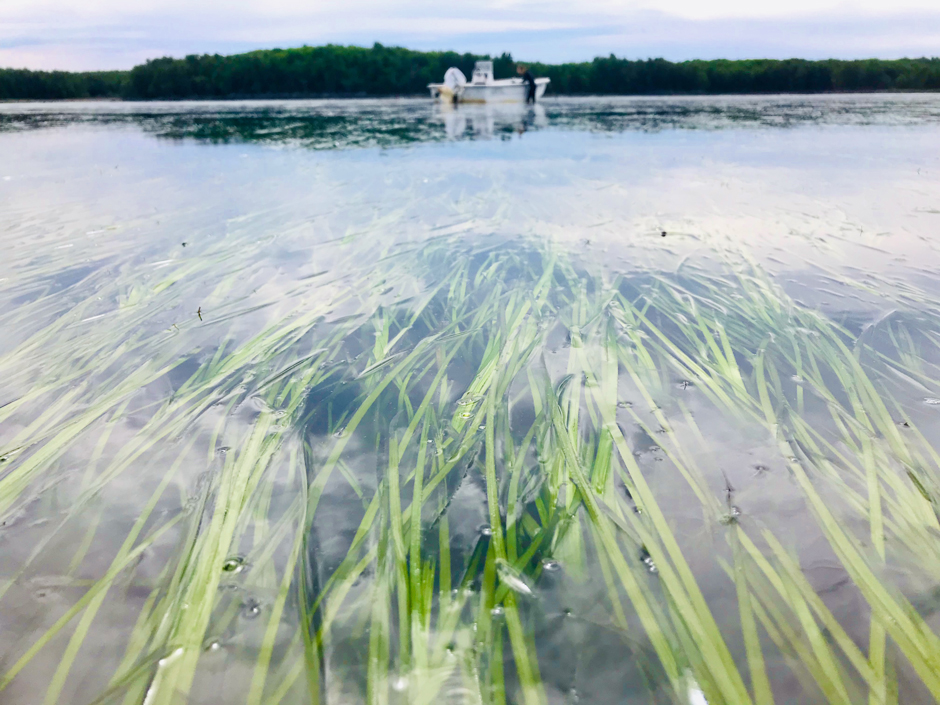
Eelgrass monitoring- this time looking at how they impact the nitrogen concentration of water by monitoring dissolved nitrogen and eelgrass cover. (Credit: Christopher Peter)
Olympic left New Hampshire without its grand oil refinery, and the town of Durham left the interaction victorious in protecting its Great Bay. But residents were wary of future approaches to their land and water, and soon after, created the Great Bay System Estuarine Conservation Trust.
This was just the first step, and in 1989, the Great Bay achieved even more protection. That year, it earned status as a National Estuarine Research Reserve (NERR), a system created by the National Oceanic and Atmospheric Administration (NOAA).
The Reserve is a state-federal partnership between NOAA and the New Hampshire Fish and Game Department (NHFG). Day-to-day management is run by NHFG while NOAA continues to support the Reserve with funding, technical assistance, and links to the national network. It has remained under protection since 1989 and looks quite similar to the view from that nearly-fateful helicopter ride over 50 years ago.
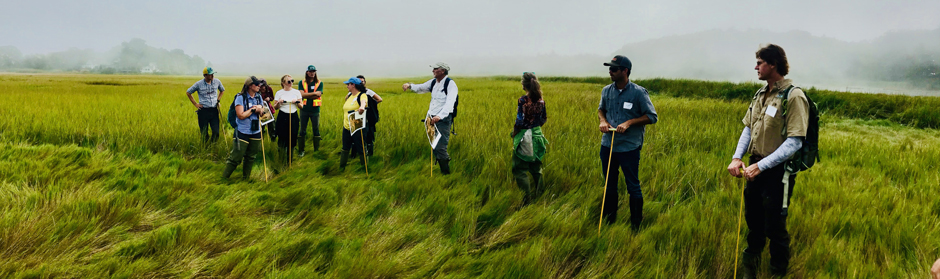
Salt marsh restoration planning. Site walk to help with the restoration design of an impaired marsh from historic farming practices and increased sea levels. (Credit: Christopher Peter)
The Current State of the Great Bay
Christopher Peter is a research coordinator at the Great Bay National Estuarine Research Reserve, where he has been since 2017. Having previously worked nearby at the University of New Hampshire, Peter knew of the sprawling 10,000-acre reserve. Yet, once he started working on the ground in Great Bay, he began appreciating the many hats the Reserve was wearing, which include education, land management, and environmental stewardship.
“We spread our resources…[some] labs are just focused on researchers, or some of these centers are focused on education,” Peter says. “And we do all of that.”
Recreation in and around the Reserve involves land and water, where people can hike, hunt, fish, and go birding, connecting visitors to protected natural resources. As a collaboration between state and federal protection, all of the lands in the Reserve are Wildlife Management Areas. Some of this land is managed for research and visitor use, and some areas are managed to benefit wildlife.
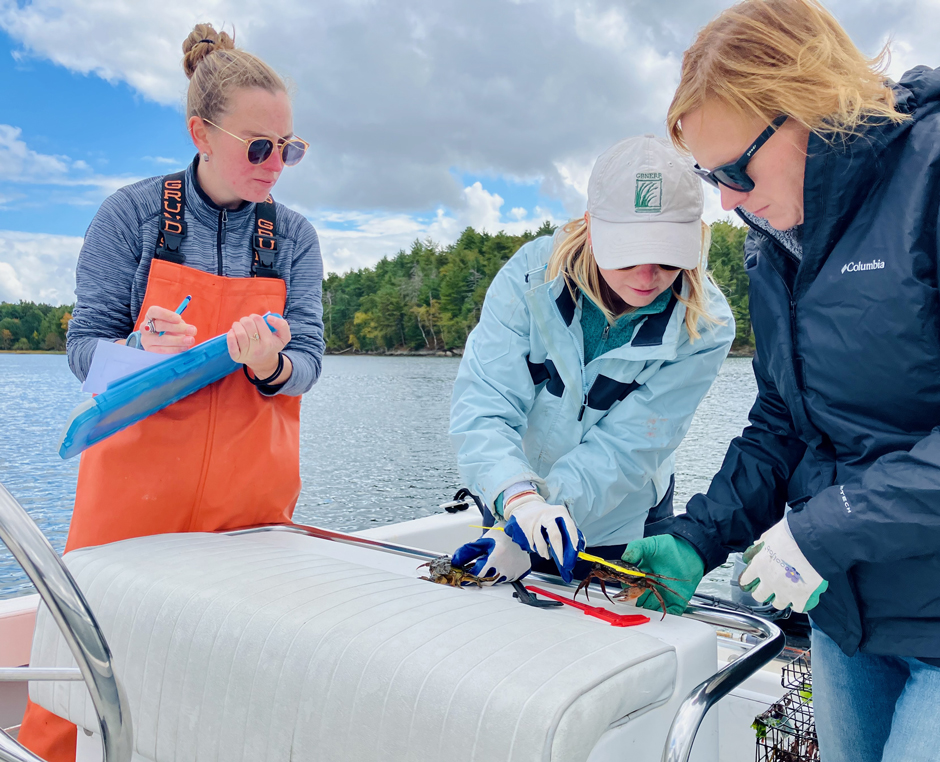
Crab monitoring on Great Bay. (Credit: Christopher Peter)
Another long-standing tradition at the Reserve is education, which occurs at the Great Bay Discovery Center in Greenland, New Hampshire. According to Peter, thousands of local school children visit the Reserve each year on field trips to learn about estuarine ecosystems. The Reserve also offers programming for young families and teacher training workshops, as well as sharing scientific information with the local community.
Much of the research Peter and his colleagues carry out is used to directly inform educational programs. Under the NERR system, collaboration between the different focus areas of a Reserve is heavily encouraged.
“I can start generating a science project that has a management application, and then have an education component too,” Peter explains. “It’s like a pipeline. It’s not just one facility.”
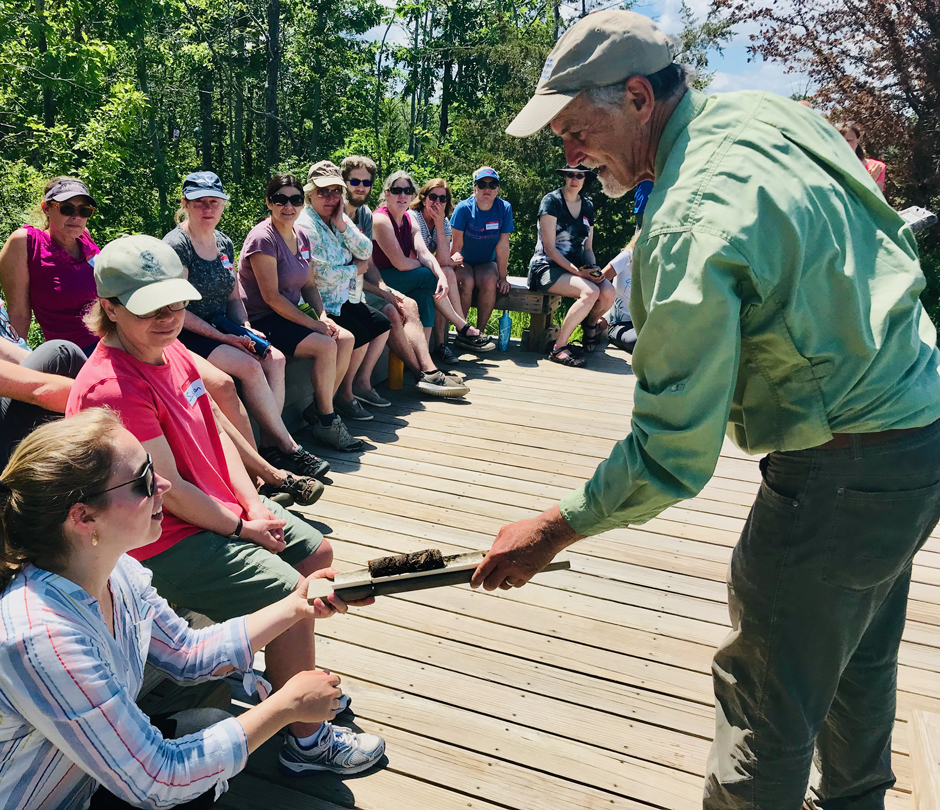
Every year, Great Bay Reserve hosts a teachers’ workshop to help bring the latest science to the classroom. (Credit: Christopher Peter)
Research in the Estuarine Reserve
Peter and his colleagues recently wrapped up a decade-long project in the estuary investigating how salt marshes are impacted by climate change, specifically how sea level rise is changing their habitat. A decade of data was analyzed, and the project came to a grim realization: salt marshes aren’t doing well.
“Marshes are changing. They’re basically drowning out now, because we’re facing unprecedented levels of sea level rise,” Peter says. “So we’re likely to see less marshes in the future unless we take some action.”
According to Peter, Great Bay has lost about half its seagrass beds, 90% of its oyster reefs, and has experienced significant marsh degradation. Some of this land has been replaced by subtidal mud flats, which now dominate the estuarine reserve.
Another key part of the Reserve is the coastal forest. Being above the water line, Peter explains that emphasis is placed on protecting these lands, although all parts of the Reserve work together to create its unique ecosystem.
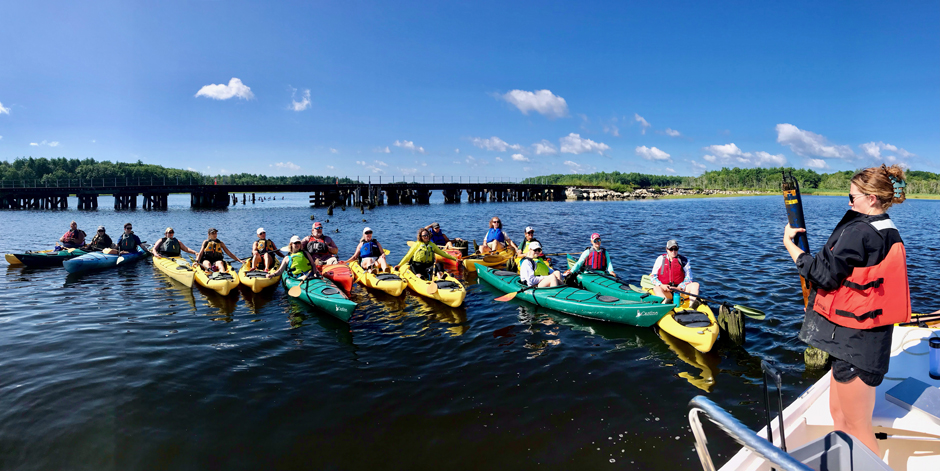
A teachers’ workshop focused on water quality monitoring with data sondes like the YSI EXO2. (Credit: Christopher Peter)
Climate change is also bringing new fish and wildlife into the Great Bay. The arrival of Atlantic blue crabs, which are usually found further south in warmer climates, has brought Peter a new dynamic to investigate. He explains that the Gulf of Maine, which is bordered by Cape Cod in the south, the New Hampshire and Maine Coasts, and Nova Scotia to the north, is rapidly warming. In fact, it is in the 99th warming percentile worldwide.
As the climate warms, Peter believes the crabs are extending their northern limit and migrating into New Hampshire and Maine. He sees at the same time that lobsters in the estuary are migrating north out of Great Bay in search of cooler waters.
“So we’ve been working on understanding how much [of] their population is here, and trying to find all the parts of the life cycle,” Peter says.
“[Do] they come here and then they die over the winter, or [do] they come and stay and reproduce?” he questions, with his current project revolving around understanding the crab’s diet in Great Bay.
However, Peter’s and his colleague’s work doesn’t just inform in-house management and education–another component of the Reserve is training engagement. This involves bringing the research conducted at Great Bay to conferences, workshops, and more, using what they have learned to aid in research projects and management decisions across the country.

Examining how seagrass meadows in Great Bay denitrify the sediment using the push-pull method (Aoki & McGlathery 2017). (Credit: Christopher Peter)
Unique Status in NERR
This is especially useful when collaborating with other estuarine reserves under NOAA, which Peter sees as one of the great benefits of joining the national NERR system.
“I think that’s one of the two biggest strengths of the Reserve system, is the integration of management, education, [and] research,” Peter says. “And then the other biggest strength is we can amplify our efforts nationally, within our system.”
Currently, Great Bay is working with scientists from the University of New Hampshire and several other reserves to catalog the biodiversity and communities in these estuaries. Components involve filtering DNA from water samples and looking at fish diversity across habitat types, salinity levels, and latitude. Understanding the diversity that estuaries harbor is key to predicting how they may change, or resist change, in the face of an ever-shifting planet.
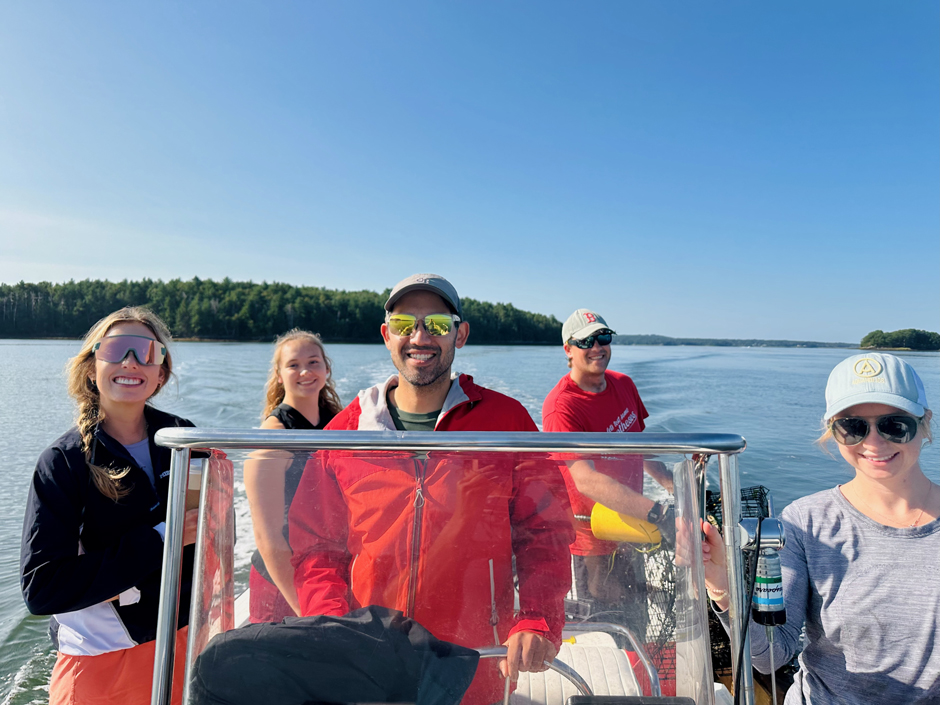
Blue crab trapping on Great Bay- understanding how this new species from warming waters is affecting the Bay. (Credit: Christopher Peter)
Conclusion
Fortunately, not all is bleak for Great Bay and other estuarine reserves. Peter says that because land management and community engagement are such large parts of running the reserve, restoration and conservation are always ongoing. Great Bay is buying adjacent land, providing science to decision makers to help add further layers of protection to improve the water quality in a bay home to so many vital plants and wildlife.
“We focus on science to management,” Peter explains. “We are buying and protecting land because they act as buffers to prevent nutrients from getting into the Great Bay.”
They also partner with other conservation organizations and volunteers to bring back lost habitat, in the hope that future visitors may experience the natural landscape that locals fought so hard to preserve all those years ago.
“[It’s] not just science for the sake of science,” Peter says. “There’s a lot of efforts here to try to restore lost habitats and prevent future lost habitats.”





0 comments