

Researching Lake Erie’s Water Quality and Fisheries at the Fairport Harbor Research Unit
Lake Erie is well known for its sport fish populations and recreation on the water. However, the lake is also notorious for occasionally suffering from poor water quality conditions, such as harmful algal blooms and nutrient runoff. Nonetheless, millions of people flock to its waters every year to enjoy all that the lake provides.
According to the Great Lakes Guide, Lake Erie is the most biodiverse of all the Great Lakes. Therefore, resources are poured into understanding Erie’s ecosystem, water quality, and wildlife.
For example, the Ohio Division of Wildlife (ODOW) has several research units spread across the state, and one of them, the Fairport Harbor Research Unit, monitors the lake’s central basin.
From trawl surveys to temperature profiles, the Fairport unit works to understand water quality conditions near and offshore in the center of America’s fourth-largest lake, and how those conditions are impacting the fish that call it home.
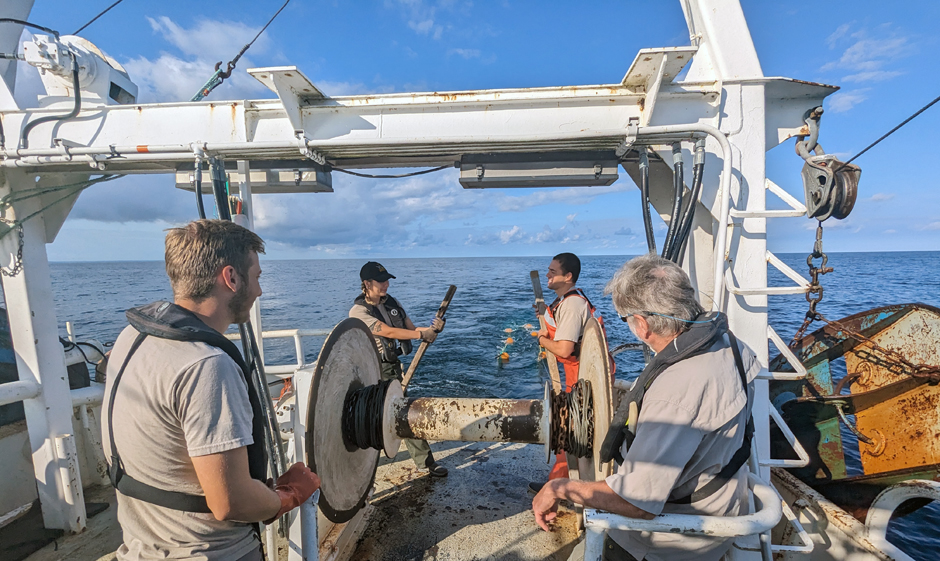
ODNR Fairport Staff retrieving a bottom trawl. (Credit; ODNR)
Lake Erie Water Quality and Wildlife Monitoring Methods
Peter Jenkins has been a fisheries biologist at Fairport for the past three years and supervises several of their research surveys. One of these is a bottom trawl survey at fixed sites, where Jenkins searches for young of year and yearling yellow perch, which are a popular sport fish in Lake Erie.
Jenkins says this involves measuring and counting the perch, among other population monitoring approaches. This data is used to model 2-year-old perch recruitment, which has recently seen declines in the central basin, according to the ODOW’s management process.
Despite this survey focusing on managing fish populations, Jenkins says that monitoring water quality is also a huge part of their fisheries management. In fact, water quality data is used to determine if trawls will be included in our annual recruitment indices.
“As the trawl is going, we cover approximately a half-mile stretch, and sometimes the beginning and end side will show different levels of hypoxia,” Jenkins says. “And so that really impacts our bottom trawl, because if there’s low enough DO, there aren’t going to be very many fish in the section of water that we’re trawling.”
To detect hypoxic conditions, Jenkins and his colleagues used a YSI ProSwap sonde to collect water quality profiles. Additionally, they attach a PME miniDOT logger to obtain finer-scale data.
Then, when his team is estimating population from the trawls, Jenkins will take the hypoxic areas into account. Fish are found at much lower levels in these hypoxic areas, so they will often exclude them from their abundance estimates.
Jenkins says hypoxic conditions in the central basin arise from the algal blooms that spread from the western basin. Bacteria feeding on the decomposing algal blooms on the lake bed proliferate and consume DO to extremely low levels.
“You’ll end up with a stratified lake with warm, oxygen-filled water on the top […]and on the bottom, below the thermocline, you’ll have low DO, and that fluctuates throughout the central basin,” Jenkins says.

Research Vessel Grandon used for sampling fish populations in Ohio’s portion of Lake Erie Central Basin. (Credit: ODNR)
Long-Term Water Quality Data Sets
Data on the central basin’s water quality conditions have benefited from decades of research. Along with the bottom trawl, Jenkins also supervises a long-term project surveying the lower trophic levels of the lake, understanding how water quality impacts phytoplankton and zooplankton.
“When you hear water quality as a fisheries biologist, you don’t exactly think it’s the most glamorous of the jobs, but it’s a very cool survey, and it’s a long time series,” Jenkins says.
Due to their dependence on water quality, the phytoplankton surveys Jenkins conducts also focus on measuring water quality parameters, particularly temperature and dissolved oxygen, with a YSI ProSwap integrated with a depth sensor to take profiles of the lake.
These measurements have gone back decades at Fairport. Using their own data and those of partner organizations, such as NOAA, the Fairport unit can see how temperature and dissolved oxygen have changed throughout the years.
Jenkins explains that his office focuses on researching how annual and seasonal environmental trends correlate to fish recruitment.
Additionally, other organizations such as NOAA predict seasonal trends, like warmer, rainier springs leading to more hypoxic summers in the central basin. Seeing how water quality parameters change, and how they impact the fish populations Fairport manages, is vital for the research unit.
“Having these [long-term] data sets can really provide us with a good, historic visualization of how things have changed over time,” Jenkins says.

ODNR staff collect water quality samples during bottom trawl survey. (Credit; ODNR)
Informing Recreation Through Research and Collaboration
Beyond below-the-water surveys, Jenkins says that his colleagues will conduct creel surveys on the lake and its tributaries. Division of Wildlife employees will talk with anglers face-to-face to understand what they’re catching for these surveys. Jenkins says it’s a helpful method to fill research gaps for their population estimates.
Anglers also benefit from a third survey that Jenkins supervises: fish contamination. Poor water quality can cause fish to digest or absorb harmful contaminants, which then make them unsafe for consumption. Fairport will send samples each year to labs to look for contaminants in Lake Erie’s fish.
“We send them off to different labs, and they test for contaminants in fish flesh, and then those [become] regulations or recommendations of how much fish you should eat,” Jenkins says.
Collaborating with other organizations drives Fairport’s research, according to Jenkins. They don’t exist on their own, but provide valuable baseline data for several organizations, and for other units within the ODOW.
“Fairport isn’t out there raising, hatching, or stocking,” Jenkins says. “We’re focused on assessing and managing fish populations along with recreational and commercial fisheries.”
Alongside anglers and the ODOW, the province of Ontario works closely with Fairport to manage their shared lake. Moreover, researchers from Ohio State University use their bottom trawl and lower trophic survey data to understand yellow perch recruitment, their relationship with phytoplankton abundance, and the interactions between prey and predators in the central basin.

ODNR creel clerk interviewing a steelhead angler. (Credit: Josh Zielinski)
Improving the Lake Erie Experience
Ultimately, Jenkins says the goal of Fairport’s research is to holistically improve the Lake Erie experience, which begins with understanding its wildlife and ecosystems. It matters less who uses the research, and more how it’s applied to protect Ohio’s largest lake.
“We are striving, in general, to conserve and improve fishing and habitat for those fish for sustainable use and appreciation of everyone,” Jenkins says. “So the more information that we can gather and know about the lake and provide to fishermen or people who just enjoy the lake and water quality, the better off the lake is.”





0 comments