

Chesapeake Bay Sees Largest Oyster Reef Restoration in the World Completed
The largest oyster reef restoration in the world was recently completed in the United States’ largest estuary: the Chesapeake Bay. The project is the result of a 10-year, over $100 million commitment from local, state, and federal agencies to restore one of the bay’s most vital keystone species.
The Chesapeake has lost 99% of its historic oyster numbers, with cascading negative effects on the entire bay ecosystem.
“When it comes to oysters, we’re down to 1% of our historic number of oysters,” says NOAA’s Chesapeake Bay Oyster Restoration Program Manager Stephanie Westby. “And when you lose 99% of your oysters, you lose 99% of your reef habitat, and you lose 99% of everything.”
Scientists have long recognized the need to restore oyster reefs in this region, with recent reports quantifying the many positive ecosystem services that they provide. Yet Westby says multiple past restoration attempts, some of which stretch back 30 years, didn’t achieve a large-scale impact. Until now.
Across 10 tributaries in Maryland and Virginia, dozens of governmental, academic, and community organizations banded together to bring 1,900 acres of oyster reef back to the Chesapeake. This project recently reached its restoration goal with the final reefs being restored over the summer, which Westby sees as a huge success story.
However, this may only be the beginning for oyster reintroduction in the Bay.
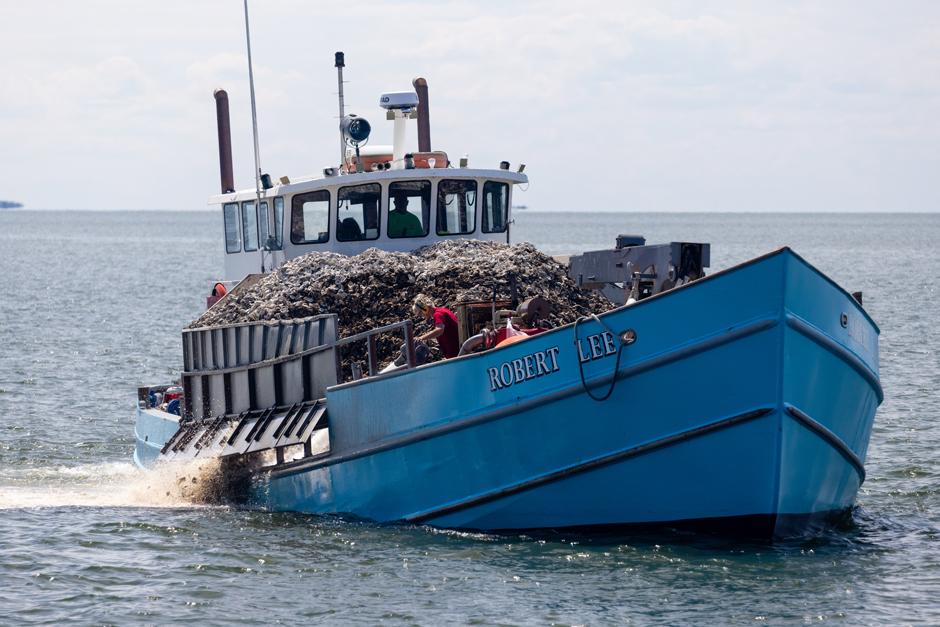
A boat carrying juvenile oysters for planting in the Manokin River. (Credit: Will Parson / Chesapeake Bay Program)
How to Restore Oyster Reefs in the Chesapeake Bay
In 2014, the Chesapeake Executive Council signed the Chesapeake Bay Watershed Agreement, an expansive 10-year plan aimed at fixing the various ecological concerns plaguing the bay. The plan’s goals range from improving local environmental literacy to reducing nutrient runoff, and it emphasizes the need to improve degraded ecosystems, which include oyster reefs.
“Nobody’s ever done it before, globally at this scale, and really set this goal, and started figuring out how many acres this is going to be, and which tributaries should we do, and who’s going to be involved in this,” Westby says.
The watershed agreement outlined oyster reef restoration on a scale never before seen in the Chesapeake, or the world. Westby believes that previous foundational, small-scale restoration efforts in the bay actually built confidence in their new plan.
She says that data collected from several previous reef-building projects and other successful, smaller projects finally revealed the most effective method for constructing these crucial habitats.
“Once we knew how to build a reef pretty well, we said, ’Let’s really try to bring these efforts up to a scale that can begin to match the problem that we’re facing,’” Westby explains.
While local communities were involved in the planning process, Westby says that industrial-scale restoration was needed to meet the Agreement’s lofty 1,900-acre goal.
After extensive monitoring and crowd-sourcing, barges from the US Army Corps and private companies unloaded hard substrate onto the tributary bottoms, forming the base of the reefs.
Then hatchery-raised, spat-on-shell young oysters were dropped to their new homes, where they could begin building the dense colonies that once dominated the Chesapeake.
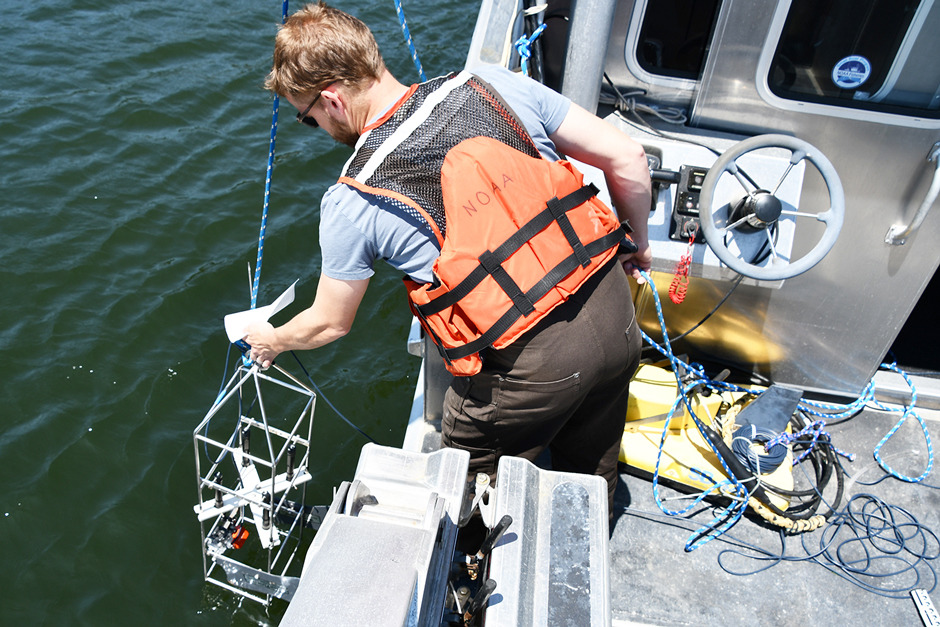
An employee of the NOAA Chesapeake Bay Office monitors a tributary pre-restoration. (Credit: NOAA Chesapeake Bay Office)
Using Water Quality and Community Engagement to Guide Restoration
Monitoring the oyster reefs and the tributaries where they were restored is an important part of the Chesapeake Bay Watershed Agreement. Westby explains that their monitoring efforts can be split into pre- and post-restoration strategies.
The ten tributaries where oyster reefs were restored were extensively monitored before selection. The NOAA team profiled these rivers using water quality sondes, such as a YSI Pro Plus, along with data from local partners.
Westby says that the project also looked at the remaining, although scarce, oyster populations that already existed. By combining field sampling and historic data, they got a better sense of which tributaries were already best at supporting reefs.
To determine the best reef-building locations within the tributaries themselves, NOAA used sonar to precisely map riverbed bottoms, looking for hard surfaces that could support these benthic animals.
Finally, the project partners spoke with local communities to ensure that reef restoration didn’t heavily interfere with their economies and livelihoods.
“We tried to work with the community […] so that we could do this work while honoring how they use the water, without interfering with it, and still building these reefs,” Westby explains.
With this data, five sites in Maryland and five sites in Virginia were chosen starting in 2014 to begin the arduous restoration process.
Monitoring didn’t stop here, as the project wanted to quantify the rate of growth in the restored reefs. Based on previous studies that determined ideal oyster density, the project decided population monitoring on individual reefs would occur at three and six years after restoration.
“We wanted to not only say, ’Yep, we built these reefs,’” Westby explains. “We wanted to describe not just the next week, not just the next year, but years later how these reefs looked, to see if they were on a trajectory that told us they were likely to be around for the long haul.”
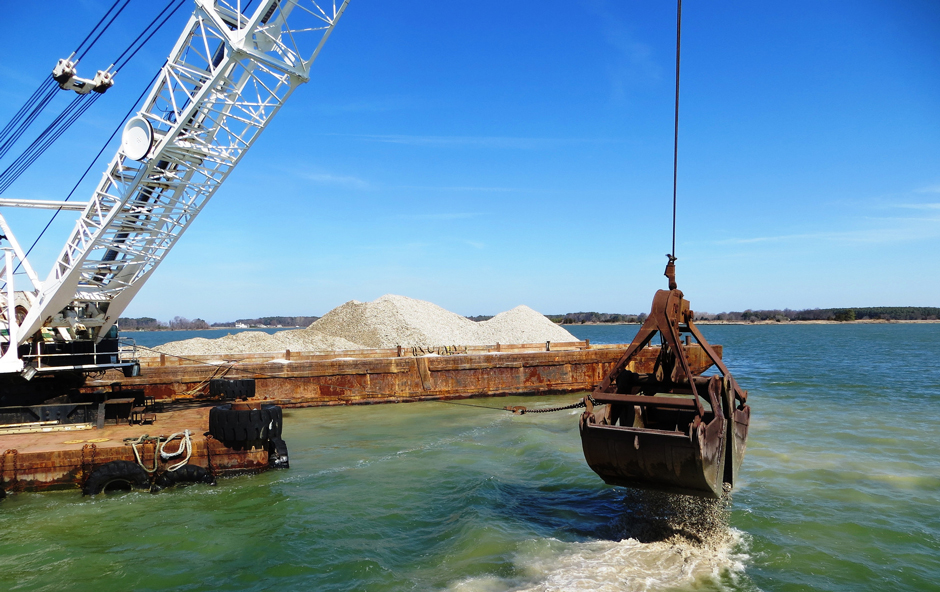
Constructing oyster reefs on an industrial scale. (Credit: US Army Corps of Engineers Baltimore District)
Initial data from some of the first restored reefs have shown promising results, according to the 2024 Chesapeake Bay Oyster Restoration Update. To date, 99% of monitored reefs have met the minimum population density threshold, while 84% have met the ideal “target” goal, an extremely positive result in Westby’s eyes.
“We were pleased with that,” Westby says. “Oysters weren’t seen at these high densities in some of these tributaries for generations.”
Water quality is also being monitored post-restoration, with a special emphasis on further quantifying the ecosystem services that restored reefs offer to the recreationally and economically important Chesapeake Bay. Similar to population metrics, these results are promising.
“Yes, it is expensive, but what we are now measuring ecologically really seems to speak to the fact that […] you will reap the returns ecologically for the fiscal investment,” Westby says.
Monitored reefs were shown to remove up to seven times more nitrogen from the water than oyster-free areas, and also significantly increase local diversity through new habitat. The removal of nutrients such as nitrogen and phosphorus was especially encouraging for Westby, as nutrient loading has been a problem in the Chesapeake for decades.
“Happily, we’ve been able to get some hard numbers around that nitrogen and phosphorus,” Westby says. “The oysters are doing a lot for us out there, and even I was pretty gob-smacked to see that.”
Westby emphatically considers the large-scale restoration to be a success, and struggles to pinpoint just one reason for this outcome.
The Success Behind the Chesapeake Bay Watershed Agreement
Like the very ecosystems they’re working to protect, the Chesapeake Bay oyster restoration project benefits from its diversity. Westby sees this level of cooperation between federal, state, and local organizations as unprecedented in modern conservation, and she’s confident it’s been beneficial.
“It has just been so amazing to see everybody, all the partners, bring their specialty to the table,” she says.
Federal and state agencies funded the work through grants and contracts, while academics and NGOs worked to monitor and understand the conditions in Chesapeake Bay tributaries.
Tapping into private companies to conduct the large-scale restoration was also crucial, and Westby is especially happy that local conservation organizations allowed them to incorporate community input from across the bay.
Westby believes this educational effort was vital, since most non-specialists don’t see the immediate benefit of healthy oysters. As non-charismatic, sessile animals stuck to the muddy river bottom, they can be a hard sell for conservation. Nonetheless, the partners persisted and transformed the Chesapeake’s oysters into “conservation heroes.”
“Elevating their ecological [benefit] in the minds of the public really helped,” Westby explains.

Monitoring water quality data aboard a research vessel. (Credit: NOAA Chesapeake Bay Office)
The Future of Oyster Reef Restoration in the Chesapeake
Despite its success thus far, the oyster reef project isn’t over yet. In fact, it’s not even halfway done. With the Chesapeake Bay Watershed Agreement’s 10-year plan wrapping up, the partners are working to continue their momentum.
Westby says that a new 15-year oyster reef restoration plan is being finalized, one that will build off of the 1,900 acres already built. The plan is housed in a revised draft of the old watershed agreement and calls for an additional 2,000 acres of oyster reef restoration.
Luckily for Westby and her colleagues, the resources and knowledge they’ve already gained over the previous 10 years will help double their restoration efforts. The new agreement will be signed in December, but with the newest reefs from the old agreement only restored a few months prior, their work will carry over into this new phase.
“We truly are out there, literally building the next generation of reefs right now,” Westby says. “So it’s nice that there’s continuity.”
The reef-building, water quality monitoring, and community engagement processes will be similar to those outlined in 2014.
Westby says that conservation success stories aren’t always common, but believes this project shows that restoring endangered animals and habitat can be done. With the positive results from their previous restoration, Westby is confident that Chesapeake Bay oyster reefs will continue to grow and thrive with these conservation efforts.
“It’s a somewhat rare example of an ecological success story,” Westby explains. “Right now, you’re not always reading about ecological success, but this is one of them.”






0 comments