

Monitoring Nutrients and Water Quality in Ohio Wetlands
The ecological importance of wetlands cannot be overstated, serving as unique habitats for a variety of species and playing a critical role in nutrient cycling. Yet, many of these environments have deteriorated over the years due to pollution, rising temperatures, and added stress from human intervention like damming, diking, and channeling for irrigation.
To bring these ecosystems back, wetland management and restoration have become key issues for environmental agencies and resource managers. To give wetlands the best chance at recovery and maximize efficiency, data-driven restoration efforts are essential.
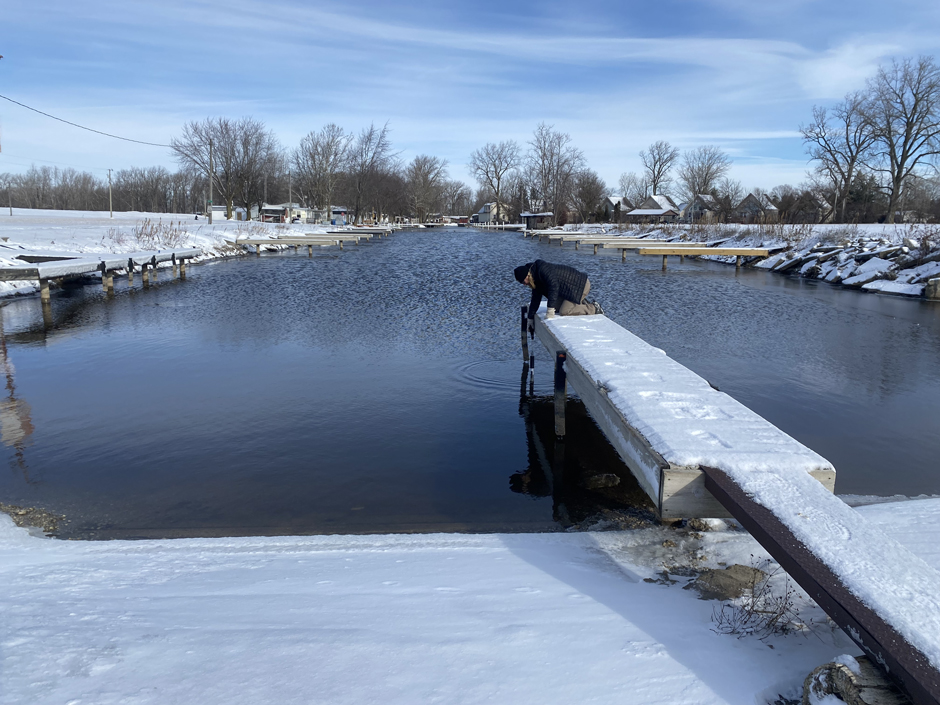
Student measuring algal concentrations in Grand Lake St. Marys using an AlgaeTorch in January 2023. (Credit: Morgan Jutte)
As is the case for the H2Ohio Wetland Monitoring Program, which focuses on assessing the performance of nutrient removal of wetland restoration and enhancement projects implemented by the Ohio Department of Natural Resources as part of the statewide H2Ohio Initiative.
This focus on nutrients is part of a larger issue in the region: harmful algal blooms, which can be found across Ohio’s freshwaters. Wetlands play a key role in mitigating blooms (HABs)—but if they are compromised, then nutrient removal is also impacted.
Morgan Jutte, a research assistant at Wright State University’s Lake Campus and research technician for the H2Ohio Wetland Monitoring Program, explains that this relationship between HABs and wetlands is a key reason she got involved with the program.
“I am from an area that has a lake known for HABs and high microcystin levels so I have always found science like this interesting,” states Jutte.

SonTek-SL1500 install in the Miami & Erie Canal in March 2023. (Credit: Silvia Newell)
Monitoring Water Quality and Hydrology in Ohio Wetlands
With this focus on minimizing HABs across the state, Jutte explains that the program’s research centers around evaluating the ability of wetlands to reduce nutrient loading to downstream bodies of water.
Nutrients such as dissolved reactive phosphorus, total phosphorus, nitrite, nitrate, ammonium and total nitrogen are measured in surface water using a HACH DR3900 and SEAL AQ300 Discrete Analyzer.
Hydrology is also important to measure since flow plays a role in calculating the total nutrient load retained by the wetland. These are measured using a few different water level loggers and AV sensors.

Flow event at the cascading grass waterway. Flows through the tile are measured using a Stingray AV sensor and a Thelmar Weir coupled with water level logger data using a HOBO logger. Flows over the concrete weir are measured using a HOBO logger. (Credit: Morgan Jutte)
Jutte’s go-to water level loggers are the HOBO U20L and MX2001-04. She explains, “I really like the MX2001-4 because undergraduate students can easily download the data using an app on their phones.”
Jutte also mentions that they sometimes use the Solinst Levelogger 5, which is a good option since “they don’t require a lot of ‘babysitting,’ [and] can be deployed for a few months at a time.”
Additionally, physicochemical parameters of surface water, like temperature, dissolved oxygen, pH, specific conductivity, and turbidity, are also measured using a YSI ProDSS multiparameter meter and EXO3 multiparameter sondes. The sondes are deployed at a few key sites to study conditions more intensively.

Installation of an EXO3 Multiparameter Sonde at Brooks Park Wetland in Columbus, OH. (Credit: Silvia Newell)
Challenges to Monitoring Wetlands
Due to the importance of hydrology and nutrient movement, Jutte explains that “a lot of strategizing goes into selecting locations for sensors.”
Almost all of the program’s water level loggers are deployed for extended periods, with some sites utilizing engineering components like water level control structures to make monitoring easier.
Agri Drains are one example of a convenient solution, as Jutte can simply drop a logger into the drain, and water depth can be translated to volume using a simple flow over flat weir equation. Tiles and culverts are also a favorite, as “depth-volume rating curves can be made using velocity and depth.”
There are also seasonal considerations that have to be made when choosing long-term monitoring sites. “We like to leave our sensors out year-round, if possible, to capture all flow events, so sensors have to be placed in locations where winter freezing does not pose a threat to sensors,” explains Jutte.
She continues, “Sometimes this isn’t possible and sensors have to be pulled in the winter meaning maybe all flow events will not be captured in the sensor data.”

Data download from Stingray AV sensor at edge-of-field cascading grass waterway project in the Wabash River Watershed, Celina, OH, during a winter flow event. (Credit: Kenneth Kline)
Longer-term deployments make flow event sampling easier since the equipment is already deployed and collecting data continuously, while other sites are spot sampled during events, to the best ability of the team.
“We monitor a lot of wetlands with minimal people so getting to all of these sites for sampling is sometimes impossible, especially with the goal of hitting the beginning, peak, and end of the flow event,” Jutte explains.
In addition to environmental considerations, wildlife can pose a threat to equipment, as native species like muskrats love to chew through sensor cables, something that impacted multiple sites a few years ago. “We now encase all sensor cables in small diameter PVC to ensure they will not be destroyed,” states Jutte.

Installation of an Onset HOBO MX2001 Water Level Logger in an outflow water control structure at Burntwood-Langenkamp Wetland in Grand Lake St. Marys Watershed. (Credit: Morgan Jutte)
The Difference of Data-Informed Restoration
While H2Ohio was launched only in 2019, wetland restoration efforts have been ongoing for decades. In the Grand Lake St. Marys watershed where Jutte is stationed, over a decade’s worth of data shows a downward trend in microcystin concentrations compared to the historical average.
She also notes that the program offers important research opportunities to undergraduate students who can grow and learn new skills in the lab and field—“just like I did as a student,” states Jutte.

Graduate and undergraduate students collecting sediment samples at Burntwood-Langenkamp Wetland in July 2024. (Credit: Morgan Jutte)
Local residents are also invested in the program, with many attending the monthly meetings held by the Grand Lake Improvement Association, where water quality progress is discussed.
“These are open to the public, and people do show up and ask questions and care about what is being done. The lake is a big part of our community.” adds Jutte.
Documenting changes in the wetlands and larger watershed, offering a chance for students to grow, and the investment of the local community are major parts of what make the work rewarding for Jutte, who grew up in a lake-based community herself.

The official mascot of Burntwood-Langenkamp Wetland, the dog, Steve Jr. (Credit: Ewan Isherwood)






0 comments